
Highlighting threats to the Global South, he stressed the need to protect maritime navigation and civilian shipping.
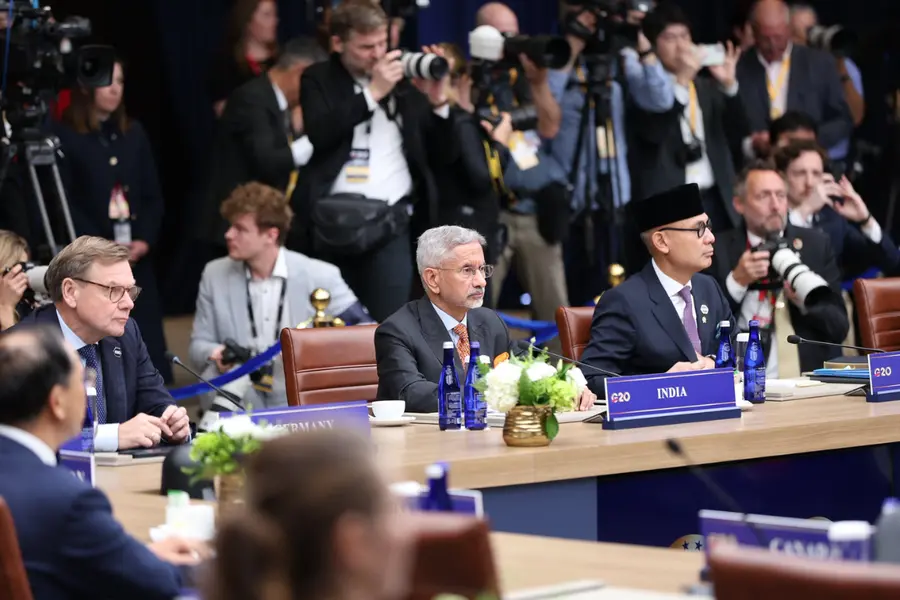
Atlanta: India asserted on Friday that military solutions cannot resolve global challenges and maintained that diplomacy must be granted an opportunity to settle international disputes.
Speaking during the first plenary session of the G20 Foreign Ministers’ Meeting in Atlanta, External Affairs Minister S. Jaishankar also highlighted attacks impacting civilian shipping and maritime crew members, underscoring the vital necessity of preserving freedom of navigation and halting assaults under international legal frameworks, specifically UNCLOS.
"Emphasised that in the face of global challenges, military solutions will not work and diplomacy must be given a chance," Jaishankar stated via X, detailing the key arguments he presented during the sessions hosted by U.S. Secretary of State Marco Rubio.
Jaishankar's remarks unfolded against the backdrop of ongoing conflicts across multiple theatres, including the Russia-Ukraine war and rising military tensions across West Asia.
Furthermore, Jaishankar pointed out that developing economies are being systematically deprived of their right to industrialise due to market flooding, the weaponisation of supply chains, restricted market access, and artificial trade distortions. "This must cease," he stated, while emphasising the imperative of constructing resilient, alternative connectivity infrastructure as international markets undergo de-risking and diversification.
"Tactical calculations should not lead to overlooking the dangers of terrorism. It is a high-risk activity which has come back to bite even the practitioners," he cautioned.
Highlighting regional vulnerabilities, Jaishankar noted that the Global South endures a disproportionate burden from attacks on commercial shipping and seafarers, which severely threatens the affordability and distribution of fuel, food, and agricultural fertilisers. Data indicates that at least 22 Indian nationals, including 14 seafarers, have lost their lives since hostilities broke out in West Asia in February this year.
Having arrived in Atlanta on Thursday evening, Jaishankar engaged with counterparts from numerous nations prior to the official opening of the proceedings.
Opening the two-day summit, Rubio warned delegates that the international community faces a pivotal moment amid escalating economic and geopolitical volatility.
"I hope this will be a productive meeting today, as we are in a critical moment. I would call it a moment of choosing, and I would say not just for my country, the United States of America, but frankly, for the world," Rubio stated to the assembly, which included Russian Foreign Minister Sergey Lavrov, seated between representatives from Mexico and Saudi Arabia.
Addressing the broader landscape of international instability, Rubio noted, "We are facing a series of interconnected economic and geopolitical crises, many of which pose severe threats to essential foundations of the global economic order, new disruptions and strains to global energy and food markets, to the global supply chain, to trade, to freedom of navigation itself."
He added that member nations must collaborate to reinforce financial stability and protect commercial markets.
The high-level deliberations are taking place against a backdrop of deep ideological divisions among G20 nations regarding ongoing international conflicts.
"At today's G20 Foreign Ministers' Meeting, I made clear that maritime and food security drive economic security. Through our America First agenda, the United States is encouraging partners to protect shipping routes, strengthen food security, and reduce the economic consequences of geopolitical crises," Rubio posted on X following his speech.
According to a State Department readout issued on Tuesday, Washington intends to work closely with G20 partners throughout the ministerial to counter geopolitical pressures causing global economic shocks, specifically targeting threats to freedom of navigation, energy stability, food security, and supply channels.
The United States is scheduled to host the G20 Leaders' Summit in Miami on December 14–15.
On the sidelines of the Atlanta gathering, Jaishankar is also scheduled to participate in a Quad meeting alongside senior diplomats from Japan, Australia, and the United States. This marks the second Quad Foreign Ministers’ Meeting convened this year, preceding the upcoming leaders' summit slated for next month in the Philippines.
Following his engagements in Atlanta, Jaishankar will travel to Antigua and Barbuda to attend the Commonwealth Heads of Government Meeting scheduled for November 1–4.
ANI
Published: 31 Oct 2026, 07:09 am IST


ABOUT THE AUTHOR

Related Topics
Disclaimer: Kindly avoid objectionable, derogatory, unlawful and lewd comments, while responding to reports. Such comments are punishable under cyber laws. Please keep away from personal attacks. The opinions expressed here are the personal opinions of readers and not that of Mathrubhumi.