
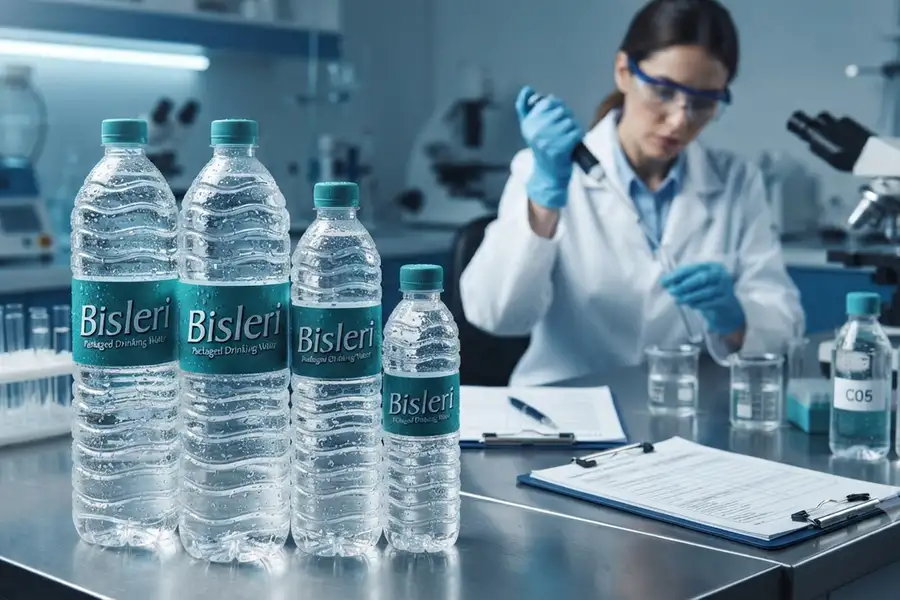
New Delhi: Bisleri International on Monday asserted that its packaged drinking water was safe for consumption and pledged to cooperate with food safety authorities, even as the Food Safety and Standards Authority of India (FSSAI) widened its enforcement drive to cover major packaged drinking water brands and signalled legal action against companies found violating prescribed standards.
The company's defence came after the FSSAI sanctioned prosecution against Bisleri over a sample of its packaged drinking water that the regulator declared unsafe following the detection of bromate beyond permissible limits and, on subsequent testing, polynuclear aromatic hydrocarbons (PAHs).
Bisleri has questioned the laboratory findings, citing discrepancies between test results, and said it has not received any formal notice of the reported regulatory action.
In a statement, the FSSAI clarified that, as per the law, the report of the referral lab should be final in case of appeal by food business operators (FBOs).
"The order for prohibition of sale was issued to Bisleri International for the Batch No. Go 270. Only one batch was found to be non-compliant. FBO (Bisleri) has been conveyed to conduct root cause analysis," the regulator informed.
The FSSAI has stepped up its nationwide enforcement drive in the packaged drinking water sector, collecting samples of major brands and inspecting manufacturing facilities to assess compliance with prescribed food safety standards, according to sources. The regulator is expected to initiate legal proceedings against companies whose products fail laboratory tests or are found violating norms, signalling broader scrutiny of an industry where consumer trust and product safety are critical.
The scrutiny puts the spotlight on quality assurance in India's packaged drinking water industry, where bottled water has become a widely consumed commodity amid concerns over drinking water quality and the growing use of packaged products in homes, offices, restaurants and public spaces.
Bromate can form as a by-product of certain water disinfection processes, including ozonation, and is subject to regulatory limits because of potential health risks associated with exposure. PAHs are a group of chemical compounds, some of which are associated with toxic and carcinogenic properties. The specific compounds and concentrations detected are important in assessing the potential health implications of any contamination.
In a statement, Bisleri said the matter pertained to a batch manufactured in September 2025 at its Goa facility, one of 143 plants in its network.
The regulatory sampling exercise dates back more than 14 months, the company said.
The FSSAI collected six samples from the facility on September 30, 2025.
Initial testing found that five complied with applicable standards, while the sixth recorded bromate levels of 12 micrograms per litre against the prescribed limit of 10 micrograms per litre, according to Bisleri.
Following an appeal by the company on November 22, 2025, the sample was sent to a referral laboratory for retesting. While the referral laboratory found bromate levels within the prescribed limit, it separately flagged the presence of PAHs, Bisleri said.
Questioning the difference between the findings, the company arranged for the same sample to be tested independently at an FSSAI-approved laboratory.
That analysis also found bromate levels within permissible limits, it said.
Bisleri said it submitted the independent test results to the FSSAI's Western Regional Office through a formal letter dated February 2, 2026, but received no subsequent communication.
"To date, Bisleri has received no notice by email or in hard copy and has been unable to locate the reported notice on FSSAI's website," the company said, adding that it had understood the matter to be closed following its submission.
"Drinking water safety is a priority for Bisleri. We maintain stringent quality controls of over 90 tests across our 10-step manufacturing process and will continue to cooperate with FSSAI to address the matter through the appropriate regulatory process," it said, reiterating that its products remained safe for consumption.
The FSSAI, however, said the regulatory sample of packaged drinking water collected from Bisleri's premises was found non-compliant with prescribed bromate limits and declared unsafe under the Food Safety and Standards Act, 2006.
Following the company's appeal, the referral food laboratory also declared the sample unsafe after detecting PAHs, the regulator said in a social media post on Sunday. Based on the laboratory findings, it has sanctioned prosecution against Bisleri International for alleged violations relating to unsafe food.
The action is part of a broader enforcement exercise in which the FSSAI has inspected facilities of food business operators engaged in the packaged water business and collected samples of major brands for laboratory testing, according to sources. The regulator is expected to initiate legal proceedings against companies whose products are found to violate food safety requirements.
The regulatory action does not, by itself, constitute a judicial finding of guilt against Bisleri. However, the decision to sanction prosecution raises the stakes for the company, particularly given the brand's national reach and its position in India's packaged water market.
Bisleri operates 143 manufacturing plants and has a distribution network of more than 6,000 distributors and 7,500 trucks across India and the UAE, according to the company. Its portfolio includes packaged drinking water, premium Vedica Himalayan Spring Water and carbonated beverages.
The wider FSSAI drive could have ramifications for the broader industry, with testing across competing brands potentially bringing manufacturing standards, water treatment processes and quality-control systems under closer regulatory scrutiny.
For Bisleri, the immediate task will be to reconcile the conflicting laboratory findings, respond to the regulator's action and reassure consumers. The episode also underscores the importance of transparent testing and enforcement in a sector where consumer trust is central to brand value.
(Except for the headline, this story has not been edited by Mathrubhumi and is published from a syndicated feed.)
Published: 23 Nov 2026, 08:36 pm IST


Related Topics
Disclaimer: Kindly avoid objectionable, derogatory, unlawful and lewd comments, while responding to reports. Such comments are punishable under cyber laws. Please keep away from personal attacks. The opinions expressed here are the personal opinions of readers and not that of Mathrubhumi.
