
He voiced India's strong condemnation of repeated attacks on civilian infrastructure, including Saudi airports, in the past few days
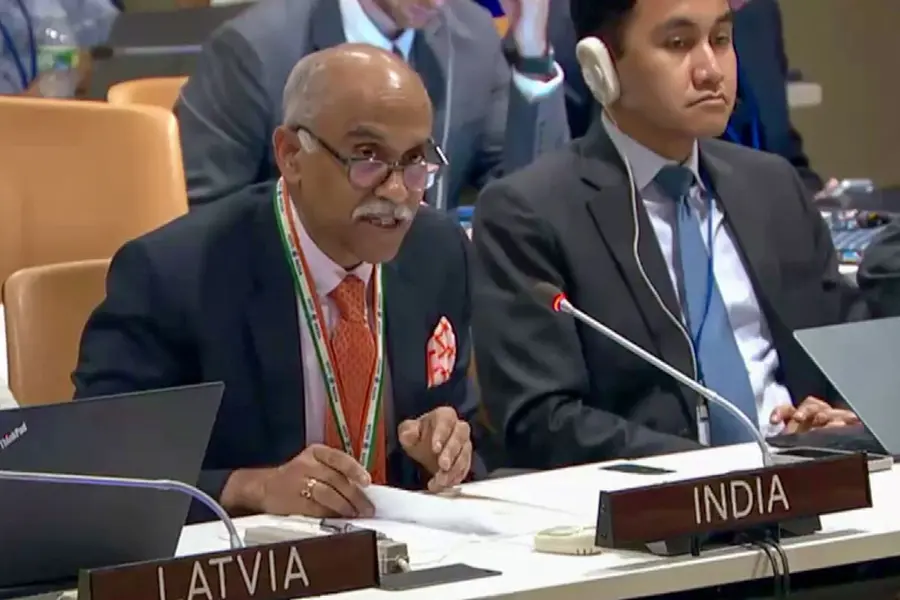
United Nations: India has described the escalation in hostilities in the Middle East as "deeply worrying", as it strongly condemned repeated attacks on civilian infrastructure, including Saudi airports, as well as on commercial shipping and Indian seafarers.
"India has very high stakes in the safety, security and stability of the Middle East," India's Permanent Representative to the UN, Ambassador Harish Parvathaneni, said on Thursday at the UN Security Council debate on the Situation in the Middle East.
"The people of the Middle East need normalcy and lasting peace. Peace is not just the absence of war. It is imperative to strengthen stability and security for the people of the region. India is committed to their well-being that would lead to a more secure, stable and prosperous world. All our actions will be derived from this approach," he said.
He said escalation in the region is "deeply worrying", underlining New Delhi's call for restraint and de-escalation in "what has developed into a principal challenge facing the international community today".
He voiced India's strong condemnation over repeated attacks on civilian infrastructure, including Saudi airports, in the past few days that have led to the loss of lives, including that of Indian citizen Mohammad Yousef Ali in Riyadh.
"India stands in complete solidarity with the Government and people of Saudi Arabia in defense of their sovereignty," Parvathaneni said.
India reiterated the need for immediate de-escalation and the resolution of the conflict through dialogue and diplomacy.
"Attacks on commercial vessels, seafarers and civilian infrastructure must cease. Freedom of navigation and the safe and unimpeded flow of maritime commerce through international waterways, in accordance with international law, must be upheld," he said. "The safety and security of seafarers remains a priority for the Government of India, and these recurring attacks risk further aggravation of a very volatile situation," he added.
The ambassador told the council that recent attacks on commercial shipping, such as the India-flagged MV DP World Cauvery this week, MT Petro Dolphin and MT Valthera last week, and MT On Peace and MT Kazimah III the week before, are deeply concerning.
"All attacks on commercial shipping and merchant mariners are legally and morally indefensible. Several of these ships have Indian seafarers, and their safety and security is our direct responsibility," the Indian envoy said, as he thanked the Omani and UAE authorities for valuable support in ensuring the safety of Indian seafarers in these attacks.
Amid rising attacks on commercial ships and seafarers, India and Liberia last month launched a 'Group of Friends on Safety and Security of Shipping and Seafarers' on the sidelines of the UN General Assembly's high-level week.
Parvathaneni noted that 23 member states joined India and Liberia in the launch and stand ready to support further coordination to prevent recurring attacks and safeguard the rights of seafarers.
With nearly two million seafarers operating the world's merchant fleet and maritime shipping accounting for four-fifths of global trade, Parvathaneni said the 'Group of Friends' is an inclusive, voluntary and action-oriented platform, aimed at deepening cooperation and fostering practical cooperation.
Talking about the BRICS Leaders' Summit hosted in New Delhi last month, the ambassador recalled that Prime Minister Narendra Modi proposed establishing a 'Seafarers Emergency Support Network' which could connect maritime authorities and Embassies of the countries concerned, and facilitate distress alerts, medical assistance, communication with families, and support for evacuation, when needed.
On Yemen, India reaffirmed its unwavering commitment to the unity, sovereignty, and territorial integrity of the country and rejected any interference in its internal affairs.
"We strongly condemn attacks on maritime navigation and on the seafarers, many of whom are Indian citizens. The protection of the Bab el-Mandeb Strait and the Southern Red Sea is a shared international responsibility and is a global interest," Parvathaneni said.
India also underlined that the global focus on the crisis impacting merchant shipping and the Strait of Hormuz must not divert the world's attention away from the dire humanitarian crisis in the Gaza Strip.
"Terrorism anywhere has no justification," and India had condemned the attacks of October 7, 2023, unequivocally."
"India will continue to stand for humanitarian relief, dialogue and diplomacy and a negotiated Two-State Solution. The international community must act in unison to prevent any further loss of civilian lives and destruction of civilian infrastructure," he said, emphasising that India strongly believes that a durable, lasting and sustained peace requires a two-state solution, support for which is growing internationally.
India is also a top emerging donor of the United Nations Relief and Works Agency for Palestine Refugees in the Near East (UNRWA), with a cumulative contribution of more than 52 million dollars, and with operational flexibility for the UN Agency to utilise Delhi's contributions, he said.
On the situation in Lebanon, India said UN Interim Force in Lebanon (UNIFIL) peacekeepers serve the cause of international peace and security and pursue UN Security Council mandates and therefore must never become targets. India has strongly condemned all attacks on UNIFIL peacekeepers, asserting that their safety and security remain a high priority.
"The sanctity and inviolability of UN premises must be fully respected. We reiterate the importance of preparing for a post-UNIFIL scenario and supporting the Lebanese Armed Forces in this regard," he said.
Published: 16 Oct 2026, 08:56 am IST
ABOUT THE AUTHOR

Related Topics
Disclaimer: Kindly avoid objectionable, derogatory, unlawful and lewd comments, while responding to reports. Such comments are punishable under cyber laws. Please keep away from personal attacks. The opinions expressed here are the personal opinions of readers and not that of Mathrubhumi.