
Source code access & tech control are key issues.
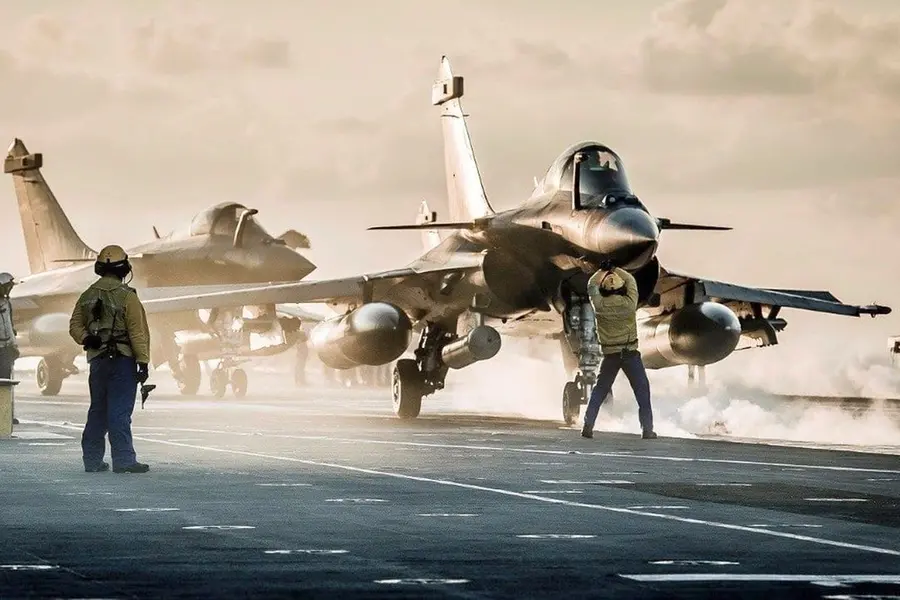
India's ambitious plan to integrate its advanced Uttam AESA (Active Electronically Scanned Array) radar into the 26 Rafale-Marine fighter jets for its aircraft carriers has reportedly encountered a significant obstacle. This initiative, central to the 'Atmanirbhar Bharat' (self-reliant India) defense push, faces staunch opposition from Dassault Aviation, the French manufacturer.
Defence industry sources indicate that Dassault has firmly rejected the use of India's homegrown radar on their aircraft. This strong resistance means the Indian Navy may not be able to equip its new Rafale M jets with the Uttam AESA, a setback for India's drive towards greater indigenization in critical military equipment.
Dassault's firm stance on technology control
Dassault Aviation maintains stringent control over its technology, particularly software codes and system integration. The company insists the Rafale M jets must continue to use their battle-proven RBE2 AESA radar, which is standard across numerous global Rafale squadrons. Dassault views this as the only practical solution to ensure combat readiness, while acknowledging India’s local manufacturing efforts.
The French side further argues that replacing the RBE2 with India's Uttam AESA radar could lead to significant technical complications, increased costs, and intellectual property disputes. These perceived risks underpin Dassault's resolute opposition to any modification involving the Indian-made radar.
The source code conundrum
At the core of this disagreement lies India’s enduring frustration over its lack of access to the Rafale fighter jets' source code. This code, acting as the jet’s "digital brain," dictates how new weapons and mission systems are integrated and operated.
Without it, India cannot easily upgrade or customize the Rafale jets with its own technology, including the Uttam radar. This lack of control is a major concern as India strives for self-reliance.
Indian defence officials confirm that Dassault Aviation has consistently refused to share the source code, despite high-level requests from New Delhi for the flexibility to install locally developed systems. This long-standing issue now threatens to impact India's naval aviation strategy for the next decade.
Boosting India's naval power amid regional challenges
The Indian Navy has ordered 26 Rafale M multi-role fighter jets primarily for operations from INS Vikrant, India’s first indigenously-built 45,000-tonne aircraft carrier.
INS Vikrant, commissioned in 2022 and expected to achieve full operational strength by 2028-2030, is crucial for India’s goal of building a powerful blue-water navy.
Timely delivery and integration of the Rafale M jets are paramount for India's power projection across the Indian Ocean region.
The estimated USD 5 billion (approximately ₹41,700 crore) deal includes a potent weapons package with Meteor supersonic air-to-air missiles and Exocet AM39 anti-ship missiles, significantly enhancing the Indian Navy's strike capabilities.
This acquisition underscores India's commitment to maintaining control over the skies and seas in the Indo-Pacific, especially as China's People’s Liberation Army Navy (PLAN) continues to expand its presence, deploying carriers like the Liaoning and Shandong into the Indian Ocean.
India's existing carrier fleet has struggled with the MiG-29K fighter jets on INS Vikramaditya, known for low reliability and frequent technical issues, limiting current carrier-based air power.
The Rafale M, purpose-built for carrier operations with a reinforced airframe, durable tailhook, and strengthened undercarriage for ski-jump takeoffs, is expected to resolve these challenges. Its RBE2 AESA radar, integrated with the SPECTRA electronic warfare suite and secure tactical data link, enables networked operations vital for modern naval warfare.
The promise of Uttam AESA radar
Developed by the Electronics and Radar Development Establishment (LRDE), a part of DRDO, the Uttam AESA radar is considered India’s most advanced airborne radar. Designed to compete with global systems like Israel's EL/M-2052, Russia's Zhuk-AE, and Sweden's Raven ES-05, Uttam can detect enemy fighter jets over 150 km away, track multiple targets, and boasts strong electronic counter-countermeasures, essential for high-threat combat zones.
Its modular design allows for adaptability across various platforms, including the Tejas Mk1A, Tejas Mk2, and the upcoming Advanced Medium Combat Aircraft (AMCA), as well as unmanned combat drones and potentially future naval aircraft.
The Indian Air Force has already approved Uttam's installation on over 80 Tejas Mk1A jets, with the first upgraded aircraft expected by 2025. Defence experts see Uttam's success as a significant step, potentially opening export opportunities in Southeast Asia, Africa, and the Middle East, bolstering India’s aim to become a defence equipment exporter.
Challenges to true self-reliance
Despite the promise of the Uttam radar, its exclusion from the Rafale M jets highlights the limitations India faces with foreign-made weapon systems, which are often tightly controlled by original manufacturers.
Dassault's refusal to share the source code means the Indian Navy's Rafale M jets will remain dependent on French radars, electronic warfare systems, and weapons, limiting India's control over upgrades and ongoing maintenance. This dependence is a concern amidst rising regional tensions.
Nevertheless, Dassault is expected to fulfill its contractual obligation to invest at least 50% of the deal’s value back into India through technology sharing, training, and bolstering Indian suppliers under the 'Atmanirbhar Bharat' initiative.
While the Uttam radar won't be on the Rafale M, DRDO continues to develop advanced versions for future Indian fighter jets and surveillance aircraft, aiming to strengthen India's entire defence communication and strike "kill chain." This includes seamless real-time information sharing across air, land, and sea units, crucial for a nation facing two-front threats.
As India awaits the first Rafale M deliveries by 2028, a critical question remains: Can India truly achieve defence self-reliance while still relying on advanced foreign technologies? The Uttam AESA radar symbolizes both a proud indigenous achievement and a stark reminder that full military independence still confronts significant political and industrial challenges.
Girish Linganna is an award-winning science communicator and a Defence, Aerospace & Geopolitical Analyst.
Published: 04 Jul 2025, 11:15 am IST
Disclaimer: Kindly avoid objectionable, derogatory, unlawful and lewd comments, while responding to reports. Such comments are punishable under cyber laws. Please keep away from personal attacks. The opinions expressed here are the personal opinions of readers and not that of Mathrubhumi.
