
India emphasised engagement over isolation, advocating for inclusive peace and democratic stability in Myanmar while respecting its sovereignty.
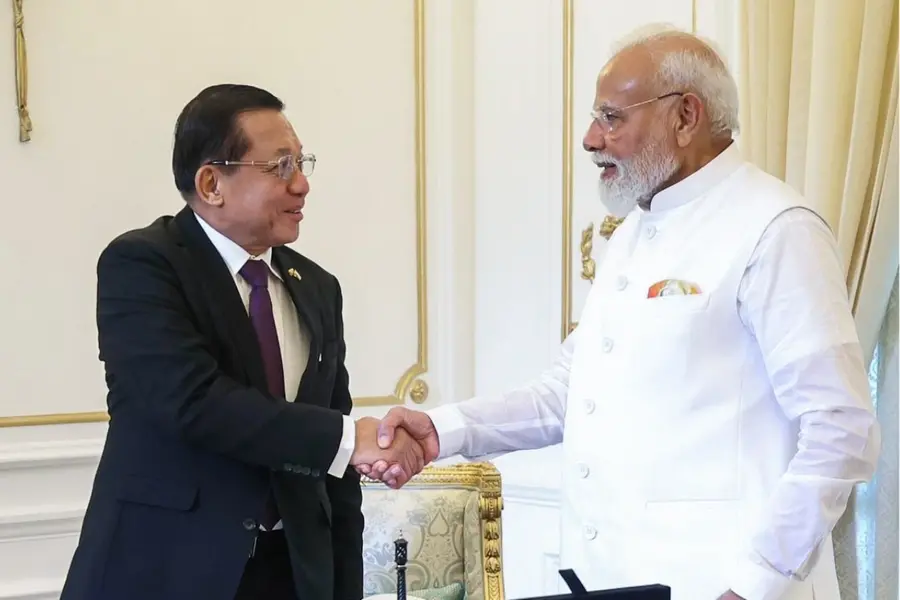
New Delhi: Myanmar President U Min Aung Hlaing provided explicit assurances to Prime Minister Narendra Modi on Monday that Myanmarese territory would not be utilised to compromise India's security interests, as the two heads of government conducted comprehensive negotiations to strengthen bilateral alliances across trade, defence, energy, and infrastructure connectivity.
Aung Hlaing is currently executing a five-day official state visit to India. The diplomatic mission occurred less than two months after his ascension to the presidency following Myanmar's national parliamentary elections.
The legislative elections were conducted across December and January, concluding years of public demonstrations against the governing military junta that initially seized administrative authority during a coup d'état on Feb. 1, 2021, which deposed the democratically elected administration of Aung San Suu Kyi.
During the executive dialogue, both delegations reaffirmed the strategic necessity of maintaining close institutional coordination to finalise major infrastructure initiatives, specifically the Kaladan Multi-Modal Transit Transport project and the India-Myanmar-Thailand trilateral highway.
The Peace Process and Democratic Transitions
Foreign Secretary Vikram Misri, addressing inquiries regarding the status of the detained Suu Kyi, confirmed that the prime minister initiated a discussion regarding her situation with the visiting president. Misri noted that the exchange occurred primarily within the context of Myanmar's ongoing domestic peace negotiations. In defining India's consistent diplomatic posture, the foreign secretary emphasised New Delhi's enduring advocacy for sustainable peace, political inclusion, and the participation of all relevant internal factions at the negotiating table.
"The prime minister did raise this matter with the President, and this was a discussion that was largely in the context of the peace process that has been underway in Myanmar for quite some time," Misri stated. "The effort to bring in all the ethnic groups onto the same platform and find a way forward within a united Myanmar. This is something that you are aware has been going on for a long period of time. There isn't yet a final agreement between all stakeholders."
Misri characterised the conversation regarding the matter as a flexible, wide-ranging exchange, noting that "where issues related to democracy, etc., were also raised."
"I should underline that, I mean our engagement with Myanmar is not intended to be a commentary on the internal political arrangements in that country," Misri explained. "We have always proceeded on the principle that sustained dialogue is what is important, and what is an imperative for India as a neighbour. And the answer is clearly not disengagement. History has shown that disengagement doesn't give us any results that are better than engagement, and it certainly doesn't produce democratic change if that is what we are interested in."
Misri reported that the prime minister reiterated India's formal commitment to the sovereignty and territorial preservation of Myanmar. Both leadership circles emphasised the absolute necessity of preventing adversarial factions from exploiting sovereign lands for activities hostile to mutual security.
Historically, specific insurgent organisations operating within India's northeastern theatre have maintained operational bases within Myanmar's borders, an ongoing vulnerability that New Delhi has routinely raised with its neighbouring counterpart.
"The President of Myanmar, in particular, reiterated the assurance that Myanmar's territory would not be permitted to be used against India's security interests," Misri reported.
Border Realities and Security Frameworks
The cross-border operations of certain Myanmarese insurgent factions opposed to the current Naypyidaw administration have concurrently generated distinct security complications for Indian defence forces. Misri confirmed that the operational footprint of these armed groups on the Myanmarese side of the frontier was directly addressed by Modi.
"He emphasised that these groups continue to carry out activities in areas close to our borders," Misri stated. "In response, the operations conducted by the Myanmar military against these groups also often take place very near the border. As a result, there is impact on people living on the Indian side of the border. At times, there can be damage or disruption in those areas. As you also mentioned, large numbers of refugees sometimes cross over from the other side of the border into India."
The foreign secretary emphasised the necessity of shielding traditional, generation-spanning cross-border human mobility, alongside the familial and cultural alliances that link frontier communities, from negative structural disruptions.
"The objective is to create an effective security framework while taking these realities into account," Misri noted. "The fencing work is currently underway, and at several locations there will be designated entry points and gates."
Expanding Bilateral Horizons
According to the foreign ministry, the high-level talks scrutinised the full spectrum of bilateral relations, encompassing commercial trade, economic frameworks, joint defence strategies, border management, international development funding, and broader regional stability.
The two delegations expressed a mutual desire to cultivate deeper collaborative partnerships, particularly within the commercial investment, healthcare, public education, and energy sectors, alongside foundational technological industries such as artificial intelligence.
"The prime minister reaffirmed India's support for the sovereignty and territorial integrity of Myanmar, and both sides underscored the importance of preventing the misuse of sovereign territory for activities inimical to their security interests," Misri reiterated.
Myanmar remains a pivotal geopolitical neighbour for India, sharing a 1,640-kilometre land border with multiple northeastern states, including the security-sensitive regions of Nagaland and Manipur.
"Overall, this visit by the Myanmar President has once again reaffirmed the shared commitment of both sides to deepen their long-standing partnership and to work together for mutual benefit, growth and prosperity in the region," Misri concluded.
The official state visit commenced with preliminary defence discussions on Sunday, during which National Security Advisor Ajit Doval met with Aung Hlaing to review critical components of the bilateral security alliance.
The Myanmarese head of state is travelling with a high-level ministerial delegation that includes multiple cabinet officials, senior bureaucrats, and prominent corporate executives.
Aung Hlaing’s initial itinerary included participating in the International Big Cat Alliance Summit in New Delhi on June 1, an event that has since been postponed. The president is scheduled to depart for Mumbai on June 2 to participate in commercial forums, industry interactions, and institutional site visits.
With inputs from PTI
Published: 01 Jun 2026, 11:10 pm IST
Related Topics
Disclaimer: Kindly avoid objectionable, derogatory, unlawful and lewd comments, while responding to reports. Such comments are punishable under cyber laws. Please keep away from personal attacks. The opinions expressed here are the personal opinions of readers and not that of Mathrubhumi.
