
Union Minister Jitendra Singh unveils plan while in Shimla to formally announce the appointment of the new President of the Himachal Pradesh BJP unit
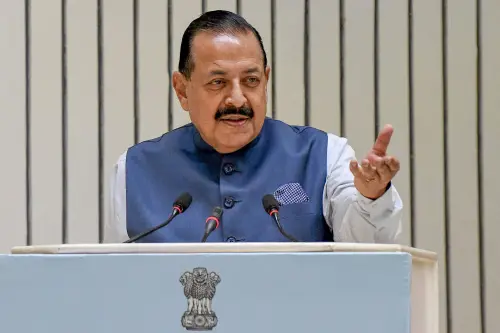
Shimla: Jitendra Singh, Union Minister for Science and Technology and Earth Sciences, said the Centre is working on implementing area-specific and more accurate weather forecasting systems to help mitigate risk and improve disaster preparedness. The announcement comes in the wake of increasing concern over the rise in cloudbursts and flashfloods in Himachal Pradesh during the monsoon season.
The Minister was in Shimla to formally announce the appointment of Rajeev Bindal as the new President of the Himachal Pradesh BJP unit for a third term.
‘Mission Mausam’ initiative to improve disaster preparedness
Speaking to reporters, Singh said that the government has taken several steps in recent years to strengthen local-level weather monitoring and prediction capabilities and raise it to global standards, under Prime Minister Narendra Modi’s ‘Mission Mausam’ initiative.
Singh acknowledged that while weather prediction systems have significantly improved over the years, cloudburst forecasting remains one of the biggest scientific challenges, particularly in hilly terrain such as Himachal Pradesh.
He noted that the Indian Meteorological Department (IMD) office in Shimla is one of the oldest in the country, which has a robust forecasting system in place. However, the ability to predict cloudbursts is still limited. “It remains a complex phenomenon due to the highly localised and intense nature of these events," he said.
Automated Weather Stations (AWS) and doppler radars for real-time prediction
"We are actively working to enhance the forecasting system further, and soon, we will have area-specific forecasts, tailored to particular regions and vulnerable zones," Singh announced.
"We have already started village-wise forecasting for the benefit of farmers, which will gradually be expanded to other sectors, including disaster management," he said.
According to a press release by the Press Information Bureau (PIB), Singh told the media that Automated Weather Stations (AWS) and doppler radars are being added across the country to improve real-time weather prediction: “While cloudbursts are sudden and difficult to forecast due to their nature, our system is improving with targeted forecasts like Long Range (30 days), Short Range (3 days), and Nowcast (3 hours),” he stated.
"The installation of more automatic weather systems will significantly improve data collection and forecast accuracy. You will soon see a noticeable difference in the precision and timeliness of weather alerts," Singh added.
Timely intervention aligns with Centre’s plans to mainstream science & tech
The Minister's remarks come at a time when Himachal Pradesh has witnessed a sharp increase in extreme weather events, including cloudbursts, landslides, and flash floods, many of which have led to loss of life and property in recent years.
These events have triggered calls for better early warning systems and more localised weather alerts to assist local administration and residents in taking timely action.
Singh's assurance of more granular weather forecasting also aligns with the Centre's broader push to mainstream science and technology into disaster risk reduction strategies.
The Union government is expected to implement the upgraded systems in phases over the coming months, beginning with high-risk districts.
(with ANI inputs)
Published: 02 Jul 2025, 10:44 am IST
Related Topics
Disclaimer: Kindly avoid objectionable, derogatory, unlawful and lewd comments, while responding to reports. Such comments are punishable under cyber laws. Please keep away from personal attacks. The opinions expressed here are the personal opinions of readers and not that of Mathrubhumi.
