
Haryana’s Jind is set to become India’s first city to run a hydrogen-powered train on the Jind–Sonipat route, boosting green rail transport.
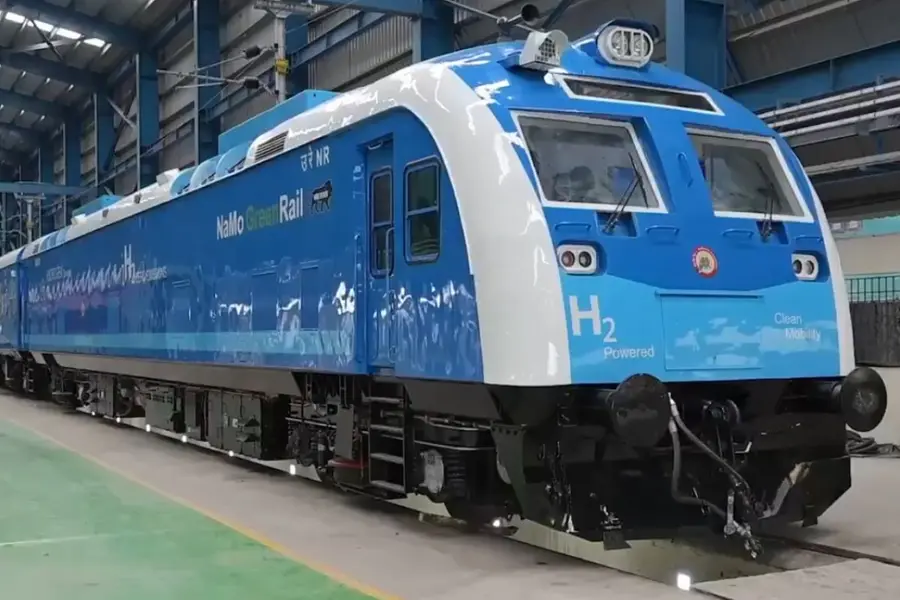
New Delhi: Haryana’s Jind is set to become the first city in India to launch a hydrogen-powered train, marking a major step towards sustainable and green transportation in the country, according to various reports. The eco-friendly train will operate on the Jind–Sonipat route and is expected to serve as a model for clean energy adoption in the rail sector.
Railway officials said the final load check trial of the hydrogen-powered train will be conducted at Jind Railway Station this week. Subject to the successful completion of the trial and final clearance from the Prime Minister’s Office, regular services are expected to begin soon.
The hydrogen-powered train uses advanced fuel cell technology, producing hydrogen from water to generate energy. Officials said nine kilograms of water can produce around 900 grams of hydrogen, enabling the train to travel approximately one kilometre. The train has a top speed of 150 kmph, ensuring efficient connectivity between Jind and Sonipat.
A hydrogen gas production plant, built by a Spanish company, has been installed at Jind Railway Station and has already received approval from the Prime Minister’s Office. Four driver power cars and 16 passenger coaches manufactured at the Integral Coach Factory in Chennai have reached Shakur Basti Station.
A 90-kilometre trial run between Jind and Sonipat is scheduled to begin on January 26. The trial will be conducted using two driver power cars and eight passenger coaches. A joint assessment report will be prepared by railway authorities, the Research Designs and Standards Organisation (RDSO) and Spain-based Green H Company.
Key features of the hydrogen-powered train include driver power cars at both ends, each fitted with a 1,200-horsepower motor, hydrogen fuel cells generating 3,750 amperes of DC current, and onboard systems such as air conditioning, lighting and fans powered by hydrogen energy. The train also features automatic doors, a metro-style digital passenger information system, and a hydrogen storage capacity of up to 3,000 kilograms. The hydrogen plant operates on a 1.5-megawatt power connection.
Officials said the project is expected to contribute significantly to environmental conservation, energy efficiency and modernisation of India’s transport systems. It is also seen as a catalyst for broader improvements in public health, education and smart mobility.
Published: 06 Jan 2026, 12:50 pm IST
Disclaimer: Kindly avoid objectionable, derogatory, unlawful and lewd comments, while responding to reports. Such comments are punishable under cyber laws. Please keep away from personal attacks. The opinions expressed here are the personal opinions of readers and not that of Mathrubhumi.
