
Hydrogen fuel produces no carbon dioxide, sulphur oxides, nitrogen oxides or particulate matter during operation, making it an attractive alternative to fossil fuels.
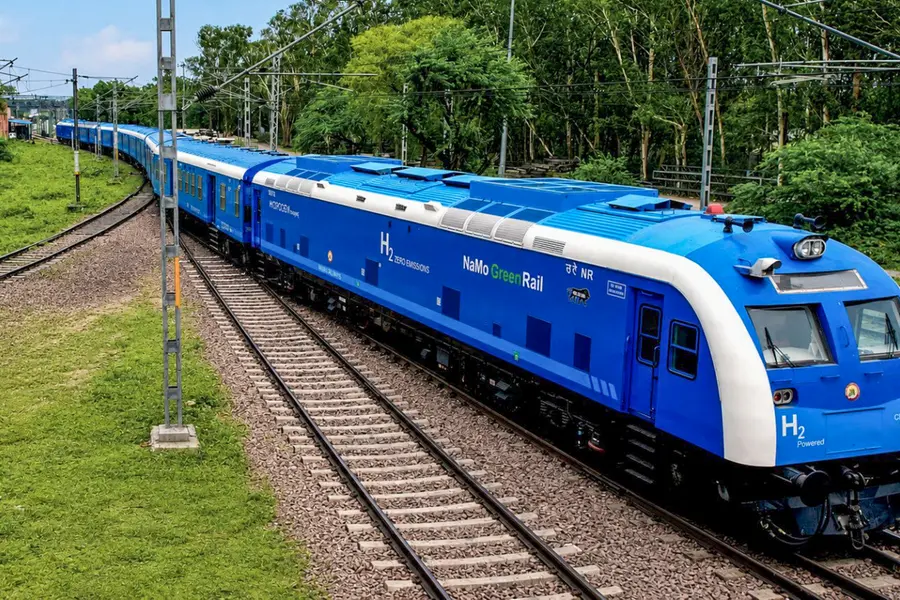
India is set to enter the hydrogen-powered rail era on Friday with the launch of its first hydrogen fuel-cell train, a move experts say represents an important step in the country's clean-energy transition, even though the technology is unlikely to become the backbone of the national railway network.
Prime Minister Narendra Modi will inaugurate the passenger service between Jind and Sonipat in Haryana, covering the 89-km route in about two hours with stops at 12 stations.
Powered by a 1,200-kilowatt hydrogen fuel-cell propulsion system, the 10-coach train will operate at a maximum speed of 75 kmph, according to the Ministry of Railways.
While the project showcases India's push towards cleaner transport, experts believe hydrogen-powered trains will mainly serve routes where electrification is difficult, as more than 95 per cent of India's broad-gauge railway network is already electrified.
How hydrogen trains work
Unlike conventional electric trains that draw power from overhead lines, hydrogen trains generate electricity onboard.
"In simple terms, a hydrogen-fuel-cell-propulsion system works by combining hydrogen with oxygen from the air inside a fuel cell to produce electricity. This electricity powers the train's motors," Harpreet Singh Arora, professor at Shiv Nadar University's School of Engineering, told PTI.
Moushumi Mohanty, senior programme manager, Electric Mobility Programme, at the Centre for Science and Environment, explained the technology further.
"A hydrogen fuel cell train is essentially an electric train that generates its own electricity on board. Instead of drawing power from overhead lines, hydrogen stored in high-pressure tanks reacts with oxygen from the air inside a fuel cell to produce electricity," she said.
"The only direct emission from the fuel cell is water vapour."
The hydrogen used by the train is produced separately, compressed, transported to the refuelling station and then stored in onboard high-pressure tanks.
"The hydrogen-refuelling infrastructure consists of hydrogen production or supply facilities, compression systems, high-pressure storage tanks, dispensing equipment and safety systems. Hydrogen is compressed, typically to high pressures, stored on site and transferred into onboard tanks through specialised dispensing systems," Mohanty said.
The Railways has established an indigenous hydrogen storage and refuelling facility at Jind. Both the train and the refuelling station are equipped with hydrogen leak detectors, heat sensors and automatic shut-off systems to enhance safety.
A cleaner alternative
Hydrogen fuel produces no carbon dioxide, sulphur oxides, nitrogen oxides or particulate matter during operation, making it an attractive alternative to fossil fuels.
Experts, however, stress that its environmental benefits depend largely on how the hydrogen itself is produced.
"The introduction of a hydrogen-powered train is significant for India's energy transition as it represents a move toward cleaner, low-emission transport. It supports India's climate goals by reducing dependence on fossil fuels and lowering greenhouse-gas emissions, especially in sectors like railways that consume large amounts of energy," Arora said.
Mainak Mukherjee, product analyst at global technology firm SLB, said the biggest challenge lies in producing green hydrogen.
"The sustainability of hydrogen as a clean-energy source depends not only on the fuel itself, but also on how it is produced, the infrastructure that supports its use and the sectors in which it is applied. To fully realise its decarbonisation potential, greater emphasis should be placed on green hydrogen, which is produced through water electrolysis using renewable electricity," he said.
Mohanty echoed the view.
"Hydrogen deployment should prioritise green-hydrogen production, minimise leakage across the supply chain, improve fuel-cell efficiency and focus on applications where direct electrification is not feasible."
Why experts see only a niche role in India
Countries such as Germany, France, Japan, China and the United States have already introduced or tested hydrogen-powered trains, primarily on regional routes where railway electrification is limited.
Experts believe India is likely to follow a similar path.
"The experiences of Germany and France demonstrated that hydrogen-powered trains can complement diesel trains to a certain extent, on non-electrified regional rail lines, where electrification is technically difficult or economically expensive. Successful deployment would depend on factors such as route suitability, shared re-fuelling infrastructure and the use of green hydrogen to maximise emissions reduction," Mukherjee said.
Mohanty said India's extensive railway electrification reduces the need for hydrogen-powered trains on most routes.
"Given that more than 95 per cent of India's broad-gauge railway network is already electrified, hydrogen trains are likely to have a niche role rather than becoming the mainstream solution."
"Their long-term contribution to climate goals will depend on the availability of affordable green hydrogen and whether they prove economically competitive for specific routes," she added.
Arora noted that railways remain an ideal testing ground for hydrogen technology because of their predictable routes and operating schedules.
"In addition, they (trains) require high power over long distances, which hydrogen can efficiently provide."
He added, "Hydrogen fuel cells typically have an efficiency of around 50-60 per cent in converting hydrogen into electricity. The efficiency of producing hydrogen through electrolysis is generally about 60-70 per cent, depending on the technology and conditions used."
Published: 17 Jul 2026, 10:21 am IST
Related Topics
Disclaimer: Kindly avoid objectionable, derogatory, unlawful and lewd comments, while responding to reports. Such comments are punishable under cyber laws. Please keep away from personal attacks. The opinions expressed here are the personal opinions of readers and not that of Mathrubhumi.
