
India expresses condolences for Ayatollah Khamenei's death as PM Modi calls for a swift end to the escalating West Asia conflict.
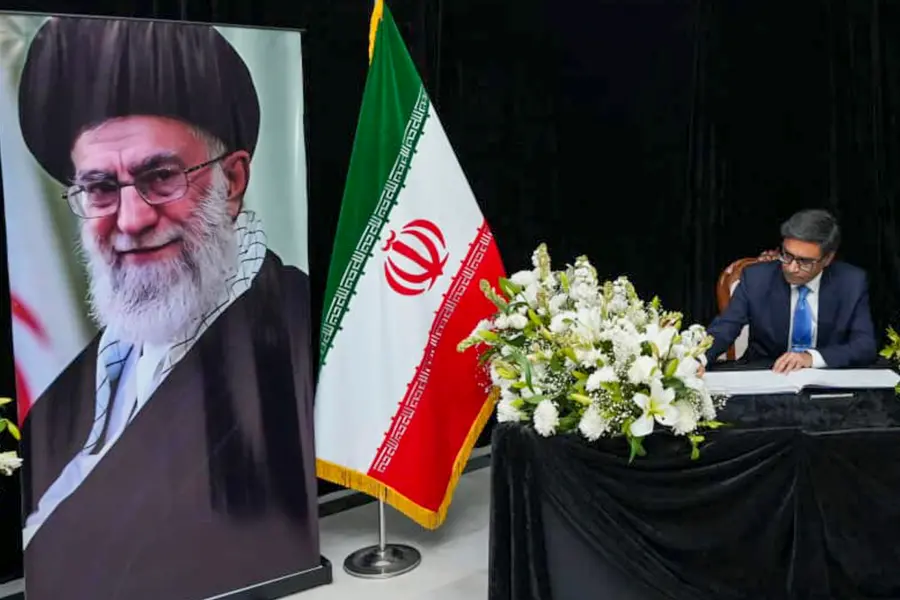
India on Thursday expressed condolences over the death of Iran’s supreme leader Ayatollah Ali Khamenei, with Foreign Secretary Vikram Misri signing a condolence book at the Iranian embassy in New Delhi.
Misri visited the mission on behalf of the government of India to pay respects following the death of Khamenei, who was killed in a joint US-Israeli airstrike on February 28. The strike has triggered a rapidly escalating conflict in West Asia that has spread across several countries in the region.
Condolence message at Iranian embassy
The Indian foreign secretary signed the condolence book during his visit to the embassy of Iran in New Delhi on Thursday, conveying condolences on behalf of the Indian government.
Khamenei’s reported killing in a coordinated strike by the United States and Israel has been widely seen as a turning point in the crisis, which has since expanded beyond Iran’s borders.
India’s External Affairs Minister S Jaishankar also held a telephone conversation on Thursday afternoon with Iran’s Foreign Minister Abbas Araghchi.
Modi calls for swift end to conflict
Amid rising tensions, Prime Minister Narendra Modi called for a rapid end to the fighting during talks with Finnish President Alexander Stubb on Thursday.
The leaders discussed the crisis in West Asia along with other global conflicts during wide-ranging discussions.
"India and Finland, both, believe in the rule of law, dialogue, and diplomacy. We are in agreement that no issue can be resolved through military conflict alone," the prime minister said.
"Be it Ukraine or West Asia, we will continue to support the swift end of conflicts and every effort towards peace," he added.
Stubb also said the two sides had discussed the situation in West Asia as well as Russia’s ongoing war in Ukraine.
"We agreed that ending the war is in everyone's interests. A lasting peace can only be one that respects the principles of the United Nations," he said.
Finland backs India’s UN Security Council bid
During the visit, Stubb reiterated Finland’s support for India’s bid to become a permanent member of the United Nations Security Council, calling it vital for broader reform of the global multilateral system.
He said expanding the council was of “utmost importance” to better reflect present geopolitical realities.
Conflict spreads across region
The war has had repercussions far beyond the Middle East, with incidents reported across a wide geographic area.
Off the coast of Sri Lanka, an Iranian warship was sunk after being torpedoed by a US submarine, while Azerbaijan warned it could retaliate after a drone strike hit one of its airports.
Azerbaijan warned that the attack "will not go unanswered" and said it was "preparing the necessary retaliatory measures," raising fears of another country entering the fray.
According to Islamic Republic News Agency, Iran’s official news agency, at least 1,045 military personnel and civilians have been killed since the conflict began, though the figure has not been independently verified.
Iranian media also reported that several civilian facilities in Tehran, including a sports complex, football stadium, municipal building and shop fronts, were damaged during recent US and Israeli airstrikes.
War continues to escalate
The conflict began after the United States and Israel launched strikes on Iran targeting its military leadership, missile arsenal and nuclear facilities. The attacks reportedly killed Khamenei, according to officials involved in the conflict.
Since then, the fighting has expanded across the region, with officials reporting more than 1,000 deaths in Iran, over 70 in Lebanon, and around a dozen in Israel.
The hostilities have also disrupted regional air travel, complicated global shipping routes and left hundreds of thousands of travellers stranded as tensions continue to mount across the Middle East.
(With inputs from agencies)
Published: 05 Mar 2026, 05:31 pm IST
Disclaimer: Kindly avoid objectionable, derogatory, unlawful and lewd comments, while responding to reports. Such comments are punishable under cyber laws. Please keep away from personal attacks. The opinions expressed here are the personal opinions of readers and not that of Mathrubhumi.
