
As the world marks World Environment Day, three Indian teenagers are gaining global recognition for turning discarded tamarind seeds into a biodegradable solution that helps remove microplastics from drinking water.
Geneva/New Delhi: What if the answer to one of the world's fastest-growing pollution problems was hiding inside a discarded tamarind seed?
As the world marks World Environment Day with renewed focus on plastic pollution, an innovation developed by three Indian teenagers is drawing attention for its potential to remove microplastics from drinking water using an unlikely ingredient: tamarind seeds.
Their solution, Plas-Stick, uses a biodegradable powder derived from discarded tamarind seeds to attract and bind microplastic particles, allowing them to be removed from water without electricity or complex filtration systems.
The innovation recently earned the students the Global Winner title at The Earth Prize 2026, making them the first team from India to win the international environmental competition.
Sixteen-year-olds Vivaan Chhawchharia, Ariana Agarwal and Avyana Mehta have been named the Global Winners of The Earth Prize 2026 for creating Plas-Stick, a low-cost solution designed to remove microplastics from drinking water using agricultural waste that would otherwise be thrown away.
The achievement makes them the first team from India to win the international environmental competition.
The inspiration came during a visit to a rural community where drinking water was commonly stored in shared plastic containers and access to advanced filtration systems was limited.
The moment that stayed with the students was watching a child drink water from an ageing plastic container.
"Seeing a child drinking from an old plastic container made us realise how invisible microplastic pollution really is, especially in communities without advanced filtration systems," the team said.
The experience prompted them to search for a solution that was affordable, accessible and practical for communities with limited resources.
Instead of looking toward expensive filtration technologies, the students turned to something far more ordinary: tamarind seeds.
Why Tamarind seeds?
Often discarded as agricultural waste, tamarind seeds contain natural polysaccharides with strong binding properties. The students found these compounds could act as bio-flocculants, attracting and binding tiny particles suspended in water.
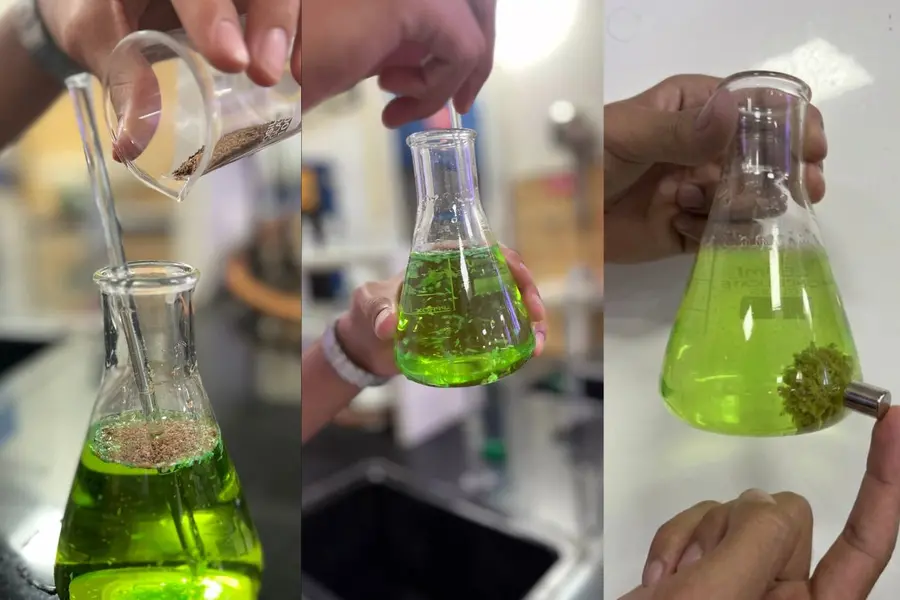
Using this principle, the team developed Plas-Stick, a biodegradable magnetic powder made from processed tamarind seeds.
When added to contaminated water, the powder attracts microscopic plastic particles and causes them to cluster together into larger visible clumps. Those clumps can then be removed using a handheld magnet, creating a simple process that does not require electricity, advanced machinery or costly infrastructure.
The result is a filtration approach designed specifically for communities where conventional water-treatment systems may be difficult to access.
Tackling a growing global problem
Microplastics have emerged as a major environmental and public health concern, with tiny plastic fragments increasingly being detected in rivers, oceans, food and drinking water supplies worldwide.
The issue is particularly significant in areas that rely on stored water and lack sophisticated treatment facilities.
Globally, more than 2.2 billion people do not have access to safely managed drinking water infrastructure, increasing dependence on alternative water-storage methods that may expose communities to contaminants, including microplastics.
The students say their goal was to create a solution that could be produced locally, deployed easily and scaled affordably.
What began as a classroom project has evolved into an internationally recognised environmental innovation.
"The most surprising part has been seeing how an idea that started as a school project could connect with people all around the world," the team said.
"We never imagined that something we worked on as students would lead to conversations with researchers, communities, and global audiences, and it has shown us that age does not limit the impact you can make."
Representing Asia, Plas-Stick had already secured regional honours and funding before competing against winners from every continent. More than 23,000 public votes were cast to determine the overall global winner.
The students have also worked with experts from IIT Guwahati to strengthen testing and further develop the technology.
Reaching thousands
Beyond the laboratory, the project has already been introduced through demonstrations and educational workshops that have reached more than 8,000 students and teachers.
The team now plans to expand the initiative through decentralised production hubs and wider deployment across rural communities in India.
"Being named the Global Winners of The Earth Prize is incredibly special for all of us, especially as the first team from India to receive this recognition," the students said.
"What started as an idea between students has now been recognised among thousands of projects from around the world, which feels both surreal and deeply motivating."
For young people worried about climate change but unsure where to begin, the students have a straightforward message: start with the problems closest to you.
"We would say to start small and start local," they said.
"Some of the best ideas come from problems you see in your own community every day. You do not need to have all the answers immediately - our project began with curiosity, research, and small experiments."
Published: 05 Jun 2026, 09:53 am IST
Related Topics
Disclaimer: Kindly avoid objectionable, derogatory, unlawful and lewd comments, while responding to reports. Such comments are punishable under cyber laws. Please keep away from personal attacks. The opinions expressed here are the personal opinions of readers and not that of Mathrubhumi.
