
Prashant Kishor’s Jan Suraaj Party collapsed in the 2025 Bihar elections, revealing how ambition without grassroots depth failed to crack the state’s entrenched political order.
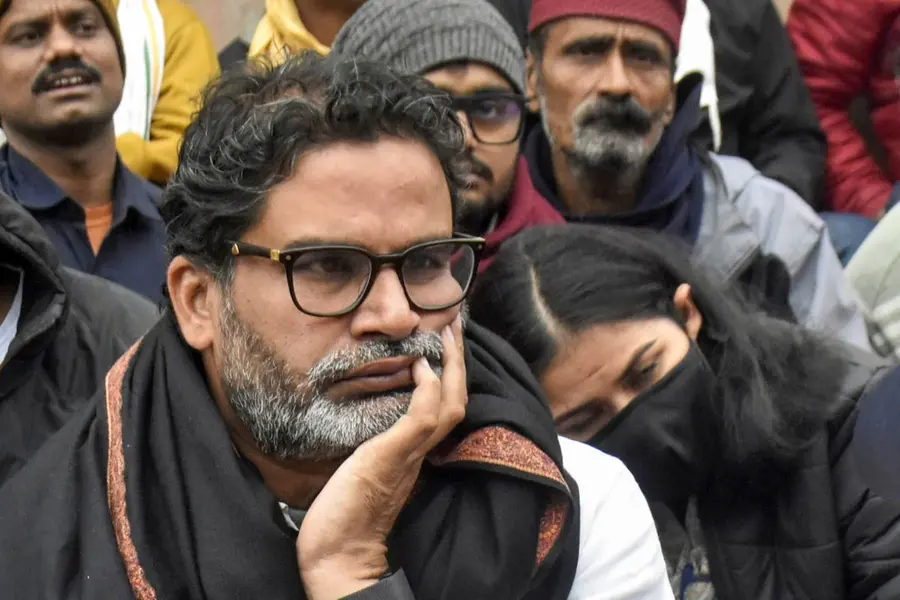
When veteran strategist Prashant Kishor launched the Jan Suraaj Party (JSP) in Bihar with grand ambitions, many political observers took note. A new party, promising to disrupt the old caste-based politics of the state and contest all 243 seats in the 2025 assembly elections: it was bold. But when the results rolled in, the verdict was unambiguous: the party failed to register a victory anywhere.
A strategist turned front-runner
Prashant Kishor had built his reputation behind the scenes: a campaign guru whose deft election-machinery work assembled victories for others, now turning himself into a political force. He announced the Jan Suraaj Abhiyan, followed by the formal launch of the Jan Suraaj Party, with the intention of contesting every seat in Bihar’s legislative assembly.
In campaign mode, JSP positioned itself as the “third option” in Bihar: neither the old ruling Janata Dal (United) (JD(U))-Bharatiya Janata Party (BJP)-led NDA, nor the established opposition alliance of the Rashtriya Janata Dal (RJD) and others. Instead, it promised governance, youth employment, migration concerns and a break from entrenched identities. Exit-polls ahead of the election projected the new entrant might capture around 7-11 % of the vote share, and bag somewhere between 2 to 6 seats.
The big ambition — full-scale fight
JSP contested almost all seats (239 out of 243) in the 2025 Bihar Assembly elections, signalling that its leadership was serious about making a state-wide impact rather than limiting itself to a few select constituencies. In the run-up, the party emphasised modern candidate-selection (fresh faces, women candidates), governance reforms, and social-policy promises. The notion was clear: rewrite Bihar’s politics.
A key plank of Prashant Kishor’s Jan Suraaj campaign was a bold promise to scrap Bihar’s liquor prohibition “within an hour” of coming to power — a commitment he made repeatedly. Kishor argued that the ban, imposed in 2016 under Nitish Kumar, has been deeply counterproductive: rather than eliminating alcohol consumption, it has fuelled a black market, promoted illegal home deliveries, and deprived the state of a massive revenue stream. The party claims that lifting the ban could restore as much as ₹28,000 crore annually, funds they plan to leverage to secure huge development loans from institutions like the World Bank and IMF. Rather than using this money for superficial gains, Kishor has pledged to channel it into transforming Bihar’s education system, improving social welfare and building modern governance.
Beyond the liquor reform, Jan Suraaj’s campaign also stressed governance over caste, youth employment, and financial inclusion. The party proposed pension increases for the elderly, low-interest loans for women entrepreneurs, and merit-based candidate selection — reflecting its broader vision of a meritocratic, development-focused political alternative.
What the numbers and vote-share told
While the official detailed results are still being sifted through, several data points stand out.
- Multiple exit-polls had predicted a razor-thin seat‐win for JSP—some gave it 0-2 seats.
- Some surveys projected a vote share of around 9.7 % for JSP, placing it ahead of the Indian National Congress in Bihar, which was forecast at roughly 8.7 %.
- As counting began, JSP showed early leads in only a handful of constituencies (four seats as per early leads).
In earlier by-polls in November 2024, JSP contested four seats and lost all — one candidate secured ~22.46 % vote share in Imamganj (SC) but that wasn’t enough for a win.
Why the huge gap between ambition and outcome?
Several factors appear to have combined to blunt JSP’s electoral launch. First, organisational depth: building a party from scratch across 243 seats in a state with entrenched local networks, caste alliances and deep-rooted loyalties is a monumental challenge. Many analysts believe JSP’s grassroots machinery simply did not match that of the larger alliances.
Second, longstanding identity-politics: Bihar has for decades operated along strong caste and social lines. Despite the rhetoric of “moving beyond caste”, JSP appears to have underestimated how persistently those alignments shape voting behaviour. Third, timing and experience: launching full-scale in one go left little room for local consolidation and trust-building. Voters may have found it easier to stick with known brands rather than gamble on a new entrant. Finally, for some critics, despite fresh faces, candidate-quality and local relevance remained patchy — vote-cutting rather than vote-winning may have been what JSP achieved in many places.
The verdict and what it means
When the dust settles, the verdict is harsh for JSP: despite contesting nearly all seats, it has zero victories and saw only limited representation in early leads. The party achieved some vote-share but not enough to translate into seats. Its role now looks less like an immediate contender and more like a vote-splitter — someone who might influence margins but cannot yet win.
For Prashant Kishor, the result raises questions about the leap from strategist to front-line politician: building a political brand, delivering wins, mastering the local electoral dynamic are very different from orchestrating campaigns. For Bihar politics, the outcome reinforces how difficult it is for new parties to upturn the status quo in a short time, especially when competing against two large coalitions with deep roots.
Looking ahead
The story does not necessarily end here. A nascent party that garners roughly 8-10 % vote-share on debut may yet grow its footprint. But JSP will need to reflect on its strategy: strengthen the grassroots, win winnable seats first, build local credibility, pick candidates who resonate regionally and show a convincing story of performance. Without that, the tag of “also-ran” may become more entrenched than the “change-maker” image it sought.
But it also bears noting that Prashant Kishor had publicly staked his political future on this election. Throughout the campaign, he declared that if Jan Suraaj failed to create even a “ripple” in Bihar’s political waters, he would step away from electoral politics altogether. The statement, intended to project confidence and momentum, now hangs heavily over the party’s complete washout, adding a personal dimension to what has otherwise been framed as merely an electoral setback.
Published: 14 Nov 2025, 02:24 pm IST
Disclaimer: Kindly avoid objectionable, derogatory, unlawful and lewd comments, while responding to reports. Such comments are punishable under cyber laws. Please keep away from personal attacks. The opinions expressed here are the personal opinions of readers and not that of Mathrubhumi.
