
Two orphaned Asiatic black bear cubs rescued from Jorhat were released in Dihing Patkai National Park after 6 months of care at CWRC, Kaziranga.
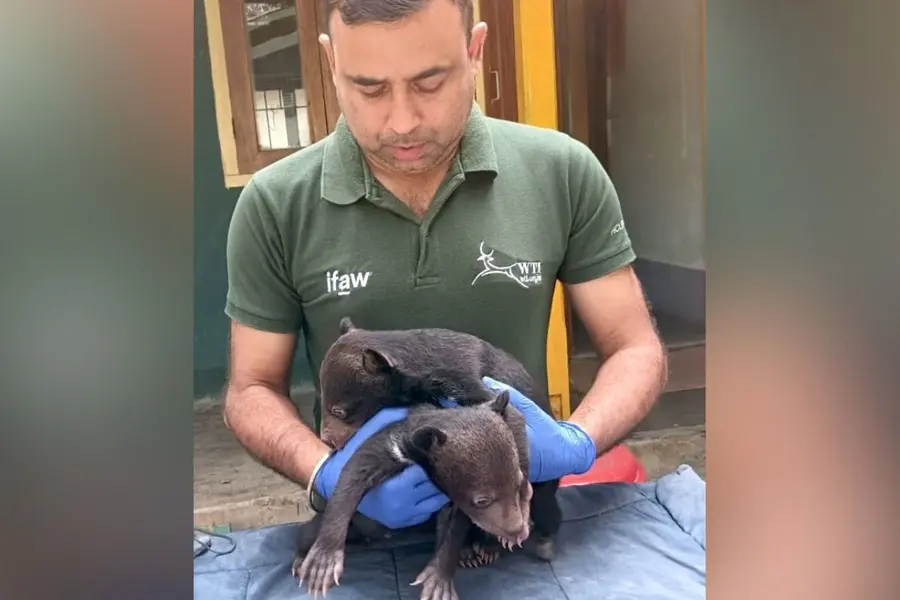
Guwahati: Two orphaned Asiatic black bear cubs rescued from the Disoi Reserved Forest in Jorhat were released in Dihing Patkai National Park after spending 6 months under care at the Centre for Wildlife Rehabilitation and Conservation (CWRC) in Kaziranga, officials said Wednesday.
Dihing Patkai National Park spans the Dibrugarh and Tinsukia districts of eastern Assam.
Kaziranga National Park and Tiger Reserve (KNPTR) director Sonali Ghosh said the two cubs, 'Ursus thibetanus', were rescued from Disoi Reserved Forest on February 26, 2025 and have “successfully begun their new life” following their translocation for eventual release into the wild. She called it an important milestone in Assam’s wildlife conservation journey.
According to Ghosh, the cubs, then estimated to be between four and six weeks old, were spotted alone by a local youth and handed over to the Nakachari beat office under Jorhat Forest Division. As surveys revealed no trace of their mother, they were transferred to the CWRC in Kaziranga for specialised care.
Established in 2002, the CWRC is a joint initiative of the Assam Forest Department, the International Fund for Animal Welfare (IFAW), and the Wildlife Trust of India (WTI). Ghosh said the cubs were treated for mild dehydration and nurtured in the small mammal nursery under the close supervision of Dr Bhaskar Choudhury and his team. They were reared on a canine milk replacer and gradually introduced to conditions that would prepare them for survival in the wild.
The rehabilitation of the orphaned cubs followed the Asiatic black bear protocols developed by the Centre for Bear Rehabilitation and Conservation (CBRC) at Pakke Tiger Reserve, Arunachal Pradesh.
Ghosh explained that the process focused on ensuring proper nutrition, maintaining natural behaviours, and minimising human imprinting to improve the cubs’ chances of successful reintegration. A scientific survey was carried out to identify a suitable release site. While the Disoi Reserved Forest was considered, its proximity to human settlements and disturbance made it unsuitable.
A systematic evaluation of natural cover, distance from habitation, prey availability, and community awareness identified Dihing Patkai National Park as the most suitable release site. With rich vegetation, abundant resources, minimal human interference, and committed support from forest staff and local communities, the park was deemed ideal for the cubs, Ghosh said.
Following approval from the Principal Chief Conservator of Forests (Wildlife) and the Chief Wildlife Warden of Assam, the CWRC team successfully translocated the cubs to Dihing Patkai National Park on Sunday, August 17.
“The journey of these cubs, from their rescue in Jorhat, to their care at CWRC, and finally to their release in Dihing Patkai, stands as a powerful example of what science-driven rehabilitation, ethical wildlife management, and community involvement can achieve,” Ghosh said. “It reflects Assam’s growing commitment to protecting its wildlife heritage and ensuring that even orphaned animals are given a second chance at freedom.”
IANS inputs
Published: 20 Aug 2025, 08:34 pm IST
Disclaimer: Kindly avoid objectionable, derogatory, unlawful and lewd comments, while responding to reports. Such comments are punishable under cyber laws. Please keep away from personal attacks. The opinions expressed here are the personal opinions of readers and not that of Mathrubhumi.
