
The agitation attracted national attention, with then Prime Minister Indira Gandhi visiting Leh during the movement.
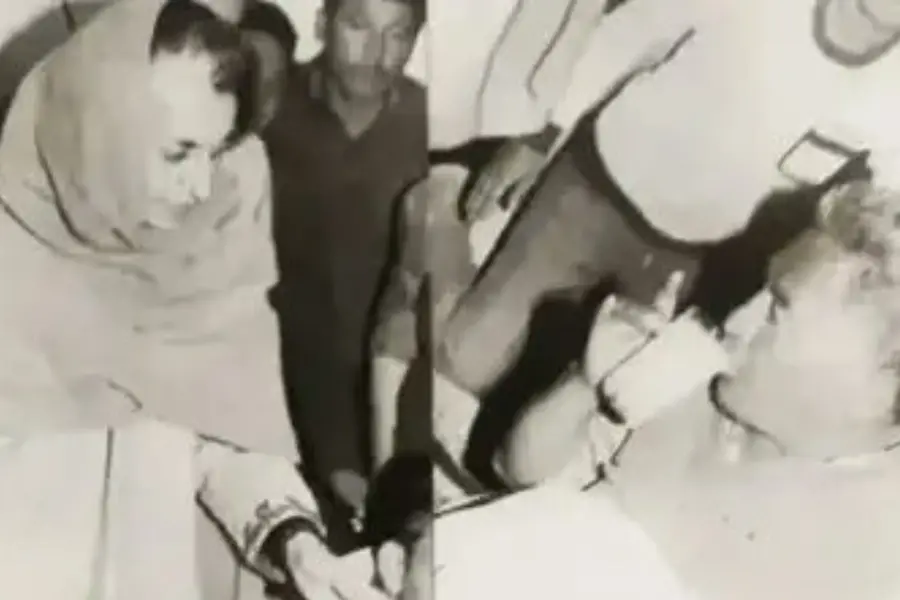
New Delhi: More than four decades after his father, veteran leader Sonam Wangyal, went on a hunger strike to demand constitutional recognition for Ladakh's tribal communities, climate activist Sonam Wangchuk has found himself at the centre of another protest.
On Saturday morning, Delhi Police shifted Wangchuk to Safdarjung Hospital after he remained on an indefinite hunger strike for 21 days at Jantar Mantar. Police said the action was taken in compliance with directions of the Delhi High Court and on medical advice as his health deteriorated. Organisers, however, alleged that Wangchuk was forcibly removed from the protest site.
Also Read

Visuals from the protest showed police personnel forming a human chain around Wangchuk, shielding him from supporters before lifting him onto a stretcher and taking him to an ambulance.
The dramatic scenes have drawn comparisons with a chapter from Ladakh's political history involving Wangchuk's father.
Sonam Wangyal's 1984 Hunger Strike
Long before becoming one of Ladakh's prominent political figures, Sonam Wangyal had earned national recognition as one of India's earliest Everest climbers. In 1965, at the age of 23, he became one of the youngest people to summit Mount Everest.
He later entered public life, serving in the Jammu and Kashmir Legislative Council and as an MLA and minister. During the 1980s, Wangyal emerged as one of the leading voices demanding Scheduled Tribe (ST) status for Ladakh's tribal communities.
In 1984, he launched a hunger strike to press the demand, arguing that the region's tribal population needed constitutional safeguards to protect its social, cultural and economic interests.
The agitation attracted national attention, with then Prime Minister Indira Gandhi visiting Leh during the movement. Although the fast ended after assurances, the demand was not implemented immediately.
The campaign eventually succeeded five years later when the Constitution (Jammu and Kashmir) Scheduled Tribes Order, 1989, issued under Article 342 of the Constitution, recognised eight tribal communities, including Balti, Beda, Bot/Boto, Brokpa, Changpa, Garra, Mon and Purigpa, as Scheduled Tribes.
The constitutional order recognised specific tribal communities rather than granting blanket Scheduled Tribe status to Ladakh as a whole, marking a significant milestone in the region's political history.
A new protest, a new generation
Now, decades later, Wangyal's son has become the face of another movement linked to Ladakh.
Wangchuk joined a protest at Jantar Mantar demanding reforms in the NEET examination system and remained on an indefinite hunger strike for three weeks before being shifted to hospital.
Delhi Police said the action was taken after doctors advised immediate medical intervention.
"As per orders of Hon'ble High Court and on expert medical advise due to the deteriorating health condition of Sh. Sonam Wangchuk, he has been shifted to the hospital for essential medical care. While complying with the orders of Hon'ble High Court the protestors tried to create obstruction, in which slight commotion ensued, however police took maximum restrain and undertook the exercise safely. We request the protestors at Jantar Mantar to peacefully vacate the place at the earliest," Delhi Police said in a statement.
Protest organisers disputed the police account, alleging Wangchuk was removed against his will.
Published: 18 Jul 2026, 01:52 pm IST
Related Topics
Disclaimer: Kindly avoid objectionable, derogatory, unlawful and lewd comments, while responding to reports. Such comments are punishable under cyber laws. Please keep away from personal attacks. The opinions expressed here are the personal opinions of readers and not that of Mathrubhumi.