
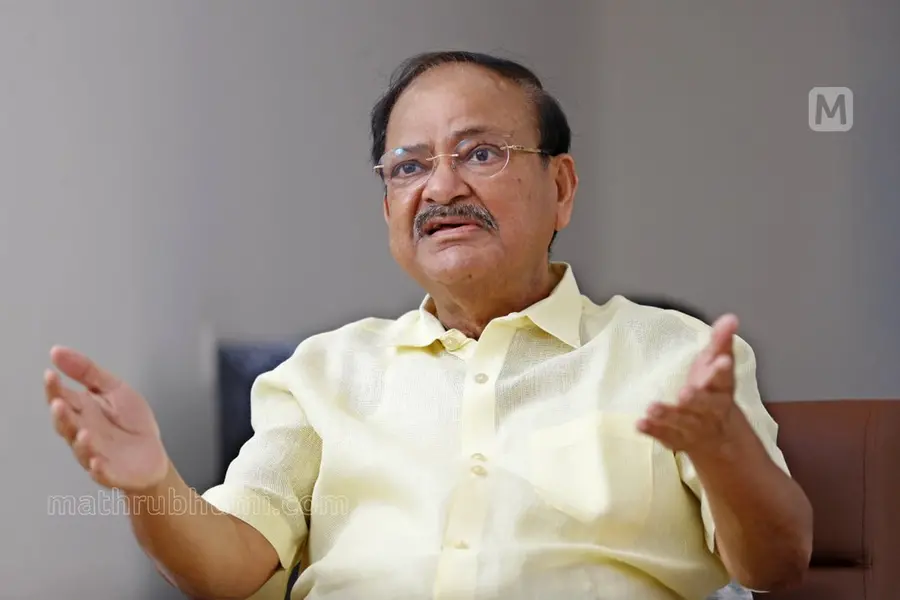
"When I informed Advani, whom I had always regarded as a father figure, about the party's decision to make Modi the Prime Minister, he did not oppose it. However, it deeply pained me." - Former Vice President M. Venkaiah Naidu in an exclusive interview with Mathrubhumi News Editor M.P. Suryadas.
"For me, it is still a painful memory to inform L K Advani on the party’s majority decision taken in the 2014 Goa convention to consider Narendra Modi for the post of Prime Minister. That incident still lingers in my mind.
During the Goa convention, both the central executive and the parliamentary board supported Modi, who was then the Chief Minister of Gujarat. The party had suffered defeats in the 2004 and 2009 elections after Vajpayee's tenure as Prime Minister. It was understood that a third consecutive failure would weaken the organisation. With this in mind, I supported Modi, a younger leader."
Naidu explained the circumstances under which Modi was chosen over Advani to be elevated as Prime Minister.
Q: In 2014, Advani was actively leading, correct? Could anyone say that he was overaged, then?
It wasn’t about age. The general need was for a younger leader who could bring the party back to power after the defeats in 2004 and 2009. Additionally, Modi’s experience as Gujarat Chief Minister for three terms was quite impressivet. These two factors worked in his favor, and I supported Modi. When I went to inform Advani, whom I regarded as a father figure, about the party's decision, he didn’t say anything against it. But it deeply pained me.
.Q: Did you orchestrate moves in favor of Modi at the Goa convention?
It is true that I strongly supported Modi. However, I did not canvas members. I conveyed my stance firmly to other members, keeping the interests of the party and the nation in mind. I communicated with many members of the national committee. The decision made at that time proved to be the right one.
Q: Earlier, BJP had several outstanding leaders. But today, there is a claim that the party lacks influential leaders like you and Pramod Mahajan. Is this true?
It’s not right for me to comment on BJP's internal affairs. However, the party has many capable leaders. New leaders must emerge, and they should be given opportunities. Just as people questioned who would lead after Vajpayee or Advani, some now ask who will lead after Modi. The BJP does not suffer from a leadership vacuum. There are capable individuals, and discussions will identify them.
Q: Is there a moral decline in the country's social and political spheres?
There has been a certain degree of moral decline in public life. Traditional values have been ignored, and individual ethics have eroded. The decline in values among politicians has disappointed people and diminished their interest in parliamentary and legislative systems. While the country progresses in every aspect, this moral erosion must be addressed.
Q: Who is responsible for this moral decline?
No single party or individual can be blamed for this. It is a gradual deterioration over the years. The 1975 Emergency, during which fundamental rights and freedom of expression were curtailed, contributed heavily towards this. Efforts were made to bypass courts and judges when faced with judicial defeats. This is where the erosion began. Politicians started switching parties for personal gains. Initially, individuals defected; later, it became group defections. To counter this, the anti-defection law was introduced. However, it has not produced the desired results. It is overdue for an amendment. Those who defect should resign from their positions before switching parties. Only by amending the law can political defections for personal gains be curbed.
Q: Should there be a system to evaluate the performance of people's representatives?
The public must examine and evaluate the performance of their representatives when voting. People must identify members who create ruckus or chaos in the assembly. Earlier, people voted based on the '4 Cs'—Character, Caliber, Capacity, and Conduct. Today, it has shifted to Caste, Community, Cash, and Criminality. Political parties should implement a code of conduct for their representatives."
Q: Isn’t the increasing issuance of whips by political parties for every vote undermining the right of members to think and express their views independently?
Whips should be issued based on the merit of each issue. Members must ensure that governance and functioning align with the party's manifesto. Internal discussions within the party are essential. Internal democracy within parties is crucial.
Q: Today, decisions in most parties are not made through open discussions, are they? Isn’t this approach flawed?
The lack of internal democracy in parties is a pestering issue. The responsibility of decision-making is entirely entrusted to the leader, who then becomes an autocrat. This is not the correct approach. As we celebrate the 75th anniversary of the Constitution, we must ask whether the Constitution has failed us or we have failed the Constitution. Our Constitution is the best in the world. Though it has been amended multiple times, those who criticise it should introspect.
Q: Do you support the idea of 'One Nation, One Election'?
There is no disagreement on the fact that we are one nation. The constant election mode must change. It is a decision that will reduce costs. However, if anyone has doubts or concerns about this, they should be addressed through discussions."
Q: Do you agree with the malicious campaigns against Nehru and his family? Isn’t the argument that Patel should have been the Prime Minister irrelevant now?
"Personal attacks on anyone are not acceptable. Misuse of social media must be curbed. However, the claim that a majority of Chief Ministers preferred Patel as Prime Minister at the time still holds. It is good to understand and study history.
Q: Wasn’t it unfair that Advani wasn’t considered for the President’s post despite the expectations of many BJP members?
That was the party's decision. It is wrong to look for personal interests in it.
Q: You, too, were not considered for the President's post despite being the Vice President. Do you see this as unfair?
The decision of who should be President is made by the party. I have no issues with it. Coming from a simple farmer's family, I was considered for roles like MLA, MP, various Union Minister positions, BJP National President and finally Vice President. I am content.
Q: Did the central government fail in resolving the Manipur issue?
The issue in Manipur is ethnic. The central government has intervened when required. Both the central and state governments must work together to resolve it.
Q: Wasn’t it improper for the Prime Minister to not visit Manipur? He traveled abroad multiple times during this period.
Many believe the Prime Minister should have visited Manipur. That is a political allegation. I have discussed the Manipur issue with both the Prime Minister and the Home Minister.
Q: Did you tell the Prime Minister that he should have visited Manipur?
It is not appropriate to publicly disclose what was discussed with the Prime Minister.
Q: Even during the Parliament session, the Prime Minister is abroad, isn't he?
During Parliament sessions, it is essential for the Prime Minister and ministers to be present in the House as much as possible. They should abstain only for highly serious reasons. There may be certain unavoidable situations that require going abroad, but being present in the House during sessions is a necessity.
Q: What is the incident that has pained you the most?
My lifelong wish was to always work alongside the people. When I was considered for the constitutional position of Vice President, I had to resign from the party membership. My eyes welled up with tears at that moment. The thought that I would no longer be able to visit the party office deeply troubled me. Even so, I felt compelled to take up the responsibility entrusted to me by the party.
Watch full interview
Published: 25 Dec 2024, 01:07 pm IST
Related Topics
Disclaimer: Kindly avoid objectionable, derogatory, unlawful and lewd comments, while responding to reports. Such comments are punishable under cyber laws. Please keep away from personal attacks. The opinions expressed here are the personal opinions of readers and not that of Mathrubhumi.
