
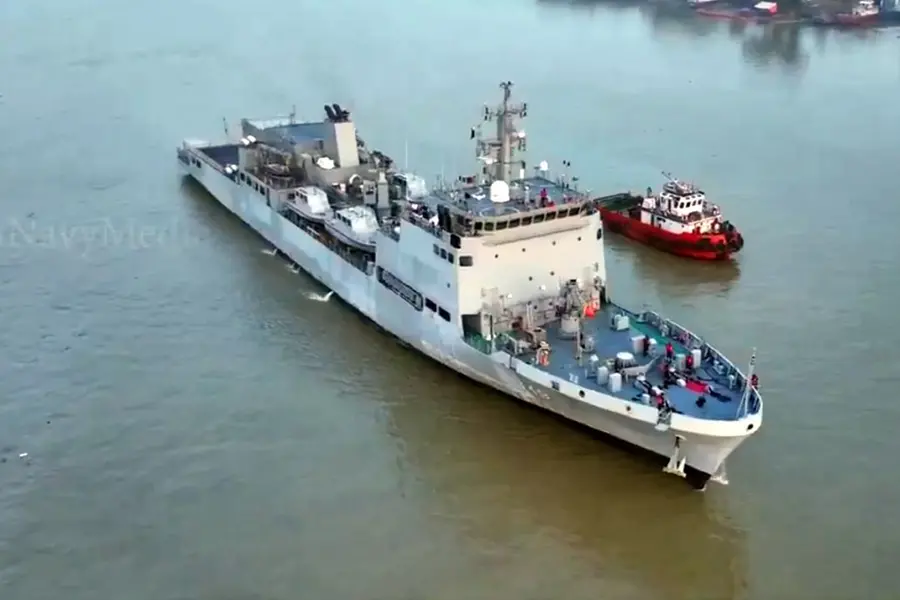
The Indian Navy is set to mark another milestone in its journey towards maritime self-reliance with the commissioning of INS Nirdeshak (Yard 3026), the second Survey Vessel Large (SVL) ship under construction by Garden Reach Shipbuilders & Engineers (GRSE), Kolkata. Scheduled for 18 December 2024, this landmark event at the Naval Dockyard in Visakhapatnam, will be officiated by Minister of State for Defence Sanjay Seth. INS Nirdeshak represents a confluence of cutting-edge technology and the national ambition of achieving self-reliance in defence production under Aatmanirbhar Bharat.
A vessel of strategic importance
INS Nirdeshak is part of a four-ship SVL project, an initiative pivotal to the Indian Navy’s hydrographic and naval operational capabilities. Designed to replace the aging fleet of survey vessels, these ships reflect a modern approach to hydrography and maritime operations. INS Nirdeshak is a robust platform with a displacement of 3,400 tons, 110 meters in length, and a beam of 16 meters. Powered by two diesel engines, it can achieve speeds exceeding 18 knots.
Fitted with state-of-the-art hydrographic equipment, satellite-based positioning systems, and terrestrial survey tools, the ship will enable detailed mapping of India’s maritime zones, ports, harbors, navigational channels, and deep-sea territories. This enhanced capability directly supports safe marine navigation, underlining the vessel's role in fostering maritime safety and security.
In its secondary role, INS Nirdeshak is designed for multi-mission naval operations, adding versatility to the Navy’s operational repertoire. This dual utility cements its importance in both peacetime and wartime scenarios.
Engineering excellence: From keel to commissioning
The construction of INS Nirdeshak commenced with the keel-laying on 1 December 2020, followed by its launch on 26 May 2022. Over the last two years, the vessel underwent rigorous harbor and sea trials to ensure operational readiness. These trials tested its engineering systems, navigation capabilities, and hydrographic tools, affirming its technical prowess and reliability.
What stands out about this project is its commitment to indigenization. Over 80% of the ship’s components are sourced domestically, with significant contributions from Micro, Small, and Medium Enterprises (MSMEs). Indigenous companies like BEL, BHEL, Avantel, ECIL, SAIL, and others have supplied critical systems, ensuring a robust local supply chain. Furthermore, the use of indigenous DMR 249A steel showcases India’s material science expertise and commitment to reducing reliance on imports.
Economic catalysis through defense production
The SVL project exemplifies how defense production can drive economic growth and skill development. The construction of INS Nirdeshak employed approximately 1,600 workers annually within GRSE and an additional 10,000 personnel in ancillary industries each year. These jobs span a range of expertise, from ship design and engineering to advanced manufacturing and logistics.
Moreover, the complexity of naval platforms like the SVL requires a highly skilled workforce. This demand catalyzes the upskilling of workers, fostering a pipeline of expertise that benefits not just the defence sector but also the broader manufacturing industry.
Towards Aatmanirbharta: A fully self-reliant Navy by 2047
India’s naval modernization efforts are part of a broader vision to achieve strategic autonomy. Currently, 63 of 64 ships and submarines under construction for the Indian Navy are being built in Indian shipyards. This commitment is not only a strategic imperative but also a testament to the Navy’s resolve to become a “Fully Aatmanirbhar Force by 2047”.
The plough-back effect of investments in indigenous shipbuilding is significant. Funds allocated to these projects stimulate domestic industries, create jobs, and drive technological innovation. By developing capabilities in advanced manufacturing, material science, and systems integration, India is positioning itself as a global hub for naval shipbuilding.
Strategic Implications of Hydrographic Survey Vessels
Hydrographic survey vessels like INS Nirdeshak play a critical role in securing India’s maritime interests. Their ability to map and survey underwater terrain is essential for safe navigation, disaster response, and resource exploration. These capabilities also enhance India’s standing as a net security provider in the Indian Ocean Region (IOR).
In addition, the dual-use potential of such vessels—ranging from supporting naval operations to aiding civilian maritime activities—demonstrates their strategic versatility. As India strengthens its maritime presence, these vessels become vital tools for projecting soft and hard power in the Indo-Pacific.
A Blueprint for Economic and Strategic Growth
The commissioning of INS Nirdeshak underscores a paradigm shift in India’s defense production strategy. By prioritizing indigenous sourcing, the Navy and the shipbuilding industry are creating a sustainable model for self-reliance. This approach not only reduces dependency on foreign defense contractors but also positions India as a potential exporter of naval platforms and technologies.
Furthermore, the technological advancements and infrastructure upgrades achieved through projects like the SVL enhance India’s competitiveness in global markets. Indian shipyards are now equipped to handle complex warship production, paving the way for future exports and international collaborations.
The commissioning of INS Nirdeshak is more than just the induction of a new ship into the Indian Navy; it is a symbol of India’s growing maritime ambition and industrial capability. By aligning defense production with economic growth and technological innovation, India is building a foundation for long-term strategic autonomy.
As the Navy moves closer to its goal of becoming a fully self-reliant force by 2047, projects like the SVL serve as cornerstones of this transformation. INS Nirdeshak stands as a testament to what India can achieve through perseverance, innovation, and a commitment to self-reliance—both in defense and beyond.
Published: 17 Dec 2024, 01:16 pm IST
Related Topics
Disclaimer: Kindly avoid objectionable, derogatory, unlawful and lewd comments, while responding to reports. Such comments are punishable under cyber laws. Please keep away from personal attacks. The opinions expressed here are the personal opinions of readers and not that of Mathrubhumi.
