
This system allows for combat free-fall jumps from 32,000 feet, with deployment at 30,000 feet – a first for the Indian Armed Forces
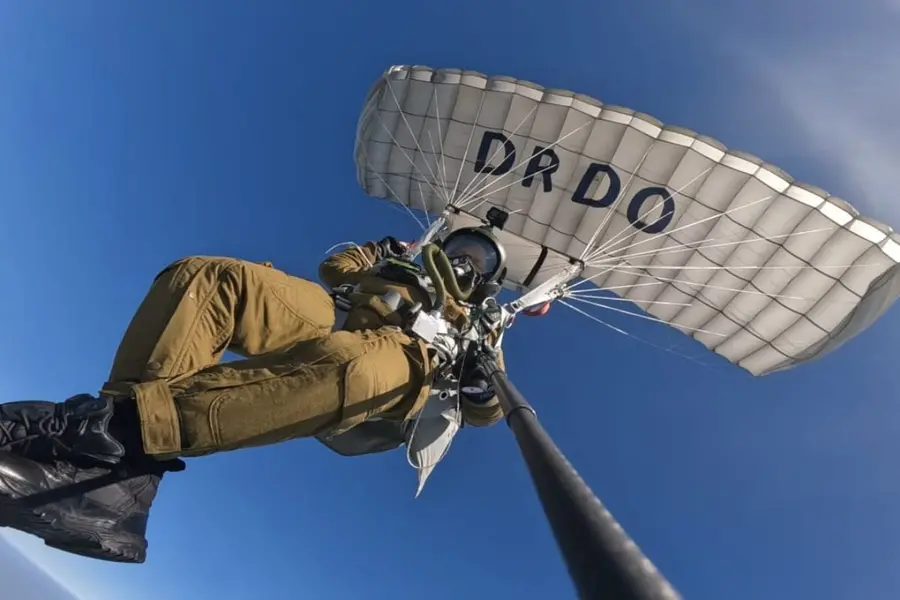
New Delhi: The Defence Research and Development Organisation (DRDO) has successfully tested its indigenously developed Military Combat Parachute System (MCPS) with a combat free-fall jump from an altitude of 32,000 feet. The parachute system was deployed at 30,000 feet, making it the only parachute system currently in use by the Indian Armed Forces capable of deployment at such a high altitude.
The test jump was conducted by experienced personnel Wing Commander Vishal Lakhesh, VM (G), Master Warrant Officer R J Singh, and Master Warrant Officer Vivek Tiwari, demonstrating the system’s reliability, advanced design, and operational capabilities.
Developed by DRDO laboratories—the Aerial Delivery Research and Development Establishment (ADRDE) in Agra and the Defence Bioengineering and Electromedical Laboratory in Bengaluru—the MCPS facilitates High Altitude High Opening (HAHO), High Altitude Medium Opening (HAMO), and High Altitude Low Opening (HALO) jumps, addressing critical tactical requirements for airborne forces.
The system is designed to carry a full combat load, including weapons, ammunition, and a survival kit, while ensuring a reduced rate of descent to minimise landing injuries and enhanced steering for accurate navigation and safe landing in designated zones. Furthermore, it incorporates compatibility with the Indian regional satellite navigation system, NavIC, enhancing operational autonomy and security by avoiding interference from external sources.
Prior to its commissioning in 2023, the MCPS underwent over 350 trials jointly with the Indian Air Force’s Paratrooper Training School at Agra and has been certified by the Centre for Military Airworthiness & Certification.
This capability allows rapid and precise insertion of special forces into hostile or difficult terrain, strengthening India’s operational readiness and self-reliance in critical defence technologies.
Raksha Mantri Shri Rajnath Singh praised the teams involved, noting this test as an important step forward for India’s indigenous defence capabilities.
The 32,000-foot free-fall jump marks a key development in India’s strategic airborne operations with homegrown technology supporting the nation’s defence preparedness.
Published: 15 Oct 2025, 09:02 pm IST
Related Topics
Disclaimer: Kindly avoid objectionable, derogatory, unlawful and lewd comments, while responding to reports. Such comments are punishable under cyber laws. Please keep away from personal attacks. The opinions expressed here are the personal opinions of readers and not that of Mathrubhumi.
