
The Chinese foreign minister is in India primarily to hold a fresh round of Special Representatives (SR) dialogue on the boundary question with National Security Advisor Ajit Doval. The SR talks will be held on Tuesday.
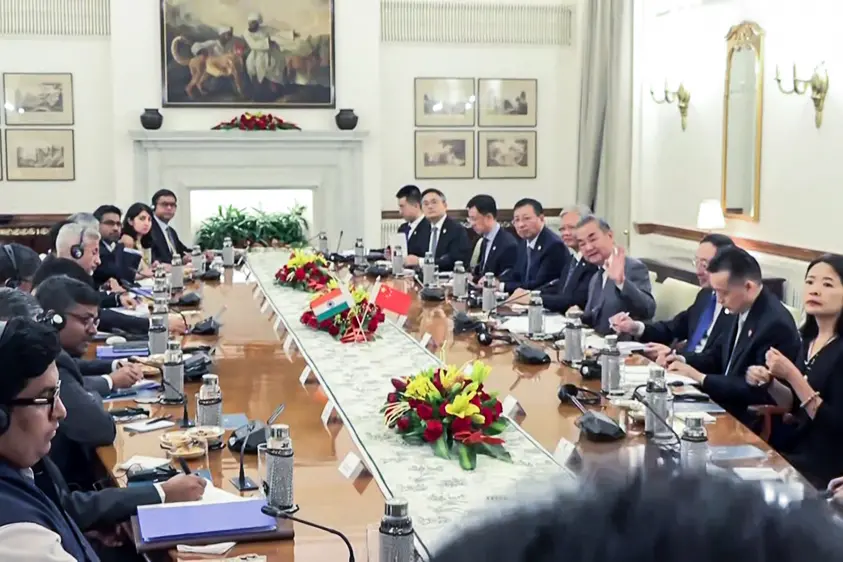
New Delhi: External Affairs Minister S. Jaishankar on Monday told his Chinese counterpart Wang Yi that India and China must adopt a “candid and constructive” approach to their relationship, stressing that differences should not turn into disputes and competition should not escalate into conflict.
At the start of their meeting in New Delhi, Jaishankar called for advancing the de-escalation process along the Line of Actual Control (LAC) in eastern Ladakh, where the two militaries have faced off for more than four years.
Wang arrived in India for a two-day visit, just days before Prime Minister Narendra Modi is expected to travel to China for the Shanghai Cooperation Organisation (SCO) summit. His trip is seen as part of efforts to repair ties strained by the deadly 2020 Galwan Valley clashes.
In his remarks, Jaishankar also mentioned fighting against terrorism in all its forms and manifestations as another major priority.
"Having seen a difficult period in our relationship, our two nations now seek to move ahead. This requires a candid and constructive approach from both sides," Jaishankar said.
"In that endeavour, we must be guided by the three mutuals - mutual respect, mutual sensitivity and mutual interest. Differences must not become disputes, nor competition conflict," he added.
The Chinese foreign minister is in India primarily to hold a fresh round of Special Representatives (SR) dialogue on the boundary question with National Security Advisor Ajit Doval. The SR talks will be held on Tuesday.
Wang and Doval are the designated special representatives for the boundary talks.
"This (SR talks) is very important because the basis for any positive momentum in our ties is the ability to jointly maintain peace and tranquillity in the border areas. It is also essential that the de-escalation process move forward," Jaishankar said.
The talks covered economic and trade issues, pilgrimages, people-to-people contacts, river data sharing, border trade and connectivity.
"I would like to follow up on some particular concerns that I had brought up with you, when I visited China in July," Jaishankar said without elaborating.
The external affairs minister also dropped enough hints of discussion on international situation.
"We seek a fair, balanced and multi-polar world order, including a multi-polar Asia. Reformed multilateralism is also the call of the day.
"In the current environment, there is clearly the imperative of maintaining and enhancing stability in the global economy as well," he said.
"The fight against terrorism in all its forms and manifestations is another major priority. I look forward to our exchange of views," he added.
The external affairs minister said New Delhi expects that the discussions would contribute to building a stable, cooperative and forward-looking relationship between India and China -- "one that serves both our interests and addresses our concerns".
"You are visiting India, shortly before the SCO summit that China is hosting in Tianjin. We have worked closely with the Chinese side during its Presidency. We wish you a successful Summit with strong outcomes and decisions," Jaishankar added.
In the SR talks, both sides are expected to deliberate on new confidence-building measures besides reviewing the overall situation along the LAC.
Though the two sides disengaged troops from the friction points, they are yet to de-escalate the situation by pulling back the frontline forces from the border.
Each side currently has around 50,000 to 60,000 troops along the LAC in the eastern Ladakh region.
NSA Doval travelled to China in December last and held the SR talks with Wang, weeks after Prime Minister Modi and Chinese President Xi Jinping decided to revive various dialogue mechanisms between the two sides at a meeting in the Russian city of Kazan.
The military standoff in eastern Ladakh began in May 2020 and the clashes at the Galwan Valley in June that year resulted in a severe strain in bilateral ties.
The face-off effectively ended following completion of the disengagement process from the last two friction points of Demchok and Depsang under an agreement finalised on October 21 last year.
In the last few months, the two sides also took a number of initiatives to rebuild the ties that included resumption of Kailash Mansarovar Yatra and New Delhi restarting issuance of tourist visas to Chinese nationals. PTI
Published: 18 Aug 2025, 08:56 pm IST
Related Topics
Disclaimer: Kindly avoid objectionable, derogatory, unlawful and lewd comments, while responding to reports. Such comments are punishable under cyber laws. Please keep away from personal attacks. The opinions expressed here are the personal opinions of readers and not that of Mathrubhumi.
