
Nearly three decades before becoming India's Union Education Minister, Dharmendra Pradhan led a major student protest against a question paper leak in Odisha. The 1997 agitation has returned to public attention as he faces mounting criticism over recurring examination paper leaks, including the ongoing NEET controversy.
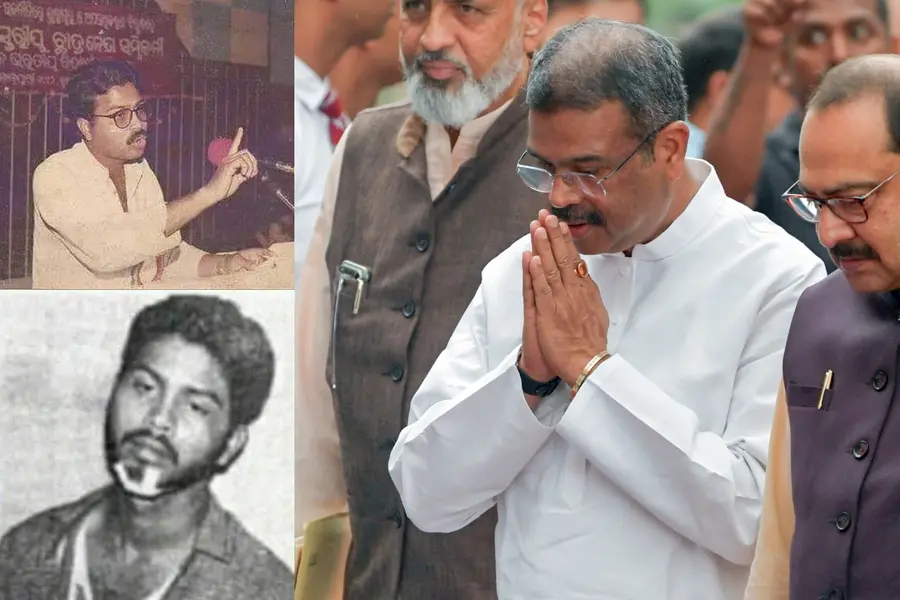
The debate surrounding repeated examination paper leaks has brought renewed attention to an important chapter in Union Education Minister Dharmendra Pradhan's early political career.
In 1997, while serving as the National Secretary of the Akhil Bharatiya Vidyarthi Parishad (ABVP), Pradhan led a large student protest in Odisha against the alleged leak of an examination question paper. At the time, India had just witnessed the formation of the Atal Bihari Vajpayee-led government at the Centre, while Odisha was governed by the Indian National Congress.
Also Read

The protest became one of the defining moments of Pradhan's emergence as a student leader and is now being revisited because he heads the ministry responsible for maintaining the integrity of national examinations.
What happened during the 1997 paper leak protest?
According to reports, around 1,500 students gathered outside the Odisha state secretariat under the banner of the ABVP to protest against the alleged examination paper leak.
The demonstration was initially peaceful but turned violent after police carried out a lathi-charge to disperse the protesters. During the crackdown, Dharmendra Pradhan allegedly suffered multiple fractures after being beaten by police personnel.
Despite the injuries, he continued participating in the movement, and the incident significantly enhanced his reputation within Odisha's student politics.
The episode has since been remembered as one of the major protests that helped establish Pradhan as a prominent youth leader in the state.
Rise through student politics
Pradhan was actively involved in student politics while studying at Utkal University.
Between November 1994 and 1997, he served two terms as the National Secretary of the ABVP. His involvement in campaigns on student issues, including examination reforms and education-related protests, helped him build a strong organisational profile within the BJP's student wing.
Political observers say these years laid the foundation for his later rise in national politics.
From student activist to Union minister
Following his student activism, Pradhan gradually rose through the BJP organisation and became one of the party's most influential leaders from Odisha.
Over the years, he has held several important positions in the Union government, including:
- Minister of Petroleum and Natural Gas
- Minister for Skill Development and Entrepreneurship
- Union Education Minister
He also played a significant organisational role in expanding the BJP's presence across Odisha, a state where the party spent years attempting to challenge the dominance of the Biju Janata Dal (BJD).
The NEET controversy brings the past back into focus
The 1997 protest has resurfaced because Pradhan now oversees India's education system as Union Education Minister.
The country has witnessed repeated controversies involving examination paper leaks over recent years. After the nationwide NEET paper leak controversy in 2024, fresh allegations and concerns surrounding competitive examinations have again placed the ministry under scrutiny in 2026.
Critics argue that the ministry has not done enough to prevent examination leaks despite technological safeguards and stricter laws.
Supporters, however, point out that Pradhan himself once fought against examination irregularities as a student leader and now faces the difficult responsibility of reforming a vast examination system involving millions of candidates.
Paper leaks remain a nationwide challenge
Reports indicate that more than 90 paper leak incidents have been recorded across India over the past eight years.
The affected examinations have included:
- Teacher Eligibility Test (TET) examinations
- State recruitment examinations
- Police recruitment tests
- Engineering entrance examinations
- Medical entrance examinations including NEET
These repeated incidents have raised serious concerns about examination security, recruitment transparency and the credibility of India's competitive examination system.
Dharmendra Pradhan's role in Odisha BJP's growth
Apart from his ministerial responsibilities, Pradhan has long been regarded as one of the BJP's principal strategists in Odisha.
He helped strengthen the party's organisational network, expanded its grassroots presence and promoted several central government welfare schemes in the state.
Many political analysts credit him with contributing significantly to the BJP's long-term expansion in Odisha, culminating in the party forming its first state government in 2024 after ending the BJD's more than two-decade rule under Naveen Patnaik.
Critical assessment of his political journey
While Dharmendra Pradhan is widely recognised as an experienced organiser and senior BJP leader, political commentators have also highlighted several criticisms of his career in Odisha.
The "Chief Minister in waiting" perception
For many years, Pradhan was viewed as the BJP's most prominent face in Odisha and an unofficial chief ministerial contender.
Critics, however, argued that he largely remained in national politics, representing states such as Bihar and Madhya Pradesh in the Rajya Sabha instead of contesting Odisha Assembly elections. This led some opponents to portray him as a Delhi-based leader who was less directly connected with state-level electoral politics.
Strong central influence but limited early electoral gains
During his tenure as Union Petroleum Minister, Pradhan oversaw major projects and promoted flagship central schemes such as the Pradhan Mantri Ujjwala Yojana.
Political analysts note that despite these initiatives, the BJP struggled for several years to significantly weaken the electoral dominance of Naveen Patnaik's BJD. The party's major breakthrough came only in 2024 after broader political shifts and anti-incumbency against the BJD.
Some political observers and former party insiders have alleged that Pradhan exercised considerable influence over the Odisha BJP's organisational structure.
Critics claim that decision-making became highly centralised and that some regional leaders who differed with his political approach found themselves sidelined. However, supporters argue that a strong organisational structure was necessary to build the BJP into a competitive force in Odisha.
Balancing state politics and national strategy
For several years, the BJP strongly opposed the BJD in Odisha while the BJD frequently supported key legislation introduced by the BJP-led Union government in Parliament.
Opposition leaders argued that this created mixed political messaging, making it difficult for voters to determine whether the BJP was pursuing a confrontational or cooperative approach towards the BJD. BJP leaders maintained that parliamentary cooperation on selected national issues did not diminish political competition within Odisha.
Dharmendra Pradhan's political career reflects a the transformation from a student activist protesting against examination irregularities in 1997 to India's Union Education Minister responsible for safeguarding the credibility of national entrance examinations who is facing more fierce opposition.
As fresh questions continue to be raised over examination security, the events of 1997 have returned to the spotlight, with both supporters and critics drawing comparisons between the young student leader who demanded accountability and the senior minister now expected to deliver lasting reforms to India's examination system.
Published: 22 Jul 2026, 05:32 pm IST
ABOUT THE AUTHOR
Related Topics
Disclaimer: Kindly avoid objectionable, derogatory, unlawful and lewd comments, while responding to reports. Such comments are punishable under cyber laws. Please keep away from personal attacks. The opinions expressed here are the personal opinions of readers and not that of Mathrubhumi.