
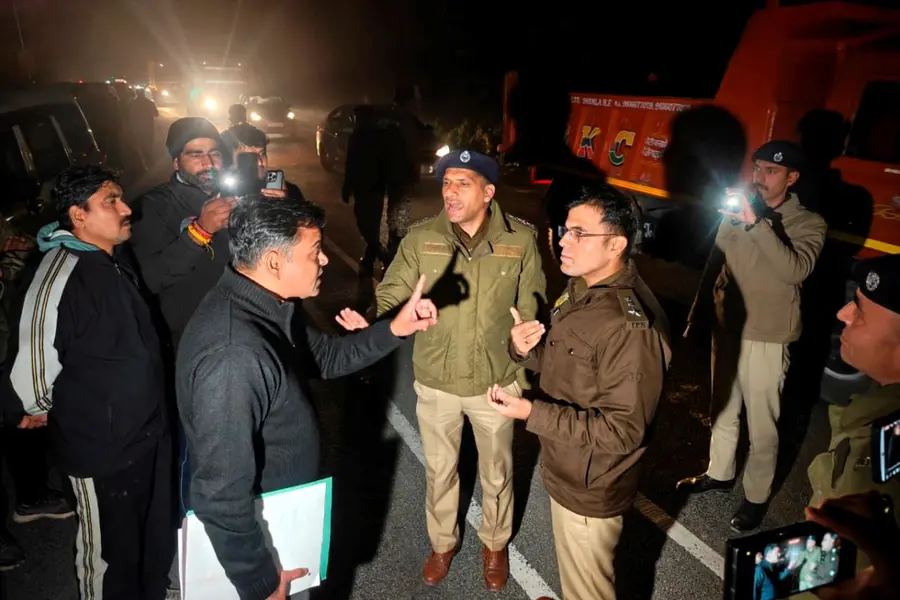
New Delhi: A high-voltage 24-hour confrontation between the Delhi Police and Himachal Pradesh Police has finally come to an end, with the Delhi team cleared to return to the national capital along with three Youth Congress activists arrested over last week’s “shirtless protest” at the AI Impact Summit.
The dramatic interstate standoff, which saw criminal cases filed, vehicles barricaded and officers briefly detained concluded early on Thursday morning after tense negotiations at the Shoghi border near Shimla.
Transit Remand Secured After Midnight Hearing
The confrontation escalated on Wednesday evening when Himachal Pradesh Police registered a kidnapping case against unidentified individuals in plain clothes, alleging that 15 to 20 men had forcibly taken three guests from a resort in Rohru and removed CCTV equipment without documentation.
The FIR was linked to a Delhi Police team that had detained the three Youth Congress activists — Saurabh, Siddharth and Arbaz — in connection with a February 20 protest case in Delhi.
Late on Wednesday night, the three accused and members of the Delhi Police were taken for medical examination at Deendayal Upadhyay Zonal Hospital in Shimla. At around 1.30am, they were produced before Additional Chief Judicial Magistrate (ACJM-II) Ekansh Kapil at his residence. The court granted transit remand, reportedly for 18 hours, allowing the Delhi Police to take the accused to the national capital.
However, the impasse did not end there.
Repeated Detentions And Highway Blockade
Despite obtaining transit remand, the Delhi Police team was stopped again early on Thursday morning at Kanlog in Shimla city. Himachal authorities instructed that some officers could escort the accused to Delhi, while others should remain behind to cooperate in the kidnapping investigation.
Delhi Police refused, maintaining that the safety of the accused and the integrity of the case were their responsibility. The team proceeded towards Shoghi.
At around 4am, the convoy was once again detained at the Shoghi barrier, roughly 15 kilometres from Shimla. Himachal Police barricaded one of the Delhi Police vehicles, stating that it contained CCTV footage and other digital evidence collected during the arrest in Rohru.
Shimla officers sought the keys to the vehicle, but the Delhi team declined to hand them over, stating that the evidence had already been documented and presented before the magistrate. A seizure memo had been prepared and shown to the court, on the basis of which transit remand was granted.
Delhi Police officers emphasised that five of the 18 hours of transit remand had already elapsed and that they were required to produce the accused before a Delhi court within 24 hours of arrest.
The deadlock was eventually resolved when Delhi Police shared a copy of the seizure memo listing the evidence in their possession. Though they did not hand over the digital material itself, the documentation satisfied Himachal authorities sufficiently to allow the convoy to proceed.
Following this, Shimla Police withdrew from the Shoghi border and the Delhi team departed for the capital.
Delhi Police ACP Rahul Vikram later told reporters that Shimla Police could not legally seize their vehicle or digital evidence without a written request.
Legal And Political Fallout
Advocate Sandeep Dutta, representing the accused, argued that the arrest was illegal and that due procedure had not been followed, opposing the transit remand on grounds of improper documentation.
In contrast, advocate Nand Lal, appearing for the Delhi Police, stated that the transit remand application was duly presented and approved by the court.
Both police forces accused each other of obstructing investigations. Shimla Police maintained that no prior notification had been given before the arrests were made in Rohru, calling the operation procedurally flawed. Delhi Police insisted they were acting under an FIR registered on 20 February and were fulfilling their legal obligations.
The standoff also caused traffic disruption near the Shoghi barrier as multiple police vehicles remained stationed on the highway for hours.
Background: AI Impact Summit Protest
The arrests stem from a protest staged on 20 February during the AI Impact Summit at Bharat Mandapam in Delhi.
According to Delhi Police, a group of Indian Youth Congress (IYC) workers entered the venue and staged a “shirtless protest” inside an exhibition hall, displaying T-shirts bearing slogans critical of the government and the proposed India–US trade deal.
Police invoked charges including rioting and promoting enmity under provisions of the Bharatiya Nyaya Sanhita (BNS). So far, 11 people have been arrested in connection with the case.
Among those detained earlier this week were IYC president Uday Bhanu Chib and former national spokesperson Bhudev Sharma, both of whom were produced before a Delhi court and remanded to police custody.
The controversy deepened after Delhi Police conducted a late-night search at Himachal Sadan in the capital amid reports that IYC workers involved in the protest had been accommodated there.
Himachal Pradesh Chief Minister Sukhwinder Singh Sukhu termed that action “unfortunate and against constitutional procedure”.
Meanwhile, Leader of Opposition Jai Ram Thakur criticised the state government, accusing it of shielding individuals from outside Himachal Pradesh and alleging political interference.
Published: 26 Feb 2026, 07:58 am IST
Related Topics
Disclaimer: Kindly avoid objectionable, derogatory, unlawful and lewd comments, while responding to reports. Such comments are punishable under cyber laws. Please keep away from personal attacks. The opinions expressed here are the personal opinions of readers and not that of Mathrubhumi.
