
With both political camps digging in their heels across multiple venues in Delhi and Haryana, Sunday is set to mark a defining moment in India's ongoing political debate over electoral integrity.
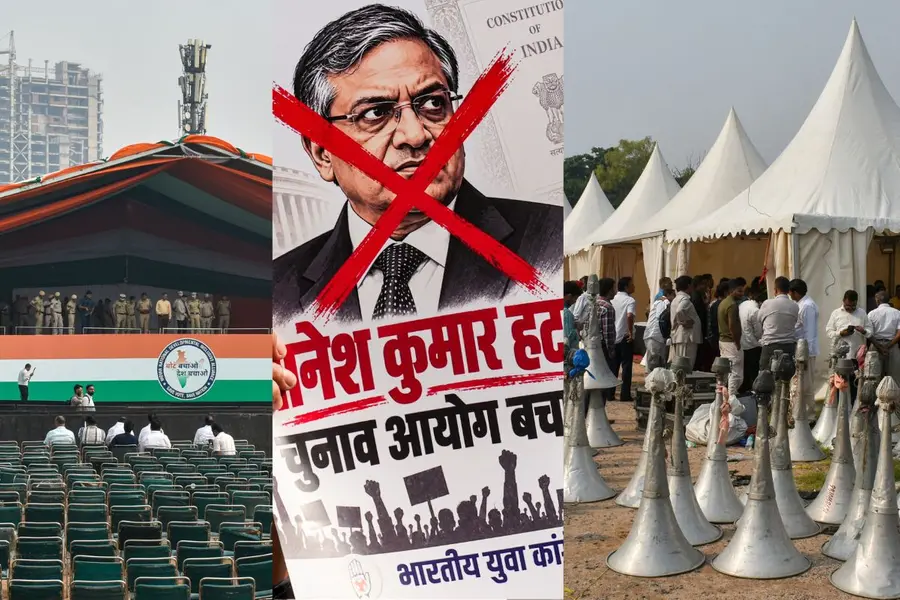
Political temperature across the national capital has reached boiling point ahead of Sunday, 1 November, as the Opposition INDIA bloc prepares for a massive demonstration at Delhi's historic Ramlila Maidan. The mega gathering has been organised under the banner of the 'Vote Bachao, Desh Bachao' campaign. Opposition leaders are converging on Delhi to mount a united show of strength against alleged irregularities in electoral rolls and to demand the immediate resignation of Chief Election Commissioner Gyanesh Kumar.
The primary trigger for the mobilisation is the ongoing Special Intensive Revision (SIR) of voter lists, which Opposition parties claim has resulted in the deletion of millions of legitimate voters. Tensions have escalated rapidly following a series of symbolic protests in Delhi, setting up a major political showdown.
Also Read

At the same time, the ruling Bharatiya Janata Party (BJP) is launching swift counter-programmes, including a nation-wide public campaign and local protest marches in Delhi and neighbouring Haryana. With tens of thousands of activists travelling towards the capital, authorities have thrown a heavy security umbrella across Central Delhi while issuing extensive traffic advisories for residents.
Stage set at Ramlila Maidan as opposition prepares Sunday march
Preparations at Ramlila Maidan have reached final stages after days of round-the-clock work by party workers. A massive tricolour canopy has been erected over the main stage to accommodate senior leaders of the INDIA bloc. A secondary stage has been constructed nearby specifically for representatives of state units and regional alliance partners. Long rows of white canopy tents, metal barricades, and temporary platforms have been set up across the venue, while fleet trucks delivered thousands of chairs to seat incoming supporters.
The schedule for Sunday's event is split into two distinct parts. The day begins with a march titled 'Chalo Dilli', scheduled to kick off at noon from the Minto Road-Connaught Place junction and proceed towards Ramlila Maidan. Top leaders of the INDIA bloc are expected to travel in open-top buses from the residence of Congress President Mallikarjun Kharge to lead the procession to the starting point.
The main rally inside Ramlila Maidan is permitted to run from 10 am until 5 pm. Venue regulations stipulate that no overnight stays will be allowed inside the ground once the event concludes. Organisers have established separate entrance gates and dedicated enclosures for different categories of attendees, including VIP delegation blocks.
To manage the crowds, organisers have been directed by the police to deploy trained party volunteers across the ground. These volunteers are tasked with assisting attendee movement, managing queue discipline, providing drinking water facilities, and maintaining separate toilet facilities arranged for women.
Wide turnout expectations face strict venue capacity limits
A significant gap remains between the attendance figures claimed by political organisers and the official ground capacity assessments made by law enforcement authorities. Leaders of the INDIA bloc have publicly stated that they expect a massive turnout of up to 10 lakh people from across India. However, Delhi Police officials estimate a far smaller overall gathering of around 50,000 people.
Police technical evaluations indicate that Ramlila Maidan can hold between 45,000 and 50,000 people when completely empty. Once the physical infrastructure is taken into account—including seating chairs, media enclosures, security barriers, and designated access walkways—the safe sitting capacity drops to between 30,000 and 40,000 people.
To prevent dangerous overcrowding or potential stampede situations, police plan to keep open spaces inside the ground. Any additional crowds arriving beyond the venue's physical limit will be directed into designated spillover zones marked outside the main perimeter of the ground.
Symbolic mock impeachment of CEC fuels fierce political clash
Sunday's public demonstration follows a high-decibel political event held in the capital on Saturday. Leaders of the INDIA bloc convened a symbolic 'public impeachment' of Chief Election Commissioner Gyanesh Kumar at the residence of Mallikarjun Kharge. The event was structured like a mock Parliament and was presided over by former Lok Sabha Speaker Meira Kumar.
During the proceedings, Kharge moved a formal resolution outlining serious allegations against the electoral body, accusing the Election Commission of facilitating voter roll manipulation and undermining democratic institutions through the SIR exercise. Delivering the closing remarks before the resolution was adopted, Lok Sabha Leader of Opposition Rahul Gandhi issued a stern warning, asserting that the Opposition alliance would not let the Chief Election Commissioner "escape" accountability.
The mock parliamentary exercise sparked an immediate political firestorm between the rival camps. Leaders of the ruling BJP rejected the event as mere "melodrama", maintaining that constitutional heads are protected by strict legal safeguards under the law. Opposition leaders, meanwhile, confirmed that they have also formally submitted petitions on the matter to President Droupadi Murmu and the Supreme Court of India.
Opposition leaders highlight voter deletion claims from the ground
Senior leaders within the alliance have voiced deep frustration over what they call a total breakdown in institutional communication. Speaking after the mock impeachment programme, Rajya Sabha MP and Senior Advocate Kapil Sibal stated that deep public resentment has built up against the central government over the past twelve years due to the lack of parliamentary debate.
Expressing his frustration over closed doors, Kapil Sibal said:
"In Parliament, they refuse to listen; they don't bring up our issues, nor do they allow for any debate or discussion. If we approach Gyanesh Kumar, he just tells us to 'get out.' Nothing happens when we go to the President, and in the courts, no verdicts are delivered—so, where are we supposed to go? For the first time in 12 years, we have finally been heard. People have come to believe that elections can no longer be conducted in this manner. Tomorrow, at Ramlila Maidan, you will see for yourselves the depth of the public's resentment toward this government."
Echoing similar concerns, Jharkhand Mukti Morcha (JMM) MP Mahua Majhi highlighted personal stories of citizens who suffered due to voter roll revisions. She argued that the core duty of the Opposition is to highlight public distress when governance fails.
Outlining specific hardship cases, Mahua Majhi noted:
"If the ruling party chooses to turn a deaf ear while the public suffers—for instance, with the names of millions of people being struck off from voter records—then we must speak up. Today, we heard accounts: one person was declared dead while still alive; another, a single mother working to support her daughter, is forced to run from pillar to post between government offices, all while losing out on her daily earnings. We want the central government to pay attention to this and rectify these injustices."
Himachal Pradesh and Jammu Kashmir lead heavy state mobilisations
Regional units of the Congress party have mobilized thousands of cadre members to travel to Delhi for the Sunday demonstration. The heaviest northern state representation comes from Himachal Pradesh, where top state leaders confirmed that around 15,000 party workers are making the journey to the national capital.
Himachal Pradesh Chief Minister Sukhvinder Singh Sukhu stated that the rally is essential to defend core democratic rights won after historic struggles.
Explaining the necessity of the protest, CM Sukhvinder Sukhu said:
"If votes are stolen and a government is formed through vote theft, then this rally is against that. We have the right to protest in a democracy, and we are using that right... If someone is found responsible for this, then the opposition has the right to raise its voice against him. We are exercising that right through this rally."
Deputy Chief Minister Mukesh Agnihotri detailed the logistics arranged for bringing state workers down to Delhi, noting that ministers, MLAs, and local office-bearers are joining the convoy.
Detailing the transportation arrangements, Deputy CM Mukesh Agnihotri stated:
"Congress has mobilised around 15,000 people from Himachal Pradesh. We are expecting that the rally will ultimately demand paper ballot elections... All MLAs and ministers will go to Delhi. We have arranged around 250 buses, and people are also travelling in their own vehicles, tempo travellers and Volvo buses. Himachal Pradesh is preparing on a large scale to make this rally successful."
Agnihotri also recalled past political friction in his state, asserting:
"We are ourselves victims of this. In Himachal Pradesh, they had also attempted Operation Lotus, but we remained alert and did not allow the government to be destabilised."
Former state party chief Pratibha Singh added that young citizens are deeply angered by multiple recent issues, linking voter deletions to previous youth protests over exam leaks. Speaking after paying tribute to former Prime Minister Indira Gandhi on her death anniversary, she asserted that young people are demanding action against Gyanesh Kumar and that workers would fight unitedly under Rahul Gandhi's guidance.
Simultaneously, a massive delegation from Jammu and Kashmir has headed toward Delhi. Ravinder Sharma, chief spokesperson of the Jammu and Kashmir Pradesh Congress Committee (JKPCC), departed for Delhi on Saturday evening alongside party workers from across the Union Territory.
Setting out the mission of the delegation, Ravinder Sharma declared:
"The right to vote freely is the foundation of democracy and any attempt to deprive people of this right undermined the democratic process... The struggle will continue until the concerns over alleged electoral irregularities are addressed."
Youth groups and civil society extend solidarity to opposition rally
The scope of Sunday's mobilisation extends beyond formal political parties to include student unions, youth outfits, women's groups, and civil society organisations. Among the prominent non-aligned groups extending support is the Cockroach Janta Party (CJP), a youth-led organisation founded by activist Abhijeet Dipke.
On Saturday, Dipke met Trinamool Congress (TMC) supremo and West Bengal Chief Minister Mamata Banerjee in Delhi. He thanked her for backing CJP's earlier protests at Jantar Mantar regarding the NEET exam paper leak and for supporting CJP leaders Saurav Das and Ashutosh Ranka during their arrest by Delhi Police.
Clarifying the outfit's stance on the Sunday rally, Abhijeet Dipke explained:
"I just came to say thank you to Didi because the way she supported our first Jantar Mantar movement, she was always so strongly with the youth movement. When Saurav and Ashutosh were arrested by the Delhi Police, even then Didi stood with us very firmly... We support the protest tomorrow, we stand in solidarity, but the Cockroach Janta Party is an independent organisation; it is a neutral platform, and we want to keep it that way... Anybody who will fight against this vote theft, we will support all organisations."
Mamata Banerjee, who is staying in Delhi to attend the Ramlila Maidan rally, praised the young activists for leading early demonstrations against electoral roll revisions.
Welcoming the youth leaders, Mamata Banerjee remarked:
"They have extended their full support for tomorrow's rally, and we have extended all support to them as well. They are the pioneers and the founders of this movement. That we must remember."
Heavy security deployment planned across capital and venue
To maintain law and order, Delhi Police has put in place an extensive multi-layered security grid. More than 4,000 police personnel, backed by multiple companies of the Central Armed Police Forces (CAPF), will guard Ramlila Maidan and the surrounding march routes. Furthermore, the central deployment of 270 CAPF companies across Delhi has been extended for a third time until 16 November to maintain stability amidst ongoing protests.
Security measures at the venue include dividing Ramlila Maidan into 14 administrative security zones. Each zone will be directly supervised by an officer of Assistant Commissioner of Police (ACP) rank, while two sensitive zones will be overseen by Additional Deputy Commissioners of Police (DCP).
Senior police officers, led by Delhi Police Commissioner Anurag Kumar, inspected security arrangements along Minto Road and Ramlila Maidan on Saturday. Surveillance infrastructure includes over 200 CCTV cameras, overhead drone cameras, and body-worn cameras assigned to field officers. A central command control room has been operationalised inside the venue, while anti-riot vehicles remain stationed on standby.
All attendees entering the ground will undergo security screening, including door-frame and hand-held metal detector checks at designated gates. Officials noted that while formal police permission was granted for the static rally at Ramlila Maidan, no official application had been submitted for the proposed procession originating from Minto Road.
Traffic diversions and emergency corridors set for Delhi commuters
Traffic movement across Central and New Delhi will face extensive restrictions on Sunday between 10 am and 5 pm. Around 150 additional traffic police officers have been posted at key junctions to manage vehicular flow.
Specific traffic diversions will be enforced at major intersections, including ITO, Delhi Gate, Rajghat, Ajmeri Gate, and Turkman Gate. Traffic authorities have urged commuters to completely avoid several main arterial roads, including Bahadur Shah Zafar Marg, Jawaharlal Nehru Marg, Minto Road, and Desh Bandhu Gupta Road. However, authorities confirmed that pedestrian movements will not be restricted.
To prevent medical disruption, police have established dedicated green corridors to guarantee uninterrupted passage for emergency ambulances travelling toward LNJP Hospital and GB Pant Hospital. Passengers heading to New Delhi Railway Station have been advised to account for delays and plan journeys well in advance.
Meanwhile, local merchant associations operating in markets around Ramlila Maidan have voiced strong anxiety over the event. Traders expressed deep concern that major traffic jams and road closures during the peak festive Diwali shopping week will severely hurt local business trade.
BJP launches Rohtak march and nation-wide campaign against opposition narrative
The ruling BJP has prepared an immediate nationwide political response to counter the Opposition's accusations regarding the electoral roll revision. BJP National President Nitin Nabin is set to lead a major padyatra (foot march) in Rohtak, Haryana, on Sunday morning.
The foot march forms part of the BJP's newly launched nationwide campaign titled 'Loktantra Bachao, Arajakta Hatao' (Save Democracy, Remove Anarchy). Scheduled to start at 11 am from Chhotu Ram Polytechnic Ground in Rohtak, the march will traverse local areas before culminating at D-Park in Model Town, where Nabin will offer floral tributes at the statue of Mahatma Gandhi.
The campaign aims to take the BJP's stance on the SIR exercise directly to citizens through door-to-door village outreach, countering what it terms false narratives spread by the Opposition. High-level planning meetings were conducted at the BJP national headquarters in New Delhi on Thursday, chaired by Nabin and attended by Union Ministers Piyush Goyal, Kiren Rijiju, Shivraj Singh Chouhan, Bhupender Yadav, Ashwini Vaishnaw, and national general secretaries.
Anti-Sikh riot anniversary sparks sharp BJP counter protests in West Delhi
In Delhi, the BJP has scheduled sharp counter-protests focusing on the historical timing of the Congress rally. Delhi BJP President and Union Minister Harsh Malhotra announced that BJP workers will hold a protest march on Sunday in the Sikh-dominated Hari Nagar area of West Delhi.
The march will be led by Union Minister Hardeep Singh Puri alongside various local Sikh organisations. BJP leaders argued that holding a political rally on 1 November is deeply insensitive, as it coincides with the anniversary of the 1984 anti-Sikh riots that broke out following the assassination of Prime Minister Indira Gandhi on 31 October 1984.
Condemning the choice of date, Union Minister Hardeep Singh Puri stated:
"These mass killings in Delhi continued from November 1 to November 4... Every political leader has a set of advisors. Rahul Gandhi should seriously introspect along with his advisors whether he wants to listen to the demands of the trading community or whatever."
Adding to the criticism, senior Supreme Court advocate H. S. Phoolka, who has represented 1984 riot victims in court, remarked:
"November 1 is not only a black day for the Sikhs but the entire country. They (The Congress) should also observe it as a black day and hang their heads in shame."
Delhi BJP Chief Harsh Malhotra charged that Congress workers massacred thousands of innocent Sikhs between 31 October and 3 November 1984, demanding an apology from the party before attempting to relaunch Rahul Gandhi.
Furthermore, Malhotra pointed out that Delhi's seasonal winter action plan against air pollution takes effect on 1 November, restricting the entry of older, non-BS VI vehicles into the city. He warned that if police enforce environmental checks on older buses carrying rally supporters, Congress leaders might create unnecessary friction by claiming government interference.
With both political camps digging in their heels across multiple venues in Delhi and Haryana, Sunday is set to mark a defining moment in India's ongoing political debate over electoral integrity.
Published: 31 Oct 2026, 11:14 pm IST


Disclaimer: Kindly avoid objectionable, derogatory, unlawful and lewd comments, while responding to reports. Such comments are punishable under cyber laws. Please keep away from personal attacks. The opinions expressed here are the personal opinions of readers and not that of Mathrubhumi.