
Delhi woke up to very poor air quality with AQI at 337, fog at India Gate and ITO, and pollution forecasted to remain hazardous until November 28.
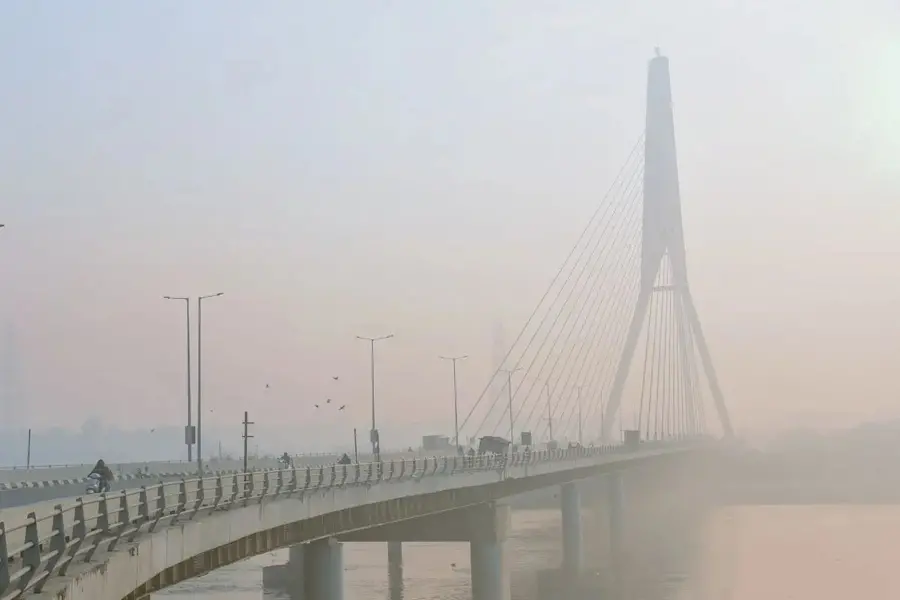
New Delhi: A thin layer of fog settled over India Gate and Kartavya Path at around 7:40 am, reducing visibility, while the Air Quality Index (AQI) hovered around 350, indicating very poor air quality.
Early in the morning, smog enveloped the ITO foot overbridge, with AQI once again close to 350, highlighting hazardous conditions for commuters in central Delhi.
According to data from the Central Pollution Control Board (CPCB), Delhi’s overall AQI stood at 337, showing only a marginal improvement from Tuesday. Of the 39 monitoring stations across the capital, 34 recorded ‘very poor’ air quality, while five reported pollution levels in the ‘poor’ category.
Several high-intensity pollution hotspots continued to struggle under toxic air early in the day. At 7 am, Rohini recorded an AQI of 376, while other severely affected areas included Delhi Technological University (367), Anand Vihar (364), Bawana (382), Ashok Vihar (364), Burari (347), Alipur (344), ITO (360) and Dwarka (361) — all within the very poor range.
In the wider National Capital Region (NCR), Noida also faced persistently polluted air, with major stations reporting very poor levels: Sector 1 (355), Sector 62 (304), Sector 116 (372) and Sector 125 (399), the latter approaching the ‘severe’ category.
The Air Quality Early Warning System for Delhi forecasts that pollution will remain in the very poor range from November 26 to 28, with conditions likely fluctuating between severe and very poor over the following six days.
Historical data from the CPCB shows that Delhi’s average AQI has remained consistently hazardous over the past week: 391 (Sunday), 370 (Saturday), 374 (Friday), 391 (Thursday), 392 (Wednesday), 374 (Tuesday) and 351 (Monday).
Meanwhile, the India Meteorological Department (IMD) has predicted moderate fog on Wednesday, with temperatures expected to range between a maximum of 24°C and a minimum of 9°C.
IANS
Published: 26 Nov 2025, 10:08 am IST
Disclaimer: Kindly avoid objectionable, derogatory, unlawful and lewd comments, while responding to reports. Such comments are punishable under cyber laws. Please keep away from personal attacks. The opinions expressed here are the personal opinions of readers and not that of Mathrubhumi.
