
Delhi’s air pollution almost doubled in November even as stubble-burning influence fell sharply, pushing the capital to the fourth spot among India’s most polluted cities.
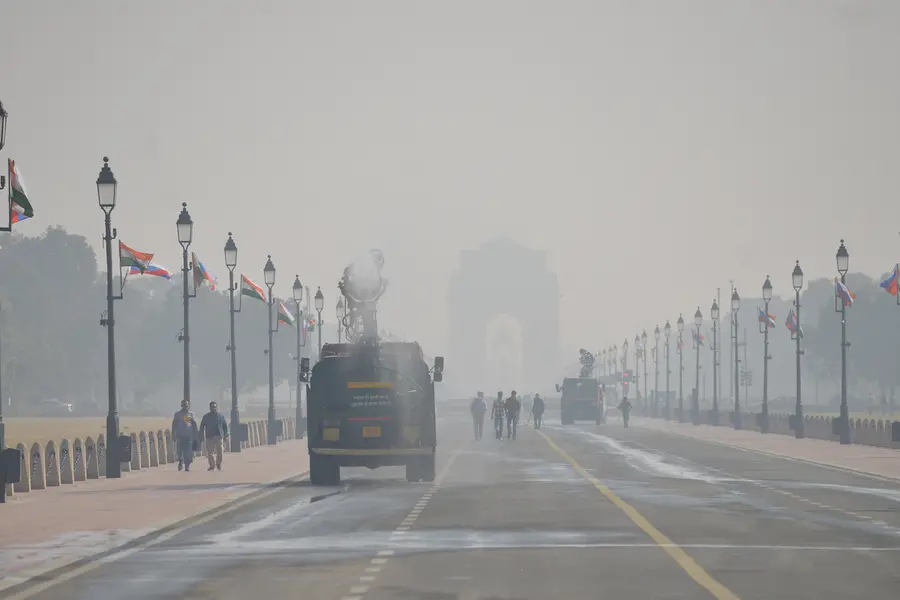
New Delhi: Delhi’s air pollution nearly doubled in November, pushing the national capital to the fourth spot among India’s most polluted cities, according to a new report by the Centre for Research on Energy and Clean Air (CREA).
Despite a notable drop in the impact of stubble burning compared with last year, Delhi’s air quality remained in the ‘severe’ and ‘very poor’ categories for most of the month, underscoring the worsening pollution crisis. The city recorded an average PM2.5 concentration of 215 micrograms per cubic metre, almost twice the October average of 107 micrograms per cubic metre.
Delhi logged 23 ‘very poor’ air quality days, six ‘severe’ days and one ‘poor’ day during November. The contribution of stubble burning averaged just 7 per cent this year, a steep decline from 20 per cent in November 2024, though peak contribution touched 22 per cent.
National air quality deteriorates; 9 of 10 most polluted cities record higher levels
The CREA analysis stated that air pollution across India worsened sharply in November, with nine of the ten most polluted cities reporting higher PM2.5 levels than last year. Ghaziabad emerged as the most polluted city in India, recording an average PM2.5 level of 224 micrograms per cubic metre and breaching the National Ambient Air Quality Standards (NAAQS) every day of the month. It logged 19 ‘very poor’ days, 10 ‘severe’ days and one ‘poor’ day.
Other cities on the top 10 most polluted list included Noida, Bahadurgarh, Delhi, Hapur, Greater Noida, Baghpat, Sonipat, Meerut and Rohtak. Uttar Pradesh accounted for six of these cities, followed by Haryana with three and Delhi with one. Only Bahadurgarh recorded a day within the safe NAAQS threshold.
NCR and northern states continue to struggle
Several other NCR cities, Charkhi Dadri, Bulandshahr, Jind, Muzaffarnagar, Gurgaon, Khurja, Bhiwani, Karnal, Yamunanagar and Faridabad, also remained above safe pollution levels throughout November.
According to CREA Analyst Manoj Kumar, the data shows that year-round pollution sources, not stubble burning, are the main drivers of India’s ongoing air crisis.
“Despite a significant reduction in stubble-burning influence, 20 out of 29 NCR cities recorded higher pollution levels than the previous year. This clearly indicates that the dominant drivers are year-round sources such as transport, industry, power plants and other combustion sources. Without sector-specific emission cuts, cities will continue to breach standards,” he said.
States with the highest and lowest air pollution in November
At the state level:
Rajasthan recorded the highest number of polluted cities, with 23 of 34 exceeding NAAQS limits. Haryana followed with 22 of 25 cities above safe limits. Uttar Pradesh reported 14 of 20 cities breaching standards. High pollution levels were also recorded in Madhya Pradesh, Odisha and Punjab.
In contrast, Shillong in Meghalaya ranked as the cleanest city in India, with an average PM2.5 concentration of just 7 micrograms per cubic metre. The ten cleanest cities list featured six from Karnataka, and one each from Meghalaya, Sikkim, Tamil Nadu and Kerala.
India’s Compliance with Pollution Benchmarks Remains Alarming
Of 255 cities with adequate monitoring data, only 114 complied with the national NAAQS limit of 60 micrograms per cubic metre.
Compliance with the World Health Organisation’s daily safe limit of 15 micrograms per cubic metre remained extremely low, with only two cities nationwide meeting the benchmark.
PTI inputs
Published: 07 Dec 2025, 07:23 am IST
Disclaimer: Kindly avoid objectionable, derogatory, unlawful and lewd comments, while responding to reports. Such comments are punishable under cyber laws. Please keep away from personal attacks. The opinions expressed here are the personal opinions of readers and not that of Mathrubhumi.
