
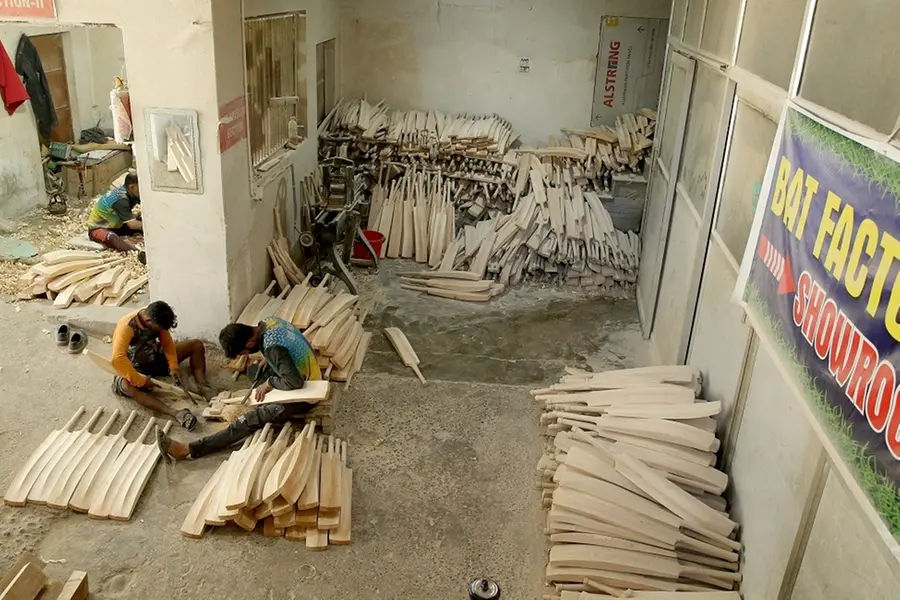
Srinagar: For fans across the world, cricket is a beloved sport that brings rapturous joy and waves of cheers in stadiums. However, in Anantnag, Kulgam, and Sangam, cricket serves as a vital source of revenue, as these areas are primarily responsible for cricket bat production in India. The soil of these villages nurtures willow trees (Salix alba caerulea) that flourish impressively, second only to London, which is considered the home of willow trees used in bat making. Cricket bats are crafted from both English and Kashmir willows. In this region, extensive willow tree growth occurs in Kashmir and Pakistan-administered Kashmir (PoK).
After tourism and agriculture, cricket bat production stands as one of Kashmir's main revenue sources. This ₹700 crore small-scale industry provides 150,000 employment opportunities.
The Indian Biography of Cricket Bats
Following London, Kashmir is a significant hub for cricket bat manufacturing, with both English and Kashmir willows being used. The British brought the game of cricket to India, which laid the foundation for bat manufacturing in the country. The history of bat production in India dates back to the 19th century, coinciding with the onset of British imperialism. A businessman named Allah Bakhsh established the first cricket bat manufacturing unit in the Halmulla area of Bijbehara, now in Anantnag district, initially producing bats for British armed forces officials. Along with the bats, the technology for crafting quality bats was introduced to India.

Over time, the cricket bat manufacturing industry expanded to Anantnag and Pulwama districts. Today, bats made from both English and Kashmiri willow trees are popular among players. The Indian cricket team members regularly use bats made in India, and after the Afghanistan team started using Kashmiri bats, demand for Indian bats surged in the global market.
Currently, there are about 400 bat manufacturing units in Kashmir, producing 3 million bats annually. In 2021 alone, 35,000 bats were exported from Kashmir, rising to 135,000 in 2022 and 196,000 in 2023.
Lightweight, Superior Stroke
Why are willow trees used to make cricket bats? "Willow trees are thin yet strong. They do not crack under compression during the manufacturing process and can return to their original shape," explains Sameer, owner of Goodluck Sports Industries, a bat manufacturing factory in Sangam. Sameer's factory has also set up an arrangement to showcase the various stages of bat making to researchers and tourists.
The first step in bat production involves sourcing suitable trees from willow-growing regions. The trees are purchased from farmers, cut into required sizes, and then left to dry for a year. Unlike in London, where tree growth follows seasonal patterns, this is not the case in Kashmir, according to Sameer.
How Cricket Bats Are Made
It takes 20 to 25 years for a willow plant to mature into a usable tree. A single tree can yield four bats. Once dried, the wood is cut into V-shapes and shaped using both machines and handcrafting. “We manufacture bats for major brands that place bulk orders. We produce different types of bats, including tennis bat and hard ball bats. Prices vary according to quality, with tennis ball bats costing between ₹500 and ₹1,200 and hard ball bats ranging from ₹1,500 to ₹4,000. However, when these bats are branded with international logos, their prices can soar significantly,” Sameer notes.
In addition to supplying domestic brands, the factory also exports according to large brand orders. Bats are handed over to companies with their logos and price tags affixed. The cricket bat manufacturing business is largely family-run, sustaining livelihoods since the British era.
Willow trees belong to farmers, and the standard practice is to purchase them after agreeing on a price. However, cultivation has significantly declined as farmers now opt for more profitable crops with quicker returns.
“Moreover, the government provides little support for this small-scale industry. The reduction in willow cultivation has made sourcing trees increasingly difficult. Additionally, a 12% GST on bats complicates matters further. The inconsistent electricity supply is another challenge, as reliable power is essential for maintaining production quality,” Sameer adds.
Fall of Wickets
Sameer and his colleagues express concern that the cricket bat manufacturing industry in Kashmir is facing a crisis due to various challenges. These issues were also discussed during the recent assembly elections. The industry is suffering from a shortage of quality willow trees, which directly affects bat quality. The reliance on low-quality wood is damaging the reputation of Kashmiri cricket bats.
For the past 30 years, no new willow trees have been planted on government land, leading to a significant decrease in available wood. Instead, poplar trees, which are used for products like pencils and plywood, have become prevalent. While willow trees take 20 to 25 years to mature, poplar trees can be harvested in just 7 to 12 years, offering faster returns.
Despite legal prohibitions, smuggling of Kashmiri willow trees persists. Although strict regulations were enacted in 2021, enforcement remains weak. Climate change, over-harvesting, and the abandonment of traditional farming practices have exacerbated the decline of willow trees. Representatives from the bat industry have repeatedly approached the government for solutions, but to no avail.
Nonetheless, industry officials report some governmental recognition of the crisis regarding willow trees. Efforts have been made to restrict the export of willow wood to bolster cricket bat manufacturing. The best willow-growing regions have been identified by the Faculty of Forestry of Kashmir under government direction, particularly in Pulwama and Shalebagh.
Manufacturers also highlight that they are not receiving prices that reflect their production costs. Despite the high market prices of bats, producers in Kashmir earn only ₹500 to ₹3,000. They remain hopeful for positive changes from the new government which would assume power in the coming days.
Published: 11 Oct 2024, 11:45 am IST
ABOUT THE AUTHOR
Related Topics
Disclaimer: Kindly avoid objectionable, derogatory, unlawful and lewd comments, while responding to reports. Such comments are punishable under cyber laws. Please keep away from personal attacks. The opinions expressed here are the personal opinions of readers and not that of Mathrubhumi.