
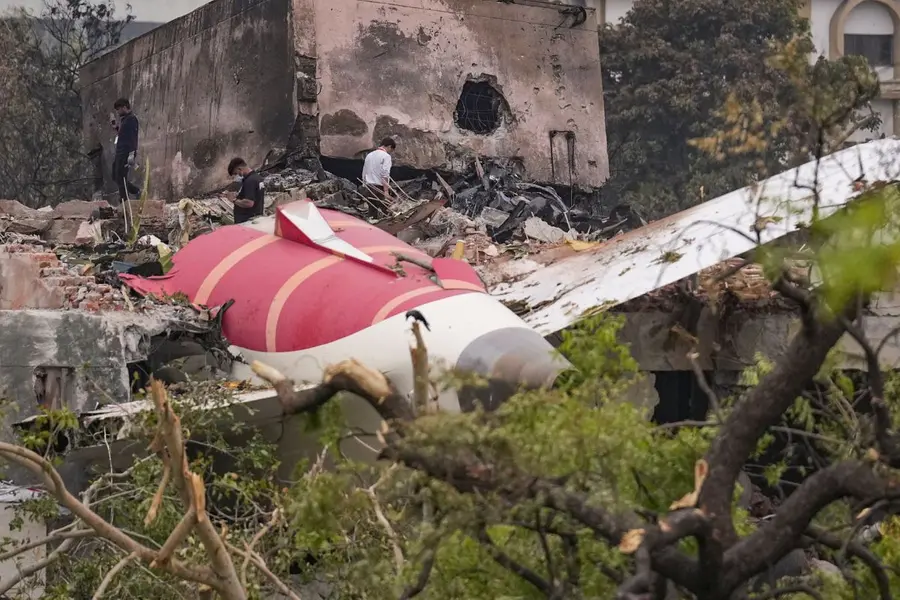
“Every incident in this industry is an immediate reminder of what can go wrong,” a sobering quote shared by Airbus CEO Guillaume Faury in the wake of the recent Air India Boeing 787 crash, highlights the urgency for aviation stakeholders to address not just root causes but the systemic lapses that allow them to recur. As investigators piece together what led to the rare widebody disaster near Ahmedabad, early expert analysis offers a sharper lens on where attention must now turn.
A Tragedy of Unanswered Questions
The Air India Express Flight AI171 crash marking the first major incident involving a Boeing 787 in Indian skies has stunned the aviation community due to its unusual profile. The aircraft, considered state-of-the-art in global aviation, failed to gain sufficient altitude post take off, colliding with buildings and causing widespread devastation.
Ashwani Sharma, Chairperson of the Aeronautical Society of India (Bombay Branch), outlines three primary causes that could explain the failure: loss of lift, loss of thrust, or sabotage. “Pictures of the wreckage confirm that both leading and trailing edge flaps were correctly configured so loss of lift appears unlikely,” he asserts. “However, only flight data from the Digital Flight Data Recorder (DFDR) can confirm if both engines were functioning normally. Sabotage remains an open question and for the first time in India’s aviation history, the Union Home Secretary is chairing the inquiry, with a senior Intelligence Bureau official also involved. That shows how seriously this angle is being considered.”
Structural Integrity and Boeing’s Shadow
Recent whistleblower revelations regarding the Boeing 787’s fuselage join defects have stirred global concern. However, Sharma rules out structural fatigue in this case: “The aircraft was intact before impact. There were no signs of in-flight breakup, which usually indicates fuselage failure.”
Prem Garg, CEO of regional airline IndiaOne Air, agrees: “Structural fatigue is a valid concern given Boeing’s documented lapses, but it seems a distant possibility in this incident. The aircraft did not disintegrate mid-air, which supports that view.”
Still, the legacy of Boeing's manufacturing quality challenges cannot be ignored. Garg adds that "a detailed probe into historical Airworthiness Directives (ADs) on the 787 particularly those related to wiring chafing, fuel systems, and avionics should be integral to the investigation."
The Maintenance Question
With supply chain constraints placing tremendous pressure on airline maintenance schedules, could oversight have played a role? Garg points to an uncomfortable truth: “Globally, the rapid scale-up in aviation has outpaced MRO infrastructure. Deferred maintenance due to part shortages or lean scheduling can allow latent defects to slip through.” Sharma, while cautious, admits this scenario can’t yet be ruled out: “Improper or delayed rectification of known snags could be a factor. But we'll need the inquiry report for confirmation.”
Automation, Human Factors, and the Unseen Strain on Pilots
Both experts agree that pilot response under stress, especially in highly automated aircraft like the 787 may be critical to understanding what went wrong. “The 787 uses a Primary Flight Control Function with three modes—Normal, Secondary, and Direct,” Garg explains. “There’s often hesitation in overriding automation. That lag can be fatal.”
Sharma further underscores the issue of pilot fatigue, which has become a simmering crisis in Indian aviation. “DGCA has drafted revised FDTL (Flight Duty Time Limitations) rules, but airlines have resisted implementation due to cost concerns. This tragedy could be a tipping point. Pilot alertness is non-negotiable in emergencies.”
External Triggers: weather, runway, and unseen Variables
Could weather or runway conditions have triggered or compounded the crash? Not likely, Sharma feels. “Weather was not a major factor at the time of take-off, though a technical issue could have been made worse under suboptimal conditions.” Garg, however, points out: “Environmental stressors like heat, low runway friction, or crosswinds can degrade take-off performance, especially during edge-of-envelope operations. These must be part of the simulation and analysis.”
The Road Ahead: What Must Happen Now
Both experts demand transparency and urgency. Sharma emphasizes that “the inquiry committee report must be made public and all recommendations implemented. Too often, cost considerations prevent real change.”
Garg agrees, advocating for a layered, multi-agency approach:
•DGCA must publish interim findings and escalate AD audits.
•Manufacturers like Boeing must re-evaluate their quality pipelines.
•Airlines should conduct fleet-wide safety reviews, especially for newer aircraft with high automation.
•And the AAIB must lead a transparent, technically rigorous investigation.
Conclusion
As India and the world awaits clarity on what caused one of the safest aircraft in operation to fall from the sky, the early insights from Sharma and Garg suggest it was not one failure but a tragic convergence of possible mechanical, human, and operational breakdowns.
What emerges is a call to action for the aviation ecosystem to re-evaluate not just aircraft, but the systems, pressures, and decisions that keep them flying.
Published: 16 Jun 2025, 07:01 pm IST
Related Topics
Disclaimer: Kindly avoid objectionable, derogatory, unlawful and lewd comments, while responding to reports. Such comments are punishable under cyber laws. Please keep away from personal attacks. The opinions expressed here are the personal opinions of readers and not that of Mathrubhumi.
