
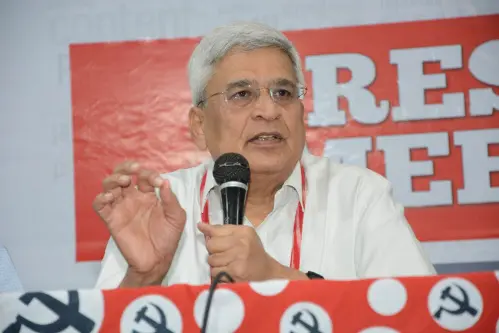
New Delhi: The Communist Party of India (Marxist) [CPM] included a note on "neo-fascist characteristics" in its draft resolution to explain the term to party members, as it was being used for the first time in a party document, senior leader Prakash Karat has said.
In an interview with PTI, Karat stated that while the CPM has not concluded that the Indian State under Prime Minister Narendra Modi is "fascist or neo-fascist," it warned that if these characteristics are not curbed, the country could evolve into a "full-fledged neo-fascist state or government."
Congress, CPI(ML) react to CPM stance
Last month, the CPM issued a note to its state units on the draft political resolution for the upcoming party congress. The document clarified that while the Modi government displayed "neo-fascist characteristics," the party did not classify it as a neo-fascist regime.
This stance drew sharp criticism from the Kerala unit of the Congress, which accused the CPM of adopting a "soft stance" towards the BJP and attempting to remain in the "good books" of the Sangh Parivar.
The CPI(ML) Liberation also criticised the CPM, warning that "downplaying the fascist danger" at this stage could weaken the electoral and moral standing of the communist movement.
Need for clarification on ‘neo-fascism’
Karat defended the need for the explanatory note, stating that the Central Committee wanted to define ‘neo-fascism’ for party members ahead of discussions at the party congress in Madurai next month.
"This is the first time we have used the term in our party resolutions or documents. When we discussed it in the Central Committee, it was felt that we must explain what we mean by ‘neo-fascism’ for the benefit of our party members," he said.
Karat, who took over as CPM Interim Coordinator last year following the demise of general secretary Sitaram Yechury, noted that the explanatory note aimed to highlight differences between "neo-fascism" and classical fascism, particularly in the Indian context.
With PTI inputs
"The first time we used the term 'fascistic' in reference to the present government was during the 2018 party congress in Hyderabad, where we noted ‘emerging fascistic trends.’ Now, after 10 years of the BJP government, we said these characteristics are no longer emerging but are being displayed," he added.
CPM calls for broader resistance against BJP-RSS agenda
The CPM leader stressed the need for a multi-faceted struggle against these "neo-fascist characteristics."
"The BJP and RSS operate not just in the political and electoral sphere but across religious, social, and cultural domains. We need interventions in these areas as well. Strengthening our presence in the cultural sphere is particularly important," he said.
Karat urged broader progressive forces to join in countering ideological influences in the cultural space, which he described as the site of the "real ideological struggle."
Party congress to discuss resolution in April
The CPM will formally debate the draft political resolution at its upcoming party congress in Madurai, Tamil Nadu, in April. The document, adopted at a Central Committee meeting in Kolkata between January 17-19, highlights the growing conflict between the "Hindutva-corporate regime" and secular-democratic forces.
"The push to impose a reactionary Hindutva agenda and the authoritarian drive to suppress opposition and democracy displays neo-fascist characteristics," the resolution states.
However, the CPM reiterated in its note that recognising these characteristics does not equate to declaring the Modi government or the Indian State as "neo-fascist."
Published: 17 Mar 2025, 07:35 am IST
Related Topics
Disclaimer: Kindly avoid objectionable, derogatory, unlawful and lewd comments, while responding to reports. Such comments are punishable under cyber laws. Please keep away from personal attacks. The opinions expressed here are the personal opinions of readers and not that of Mathrubhumi.
