
Rumours surrounding possible changes at Kolkata’s iconic College Street book district have raised concerns among readers and traders, while protests over hawker eviction drives at Jagaddal and Bandel stations have intensified political debate.
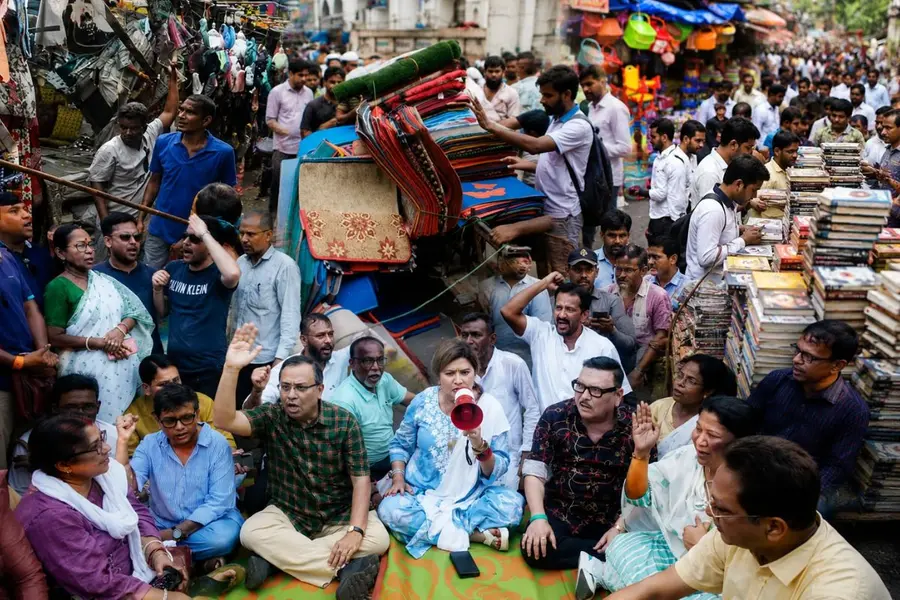
Kolkata: Rumours surrounding the possible eviction of Kolkata’s iconic College Street book district have triggered concern among book lovers, students and traders, even as recent hawker removal drives in parts of West Bengal have led to protests and political opposition.
While social media discussions have intensified over the future of the historic book market, no official announcement has been made regarding any administrative action against the area.
College Street has for decades remained one of Bengal’s most significant cultural and academic landmarks.
The stretch, often referred to as the city’s ‘book paradise’, is known for its rows of bookstores and pavement stalls selling everything from school textbooks and competitive examination material to rare literary works and research editions.
The concern around College Street appears to have gained momentum after administrative action against hawkers and alleged illegal structures in several locations across the state.
Discussions around urban planning, public movement, and encroachment issues have increasingly put older commercial zones under attention.
No official decision on College Street yet
Despite the growing speculation online, there has been no formal government announcement or final administrative decision concerning the eviction of shops or book stalls at College Street.
Observers have stressed the importance of separating social media narratives from official administrative measures.
The uncertainty, however, has generated concern among readers and local businesses who view the area as much more than a marketplace.
For many generations of students, College Street has been closely linked to academic life and affordable access to books. It also continues to attract researchers, collectors and book enthusiasts searching for rare publications.
In previous years, discussions involving infrastructure, road usage and civic planning in and around College Street have surfaced periodically.
However, any administrative action involving a place with such historical and cultural significance would likely involve wider considerations beyond civic management alone.
Jagaddal and Bandel protests add to concerns
The debate over College Street comes at a time when hawker eviction drives in other areas have already triggered public protests.
At the Jagaddal Railway Station on the busy Sealdah–Ranaghat main line, tensions erupted after railway authorities reportedly began removing and demolishing several hawker stalls.
According to local sources, allegations emerged that traders were being removed without prior notice or assurances regarding rehabilitation.
Workers and leaders of CPI(M) reached the station and protested against the move. The party argued that no eviction process should take place without rehabilitation arrangements for affected hawkers.
Railway Police and local police personnel were later deployed to maintain order in the area.
A similar protest unfolded at the Bandel Station where CITU organised demonstrations against alleged hawker eviction measures.
CPI(M) leader Minakshi Mukherjee attended the gathering. Protesters claimed police prevented a planned rally from proceeding, resulting in heated exchanges between demonstrators and law enforcement personnel.
Police maintained that the rally did not have the required permissions and was stopped in the interest of maintaining law and order.
While concerns over College Street continue to spread online, there remains no indication of any immediate official action.
For now, attention is likely to remain focused on administrative announcements rather than speculation, particularly given the emotional, cultural, and economic significance attached to Kolkata’s historic book district.
Published: 26 May 2026, 09:10 am IST
Disclaimer: Kindly avoid objectionable, derogatory, unlawful and lewd comments, while responding to reports. Such comments are punishable under cyber laws. Please keep away from personal attacks. The opinions expressed here are the personal opinions of readers and not that of Mathrubhumi.
