
Congress slams BJP as social media criticises CCP visit amid reports of Chinese construction in Shaksgam Valley.
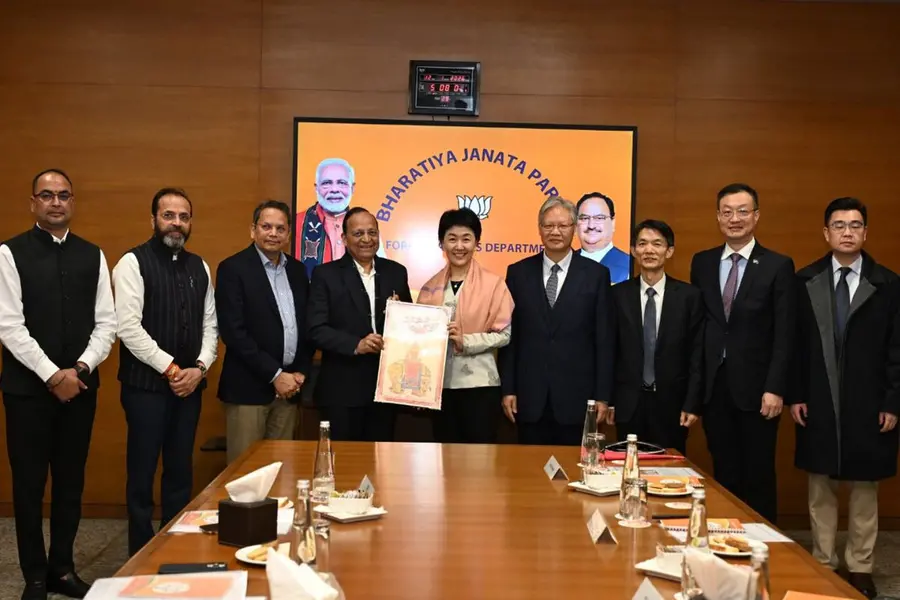
A fresh political storm has erupted after reports of Chinese construction activity in the Shaksgam Valley of Jammu and Kashmir surfaced alongside a meeting between the BJP and a delegation of the Chinese Communist Party (CCP) in New Delhi. The timing has sparked a sharp political row, with the Congress accusing the ruling party of sending mixed signals to Beijing at a sensitive moment in India-China relations.
What triggered the controversy
The controversy centres on the Shaksgam Valley, a strategically important region in Jammu and Kashmir that India claims as its own. Reports of construction activity linked to the China-Pakistan Economic Corridor (CPEC) in the area have renewed concerns, given India’s long-standing opposition to the project.
These developments have come amid ongoing border tensions with China, shaped by past clashes in Ladakh and continuing concerns over Chinese activity in Arunachal Pradesh.
Why Congress is attacking the BJP
Congress leader Supriya Shrinate has questioned how China can assert territorial claims and pursue infrastructure projects while senior BJP leaders hold talks with the CCP in Delhi. She has flagged the optics of such engagement, citing China’s support for Pakistan, the Galwan clash in which Indian soldiers were killed, and unresolved disputes along the Line of Actual Control.
The Congress has also accused the BJP of avoiding scrutiny, asking why the CCP delegation’s visit has not been widely questioned and arguing that it raises serious national security concerns.
BJP’s defence: ‘routine party dialogue’
The BJP has confirmed that a CCP delegation visited its headquarters, describing the interaction as part of routine inter-party communication. Party leaders have said the discussions focused on maintaining dialogue between political parties, and pointed out that China’s ambassador to India was present during the meeting.
India’s official position on Shaksgam Valley
Separately, the Indian government has reiterated that the Shaksgam Valley is Indian territory. New Delhi has restated that it does not recognise the 1963 China-Pakistan boundary agreement under which Pakistan ceded the area to China, and has again opposed CPEC projects passing through territory it says is under illegal occupation.
Old accusations resurface
The latest political clash has revived memories of a 2020 BJP attack on the Congress over a 2008 memorandum of understanding it signed with the CCP. At the time, the BJP accused the Congress of undermining national interest. With roles now reversed, India-China relations have once again become a domestic political battleground.
Social media backlash over CPC visit
The visit of a Chinese Communist Party delegation to Delhi, including a call on RSS general secretary Dattatreya Hosabale, has triggered sharp criticism and outrage on social media. Many users have questioned the BJP-led government’s approach towards China.
A dominant sentiment across posts is that the meeting is “unacceptable” at a time when China continues to assert territorial claims over India. Users argue that hosting a CPC delegation sends the wrong signal while Chinese troops are accused of building infrastructure in disputed areas and dismissing India’s objections. Several posts portray the interaction as a sign of “submission” rather than diplomacy.
Some commentators frame the engagement as part of a broader pattern of appeasement despite repeated Chinese aggression. They point to what they describe as India’s quiet retreat from demands to restore the pre-2020 status quo in eastern Ladakh, alongside China’s more assertive posture on regions such as the Shaksgam Valley.
References to the Galwan clash recur frequently, with users highlighting the loss of Indian soldiers and China’s alleged support to Pakistan, including during Operation Sindoor. These reactions question the optics of political and ideological engagement with the CPC so soon after such confrontations, calling it insensitive to national security concerns.
A section of users has gone further, alleging that meetings between the CPC, BJP leaders and the RSS point to behind-the-scenes coordination that undermines India’s national interest.
Published: 13 Jan 2026, 03:44 pm IST
Disclaimer: Kindly avoid objectionable, derogatory, unlawful and lewd comments, while responding to reports. Such comments are punishable under cyber laws. Please keep away from personal attacks. The opinions expressed here are the personal opinions of readers and not that of Mathrubhumi.
