
Blood Moon enchants India during rare total lunar eclipse visible from Ladakh to Tamil Nadu.
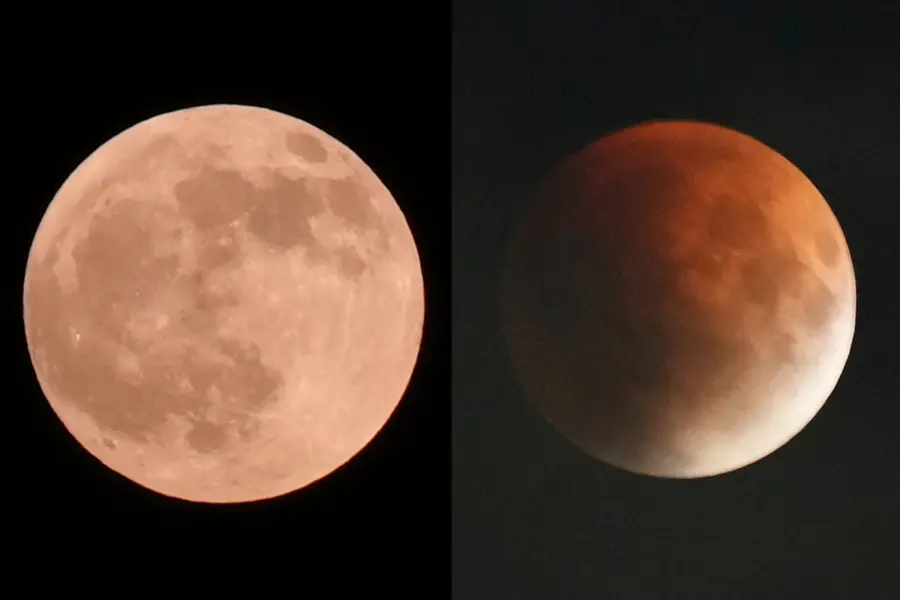
Bengaluru/New Delhi: From Ladakh to Tamil Nadu, skywatchers turned their eyes skyward on Sunday night to witness a rare ‘Blood Moon’ during a total lunar eclipse.
The earth’s shadow began covering the lunar disc at 9:57 pm, as the moon played hide-and-seek behind cloudy skies, with monsoon rains lashing several parts of the country. The shadow fully covered the moon at 11:01 pm, turning it a coppery red for a spectacular display.
“The Moon will be fully eclipsed from 11.01 pm to 12.23 am for a duration of 82 minutes,” said Niruj Mohan Ramanujam, Head of Science, Communication, Public Outreach and Education (SCOPE) Section, Indian Institute of Astrophysics.
“The moon appears red during lunar eclipses because the only sunlight reaching it is reflected and scattered through the earth’s atmosphere,” explained B S Shylaja, former director at Jawaharlal Nehru Planetarium.
The Indian Institute of Astrophysics focused telescopes at its campuses in Bengaluru, Ladakh, and Tamil Nadu on the moon, streaming the eclipse live on social media platforms. While cloudy skies obscured the view in several areas, enthusiasts worldwide compensated with live streams.
Sunday’s total lunar eclipse was visible across Asia and parts of Europe, Africa, and western Australia. It was the longest total lunar eclipse observable from India since 2022, and the first since July 27, 2018, to be seen from all parts of the country. The next total lunar eclipse visible from India will occur on December 31, 2028.
Understanding lunar eclipses
Eclipses do not happen every full or new moon because the moon’s orbit is inclined about five degrees to the earth’s orbit around the Sun. A lunar eclipse occurs when the earth comes between the sun and the moon, casting its shadow on the lunar surface. Unlike solar eclipses, total lunar eclipses are safe to observe with the naked eye, binoculars, or a telescope.
Debunking superstitions
In India, lunar eclipses are often linked to superstitions, with people avoiding food, water, or physical activity, fearing “poisoning or negative energy”. Some even believe eclipses are harmful to pregnant women and their unborn children.
Astronomers, however, emphasise that lunar eclipses are merely shadow phenomena, understood long before Aryabhata’s time, and “pose no risk to people or animals”. Ramanujam noted, “It is perfectly safe to go outside and eat while enjoying this magnificent celestial spectacle.”
Published: 07 Sept 2025, 11:05 pm IST
Related Topics
Disclaimer: Kindly avoid objectionable, derogatory, unlawful and lewd comments, while responding to reports. Such comments are punishable under cyber laws. Please keep away from personal attacks. The opinions expressed here are the personal opinions of readers and not that of Mathrubhumi.
