
The BJP is sharpening its strategy in West Bengal by focusing on Chief Minister Mamata Banerjee’s Bhabanipur constituency, with Leader of the Opposition Suvendu Adhikari intensifying political activity and positioning himself as a potential challenger ahead of the 2026 Assembly elections.
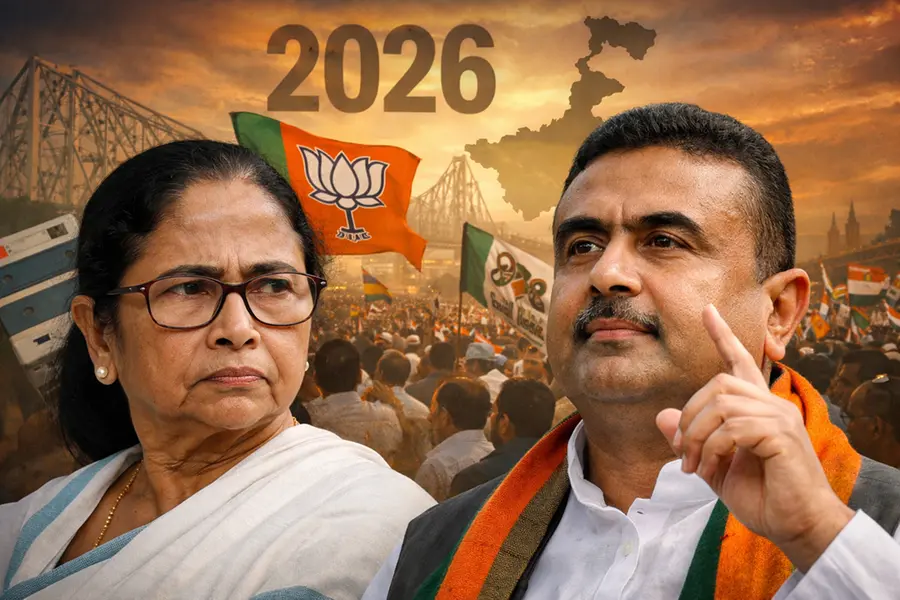
The BJP has begun shaping a political narrative in West Bengal aimed at placing Chief Minister Mamata Banerjee under constant pressure in her own Bhabanipur Assembly constituency, a strategy the party hopes will also restrict her ability to campaign aggressively across the state ahead of the next elections.
Senior BJP leaders say the groundwork for this plan started several months ago when the party asked Leader of the Opposition Suvendu Adhikari to intensify political activity in Bhabanipur, a constituency long regarded as a stronghold of the Trinamool Congress.
Adhikari, who defeated Mamata Banerjee in the high-profile Nandigram contest during the 2021 Assembly elections, has since been making frequent visits to the south Kolkata constituency, holding meetings, rallies, and outreach programmes.
Even during Holi celebrations this week, when many political leaders remained engaged in events within their own constituencies, Adhikari travelled from Nandigram to Bhabanipur to participate in a rally. During the event, he sang devotional songs and spoke about Hindu unity while addressing supporters in the constituency represented by the chief minister.
Sources in the BJP indicate that the increased activity could be part of preparations for a direct contest between Adhikari and Banerjee in Bhabanipur in the next Assembly election. Adhikari himself has repeatedly said he is ready to take on the chief minister again if the party nominates him.
According to BJP insiders, the strategy has two key objectives. The first is to ensure that Banerjee spends significant time protecting her own constituency during the election campaign, thereby limiting her ability to travel extensively across the state to mobilise support for Trinamool candidates.
The second objective is to build a perception among voters and party workers that even Banerjee’s own seat is no longer politically secure. Party leaders believe such a narrative could affect the morale of Trinamool workers across West Bengal during the campaign.
The strategy has gained traction after recent electoral data and revisions to the voter rolls in Bhabanipur.
Nearly 47,000 voters, close to one-fourth of the constituency’s electorate, have reportedly been removed from the voter list, while the names of more than 14,000 electors are currently marked as “under adjudication.”
As of February 28, the total number of registered voters in Bhabanipur stands at 1,59,201. Banerjee has publicly raised concerns about the changes in the electoral rolls and has repeatedly met party workers in the constituency to strengthen organisational networks there.
At a Holi-Dol celebration earlier this week, the chief minister alleged that voters were being removed from the electoral list in Bhabanipur. She also asserted that she remained confident of winning the seat regardless of the circumstances.
“My Bhabanipur constituency is small, yet thousands of voters are being excluded. Even then, I will win from Bhabanipur,” she said while addressing supporters.
Political observers note that the BJP significantly narrowed the gap with the Trinamool Congress in the Bhabanipur segment during the 2024 Lok Sabha election in the Kolkata Dakshin constituency.
While Trinamool retained the lead in the segment, the margin was reduced to just over 8,000 votes, and the BJP secured leads in five of the eight municipal wards that make up the Assembly constituency.
This shift has intensified the political focus on Bhabanipur, which had earlier seen comfortable victories for Trinamool candidates.
In the 2021 Assembly election, Trinamool leader Sovandeb Chattopadhyay won the seat by 28,719 votes. Later that year, Banerjee contested the Bhabanipur bypoll and won with a margin of 58,835 votes.
Political analysts say the BJP’s strategy could help maintain sustained pressure on Banerjee, though translating that into an electoral victory may be difficult unless the party significantly expands its support among urban voters in Kolkata. Trinamool leaders, however, dismiss the BJP’s efforts as unrealistic.
Party spokesperson Arup Chakraborty argued that the opposition was misreading the electoral numbers and insisted that Bhabanipur would remain firmly in Trinamool’s control.
According to him, voter turnout in the 2021 Assembly election was only about 57 percent, suggesting that a large number of registered voters did not participate in the poll due to migration or other reasons.
Trinamool leaders also claim they are taking legal and organisational steps to ensure that voters whose names are currently under scrutiny are reinstated on the electoral rolls.
Despite the war of words, Bhabanipur is rapidly emerging as one of the most closely watched constituencies in West Bengal’s political landscape, with both sides treating it as a symbolic and strategic battleground ahead of the next Assembly election.
Published: 04 Mar 2026, 03:24 pm IST
Related Topics
Disclaimer: Kindly avoid objectionable, derogatory, unlawful and lewd comments, while responding to reports. Such comments are punishable under cyber laws. Please keep away from personal attacks. The opinions expressed here are the personal opinions of readers and not that of Mathrubhumi.
