
The election contest in Kerala is ultimately about the kind of state Indians deserve: one that prioritises welfare over spectacle, inclusion over division, and dignity over neglect, says Tejashwi Yadav
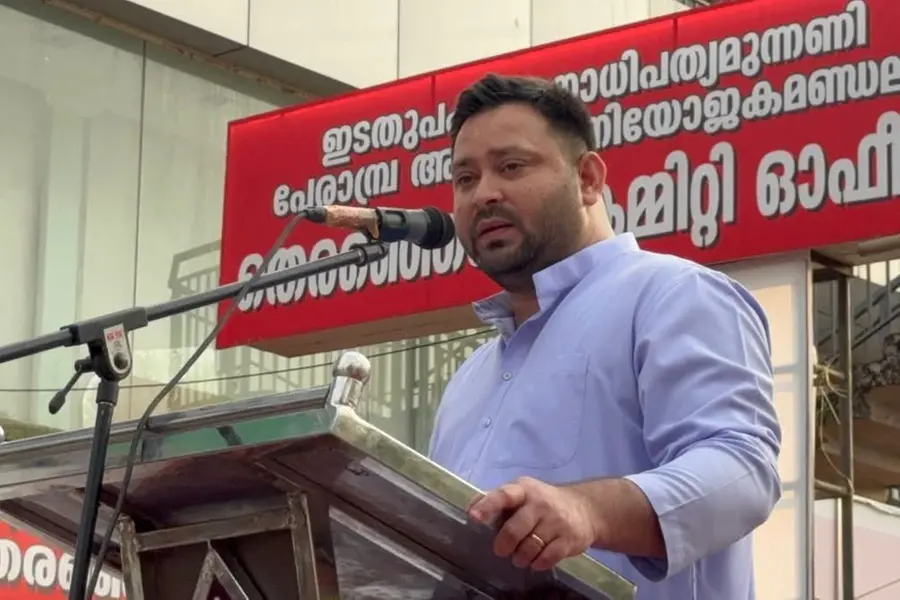
My arrival in Keralam ahead of the April 9 Assembly elections is not merely a matter of campaign scheduling. It carries a deeper political significance. As I travelled across constituencies to campaign for the Left Democratic Front (LDF), it was, of course, an act of electoral solidarity, but equally, it was a recognition of what this southern coastal state represents in India’s political imagination.
Keralam has long occupied a distinctive place in India’s public life. Its achievements in health, education, and social development are not incidental -- they are the result of sustained political choices. For decades, policymakers and political actors across the country have invoked Keralam as a living example of what a committed, welfare-oriented state can deliver.
On the campaign trail, when I spoke of its robust public health system and its enduring commitment to education, it was not to flatter one state at the expense of another. It was to make a larger political argument: that governance rooted in social justice and public investment produces tangible, measurable outcomes.
For a state like Bihar, where structural challenges remain deep and persistent, such comparisons are neither rhetorical excess nor political provocation -- they are necessary. They compel us to ask difficult questions about priorities, about political will, and about the kind of development we seek to pursue. If Keralam can achieve these outcomes, why should others not aspire to the same?
There is also a human geography to this political moment that cannot be ignored. Hundreds of thousands of workers from Bihar and other Hindi-speaking states have made Keralam their home. They are not outsiders; they are contributors to its economy and participants in its social fabric. The relationship is not extractive as it is mutually reinforcing. Their labour sustains sectors of Keralam’s economy, while the state, in turn, has offered them a degree of dignity and security that remains elusive in many parts of the country.
Our party’s presence in this election is, therefore, not symbolic. It signals that the concerns of these workers matter -- that a political formation rooted in the Hindi heartland recognises their aspirations as inseparable from the broader project of defending a state that has consistently upheld the rights and dignity of working people.
This alliance with the Left Democratic Front is also significant because it cuts across conventional national alignments. It is anchored not in expediency, but in shared ideological commitments. We believe, as the LDF does, that Keralam must remain free from the corrosive effects of communal politics. Safeguarding this ethos is not a peripheral concern; it is central to why we are here.
Under the leadership of Pinarayi Vijayan, the LDF government is seeking what would be an unprecedented third consecutive term. This election, therefore, is not merely about continuity; it is about the direction of governance itself.
Together, we seek to reinforce the LDF’s larger argument -- that this contest is ultimately about the kind of state Indians deserve: one that prioritises welfare over spectacle, inclusion over division, and dignity over neglect.
(The author is Leader of Opposition in the Bihar Legislative Assembly and leader of the Rashtriya Janata Dal)
Published: 04 Apr 2026, 11:11 pm IST
Related Topics
Disclaimer: Kindly avoid objectionable, derogatory, unlawful and lewd comments, while responding to reports. Such comments are punishable under cyber laws. Please keep away from personal attacks. The opinions expressed here are the personal opinions of readers and not that of Mathrubhumi.
