
Vande Bharat has successfully completed a loaded 180 kmph high-speed trial, but empty-condition, coupler force and emergency braking tests remain before RDSO can issue final speed certification.
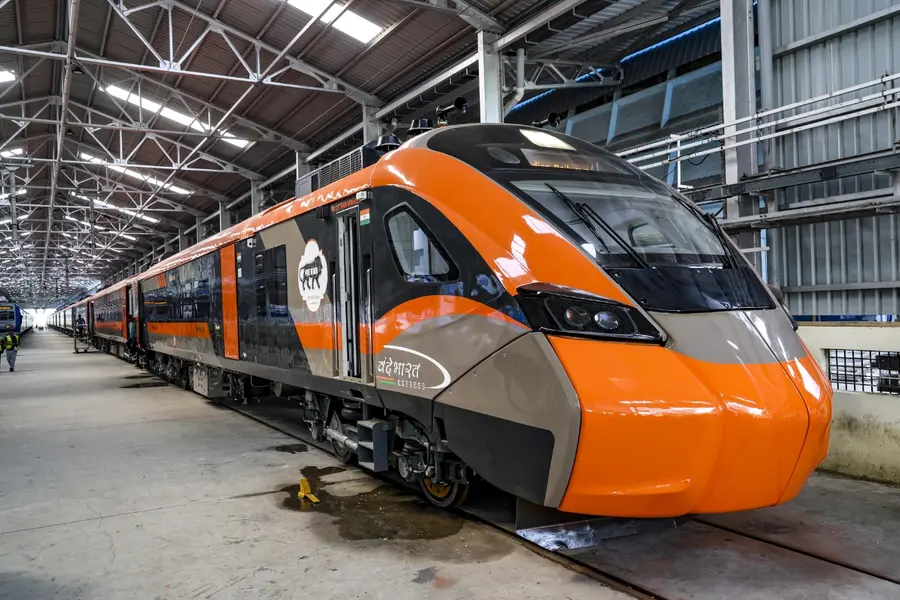
A Vande Bharat Chair Car rake has successfully completed a loaded high-speed trial at 180 kmph, marking an important stage in its testing programme, but the train is yet to receive final speed certification.
The Vande Bharat Chair Car rake, manufactured at the Modern Coach Factory in Raebareli, underwent a loaded oscillation trial on the Nagda-Kota-Sawai Madhopur section of West Central Railway.
Also Read

The trial was conducted at speeds of up to 180 kmph to assess the rake’s riding quality, stability and performance under high-speed operating conditions.
The rake was tested in a loaded condition with its air springs inflated. The successful trial means the train has cleared one important part of the high-speed testing programme.
However, the 180 kmph run does not by itself mean that the train has been cleared to operate commercially at that speed.
What tests are still pending?
The Research Designs and Standards Organisation (RDSO) has several more tests to complete before issuing the final speed certificate.
These include:
- Empty-condition oscillation trial
- Coupler force trial
- Emergency braking trial
The empty-condition test will assess the rake's behaviour without the specified passenger load.
The coupler force trial will examine the longitudinal forces generated between coaches during acceleration and braking. Both tensile and compressive forces acting on the couplers will be assessed.
Emergency braking test will check stopping performance
The rake will also undergo an emergency braking trial at speeds of up to 160 kmph.
Engineers will assess the train's braking response and stopping distance after emergency brakes are applied. The results will form part of the overall technical assessment before certification.
Why does the 180 kmph trial matter?
High-speed trials are conducted to establish whether a train can maintain safe and stable performance at elevated speeds.
The oscillation trial examines factors such as riding behaviour and stability. The coupler test checks forces between coaches, while the braking trial focuses on the train's ability to slow down safely under emergency conditions.
Together, these tests provide RDSO with the data required to assess whether the rake meets the prescribed technical parameters.
RDSO will decide on final certification
Data recorded during the testing programme will be examined by the RDSO testing directorate.
The final speed certificate will be issued only after the prescribed tests have been completed and the results have been found satisfactory against the required technical standards.
This means the successful 180 kmph loaded trial is an important milestone, but final speed approval is still pending.
What technology does the rake use?
The Vande Bharat Chair Car rake is equipped with a Siemens propulsion system and a Knorr-Bremse braking system.
It also features Kavach, India's Automatic Train Protection system, along with CCTV cameras, emergency alarm push buttons and passenger-to-crew communication systems.
Other safety features include fire detection and suppression systems, centrally controlled automatic plug doors and sealed gangways between coaches.
Passenger-focused features
The rake includes ergonomically designed seats and upgraded Executive Class seating.
It also has air-conditioning with a UV-C-based air disinfection system and facilities designed for passengers with disabilities.
The train uses regenerative braking, allowing some of the energy generated during braking to be fed back into the electrical system.
The next stage will involve completing the remaining high-speed trials and analysing the recorded data.
Only after the empty-condition oscillation, coupler force and emergency braking tests are completed will RDSO evaluate the complete testing programme.
If the results meet the prescribed technical requirements, the rake can receive its final speed certificate.
The 180 kmph trial demonstrates that the rake has been tested at the target speed under a loaded condition, but testing at a particular speed and receiving operational certification are separate stages.
The remaining trials are designed to examine different aspects of high-speed operation, including stability, forces between coaches and emergency braking performance.
Therefore, the immediate development is the successful completion of the 180 kmph loaded trial, while the broader question of whether and where the train can operate at that speed depends on the outcome of the remaining tests and RDSO's technical evaluation.
Published: 24 Sept 2026, 09:21 am IST
ABOUT THE AUTHOR
Disclaimer: Kindly avoid objectionable, derogatory, unlawful and lewd comments, while responding to reports. Such comments are punishable under cyber laws. Please keep away from personal attacks. The opinions expressed here are the personal opinions of readers and not that of Mathrubhumi.