
Assam BJP's razor-sharp social media offensive, blending influencers, AI visuals, and infiltration fears, successfully painted Congress as a "party of minorities," securing a hat-trick victory with 82 seats amid polarised polls.
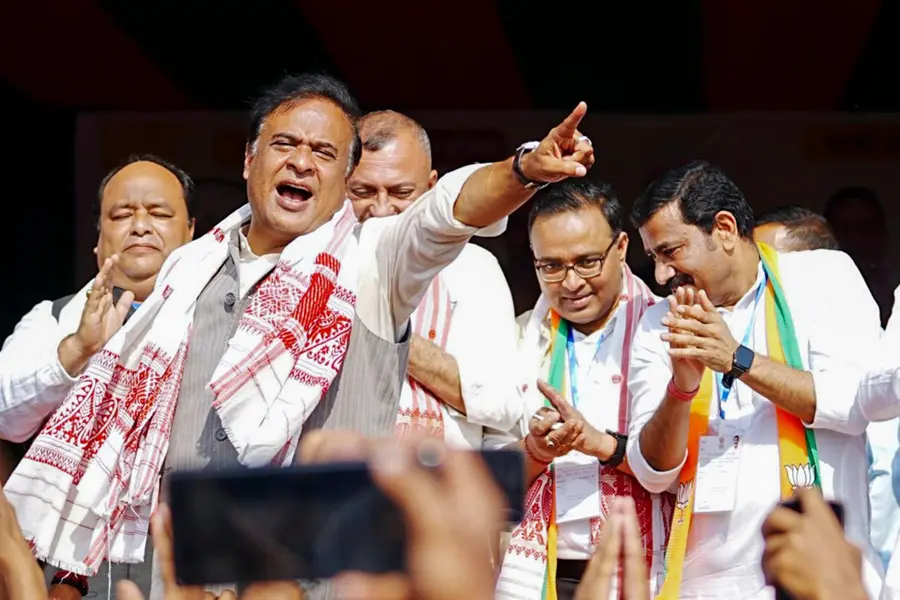
In Assam, the Bharatiya Janata Party has pulled off one of its most effective political messaging campaigns in recent years, using a mix of ground rhetoric, identity politics and a tightly coordinated digital push to project the Congress as a "party of minorities" and consolidate its own support base, according to political observers and campaign material seen during the polls.
The strategy appears to have paid rich dividends in the May 4 election results, where the BJP returned to power in Assam with a decisive mandate, winning 82 seats on its own in the 126-member Assembly and crossing the majority mark comfortably with its allies.
Also Read: Assam Election 2026 vote share: BJP rises to 37.91%, Congress stable, AIUDF declines sharply
The Congress, by contrast, was reduced to 19 seats, with its ally Raijor Dal winning two, marking a steep decline from its earlier standing in the state.
The result gave the BJP a hat-trick of victories in Assam and underlined how deeply polarised the campaign had become. Political analysts say the contest was increasingly fought on identity lines, with the BJP's messaging aimed at convincing Hindu voters that the party was the only force capable of protecting Assam’s cultural and demographic identity.
Chief Minister Himanta Biswa Sarma was at the centre of that effort. His campaign repeatedly highlighted what he described as threats posed by infiltrators and Bengali-speaking Muslims of alleged Bangladeshi origin, using the term "Miya Muslims" -- widely regarded as pejorative -- to sharpen the narrative around migration, identity and belonging. That messaging resonated in several Hindu-majority pockets, where Congress faced a near-total wipeout.
Also Read: How did Gaurav Gogoi lose Jorhat despite a recent Lok Sabha win?
The Congress, in contrast, struggled to broaden its appeal beyond Muslim-dominated constituencies. Official results showed that most of its victories came from areas with a substantial Muslim population, leaving the party with just one Hindu MLA among its 19 legislators. The pattern reinforced the BJP's argument that Congress had been reduced to a minority-focused political outfit.
Digital campaign amplified message
A major factor behind this political framing was the Assam BJP's social media operation, which campaign watchers describe as unusually aggressive and highly coordinated. The party's digital team, along with influencers and anonymous or "shadow" handles, circulated posts and videos that sought to present Congress leader Gaurav Gogoi as "Paaijan" — a term used online to suggest closeness to Pakistan.
The campaign gained further momentum after the state government's Special Investigation Team reportedly uncovered alleged links between Pakistani entities and Gogoi's wife, adding fuel to the BJP’s online offensive. While the allegations themselves became a subject of political dispute, they were quickly folded into the wider digital narrative that Congress leaders were sympathetic to minority appeasement and external influence.
Also Read: How Himanta Biswa Sarma engineered BJP's third Assam election win
The BJP's online ecosystem also revived older clips and posts to label Congress leaders and commentators as "Miya lovers", while some content used AI-generated visuals to mock what it portrayed as the opposition's minority outreach. Party-linked accounts repeatedly highlighted Congress meetings, rallies and community outreach programmes aimed at Muslim voters as evidence of a deliberate vote-bank strategy.
According to the chief minister, more than 10,000 Bangladeshi Muslim Facebook accounts were used in Congress-linked digital campaigning ahead of the elections. The claim, whether independently verified or not, was widely circulated by BJP supporters online and further strengthened the party’s core message that Congress had become too dependent on minority votes.
Voter polarisation deepened
The BJP's digital strategy did not operate in isolation. It worked in tandem with a broader political message built around Assamese identity, cultural protection and fears of demographic change.
By linking Congress to religious minority consolidation and portraying itself as the defender of the indigenous population, the BJP managed to sharpen voter polarisation and turn the election into a referendum on identity as much as governance.
Many of the social media posts that circulated during the campaign featured short video clips, some allegedly from Pakistan, praising Gogoi or referring to him as "Paaijan". These posts were widely shared on Facebook and Instagram and helped reinforce the BJP’s narrative in online spaces where political messaging can spread rapidly and shape perceptions beyond traditional campaign venues.
For the BJP, the outcome validated a long-term strategy that combined on-ground organisation, digital targeting and a carefully cultivated identity discourse. For Congress, the result exposed the limits of its coalition-building efforts in a state where questions of migration, religion and ethnic identity continue to dominate political imagination.
The Assam verdict now stands as another example of how political parties are increasingly using social media not just to communicate messages, but to define opponents, frame identities and shape the terms of electoral debate. In this case, the BJP's digital machine appears to have succeeded in turning Congress's outreach to minorities into a liability rather than an advantage.
Published: 05 May 2026, 06:26 pm IST
Disclaimer: Kindly avoid objectionable, derogatory, unlawful and lewd comments, while responding to reports. Such comments are punishable under cyber laws. Please keep away from personal attacks. The opinions expressed here are the personal opinions of readers and not that of Mathrubhumi.
