
With Vijay’s TVK short of a clear majority in Tamil Nadu, the actor-turned-politician faces multiple routes to power. Beyond the arithmetic, the larger story is clear: Tamil Nadu has entered unfamiliar territory.
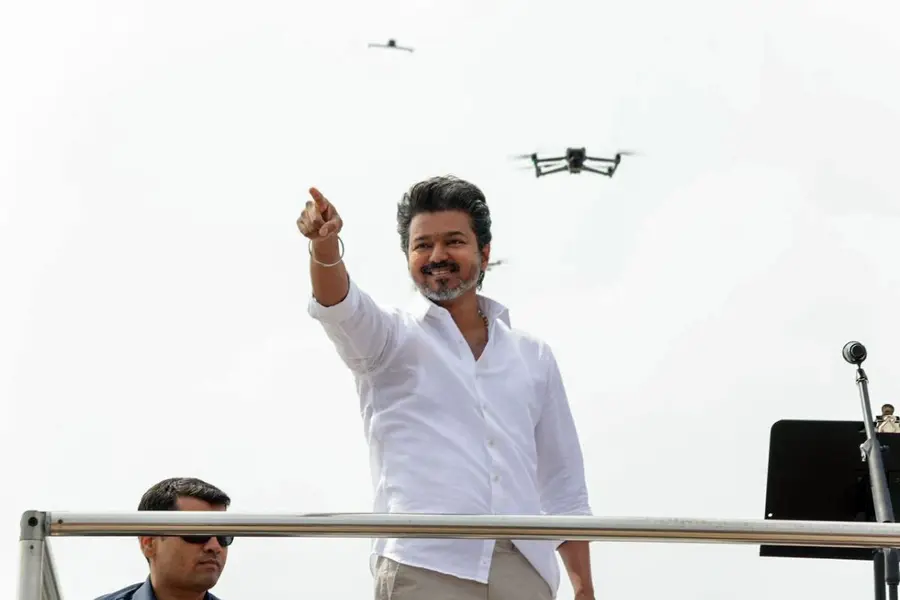
Tamil cinema star-turned-politician Vijay and his Tamilaga Vettri Kazhagam (TVK) have detonated Tamil Nadu's political status quo, but the immediate question now is not just about their stunning debut -- it is about what comes next. With TVK leading the race but still projected to fall short of the 118-seat majority mark in the 234-member Assembly, the state is staring at complex coalition arithmetic and unprecedented negotiations.
By 6.20 pm, Election Commission trends showed TVK at 108 seats, ahead of the Dravida Munnetra Kazhagam (DMK) with 75 seats and the All India Anna Dravida Munnetra Kazhagam (AIADMK) with 51 seats. In a state habituated to clear Dravidian majorities, the 2026 result has opened up a spectrum of scenarios for government formation, with Vijay at the centre of each.
Below are the five (arguably six) most plausible routes for Vijay to become chief minister.
Scenario 1: TVK–AIADMK coalition, with BJP still in the room
The most immediate and arithmetically comfortable option is a formal coalition between TVK and AIADMK. The idea is not new. Before the polls, AIADMK courted TVK for a pre-poll tie-up, but talks collapsed when Vijay’s camp reportedly demanded more than half of Tamil Nadu's 234 seats and insisted on projecting him as the chief ministerial face. The numbers -- and the political mood -- have since flipped.
Also Read: 5 big reasons why Tamil Nadu chose Vijay as its new 'Nayagan'
Now, with TVK clearly ahead and AIADMK pushed into third place, the incentive structure has changed. A TVK–AIADMK coalition would immediately cross the majority mark, offer stability, and create a formidable anti-DMK bloc. But it comes with a crucial complication: the presence of the BJP, AIADMK's current national ally and an organisation Vijay has described as his "ideological enemy".
For now, this is the "straightforward numbers, messy optics" option.
Scenario 2: TVK–AIADMK tie-up, but only if AIADMK dumps the BJP
A more politically coherent variant of the above is a TVK–AIADMK arrangement contingent on AIADMK exiting the BJP-led National Democratic Alliance (NDA). This would allow Vijay to retain his anti-BJP stance while still tapping into AIADMK’s base and organisation.
Vijay has gone out of his way to frame the BJP as his ideological opposite, accusing it of being inimical to Tamil interests. He has also alleged an "underground dealing" between DMK and BJP, claiming that Chief Minister MK Stalin would "fall at the feet of PM Modi" after defeat to escape corruption cases.
Also Read: Vijay's MGR move! TVK surge triggers 1977-style upset as DMK, AIADMK struggle
His friction with the saffron party is not just rhetorical. After the Karur stampede last year, which killed over 40 people, BJP leaders attacked Vijay aggressively. His upcoming film Jana Nayagan battled censor hurdles, and its leak -- reportedly causing losses of nearly ₹70 crore -- has only deepened his distrust.
For Vijay to partner with AIADMK while keeping his credibility intact, he is likely to demand that the Dravidian party snap ties with the BJP. This would be a "cleaner" coalition in ideological terms and could be presented to voters as a Tamil-centric front free of Delhi's influence. But it is also a big ask. The BJP invested considerable effort in reuniting AIADMK's factions, and a break with the NDA would carry national repercussions. Whether AIADMK is willing to pay that price remains uncertain -- and could be the single biggest obstacle to this scenario.
Scenario 3: TVK as minority government, propped up by smaller dravidian and regional parties
If Vijay wants to preserve TVK's "clean break" image from both major Dravidian houses, he has a third option: form a TVK-led minority government backed by smaller parties from across the spectrum, without formally aligning with either DMK or AIADMK.
Here, parties such as Pattali Makkal Katchi (PMK), Viduthalai Chiruthaigal Katchi (VCK), Premalatha Vijayakant's Desiya Murpokku Dravida Kazhagam (DMDK) and other regional outfits like AMMK/MNM-type splinters could become crucial players. The PMK, led by Dr Anbumani Ramadoss, is especially significant. Politically, it may find it easier to switch from the NDA to a TVK-led front, given the absence of irreconcilable ideological differences with Vijay's party.
This configuration would allow Vijay to become chief minister without being overshadowed by an older, larger ally. He would retain his outsider, anti-corruption persona, while stitching together a workable majority through issue-based support. The trade-off: such a government would be inherently more fragile, with multiple small partners capable of exerting pressure or extracting concessions.
Scenario 4: TVK government with outside support from the Congress
A fourth route runs through the Congress. In the run-up to the polls, reports suggested that at least three senior Congress leaders had explored breaking away from the DMK-led alliance to back Vijay. Post-result, the state Congress has already sent feelers to the Jana Nayagan star, and Vijay's father has publicly suggested that TVK is prepared to "share power" with the party.
Also Read: Vijay TVK manifesto explained: Welfare promises behind Tamil Nadu election surge
In the outgoing Assembly, the Congress was a junior ally in the DMK government but held no ministerial berths. A post-poll realignment where the Congress offers outside support to a TVK minority government -- or joins it with limited portfolios -- would give Vijay a majority without forcing him into the embrace of either DMK or AIADMK. It would also give the Congress a renewed relevance in Tamil Nadu, where it has long struggled to recover independent ground.
This option lets Vijay sidestep both Dravidian majors while keeping the BJP at arm’s length, aligning instead with a national party that is not electorally dominant in the state. It is politically less toxic than a direct deal with DMK and organisationally less suffocating than a junior role under AIADMK.
Scenario 5: TVK-led rainbow coalition of small parties, with AIADMK or Congress providing quiet outside support
A fifth, more intricate possibility is a layered arrangement: TVK formally partners with a clutch of smaller parties (PMK, DMDK, VCK, Left, IUML, CPI, CPI-M and others with a handful of seats), reaches close to the majority mark, and then secures outside support -- or selective abstention during key votes – from either AIADMK or the Congress.
In this design, TVK would preserve its image as a party that has not entered a "grand bargain" with either Dravidian giant. The supporting party could claim it is merely ensuring stability and preventing President's Rule, without joining the government. This would be coalition politics done through calibrated distancing rather than formal power-sharing, and it could appeal to parties wary of being seen as opportunistic.
The risk here is complexity: multi-level understandings are harder to manage, especially for a debutant party with no prior experience in coalition management. But it may be attractive if Vijay wants maximum autonomy while avoiding the political cost of a direct embrace of either big rival.
Scenario 6 (least likely): TVK backs a DMK government from outside
On paper, there is a sixth scenario: TVK, having branded DMK as its "political enemy" and BJP as its "ideological enemy", could still offer issue-based outside support to a weakened DMK in the name of stability, without joining the government. This would be the most counterintuitive outcome, given the vitriolic attacks Vijay has launched against the DMK during the campaign.
He has accused the Stalin-led party of deep corruption and even alleged secret understandings with the BJP. Given this rhetoric, a public partnership would severely damage TVK's credibility. Yet, in hung Assemblies, politics can produce strange bedfellows, particularly if there is pressure to avoid a return to the polls.
For now, this remains the least plausible scenario. But its very existence in the realm of speculation underscores just how fluid Tamil Nadu’s political landscape has become.
Whether Vijay chooses the relative safety of a big-tent coalition, the ideological clarity of a BJP-free alliance, or the riskier path of a minority government backed by smaller players will determine not just who occupies Fort St George, but also what kind of politics Tamil Nadu practices in the post-2026 era.
Published: 04 May 2026, 06:27 pm IST
Disclaimer: Kindly avoid objectionable, derogatory, unlawful and lewd comments, while responding to reports. Such comments are punishable under cyber laws. Please keep away from personal attacks. The opinions expressed here are the personal opinions of readers and not that of Mathrubhumi.
