
By day, Aadesh Khambra was a charming, smooth-talking tailor in Mandideep who could gauge a man’s measurements at a single glance. By night, he transformed into the "Highway Reaper" -- a cold-blooded serial killer who turned India’s trucking routes into a decade-long slaughterhouse
If you walked into ‘Z’dex Tailors’ in the smog-choked industrial hub of Mandideep, just a stone's throw from Bhopal, you’d meet a guy who seemed to have it all figured out. Aadesh Khambra. Clean-cut, sharp-dressed, and radiating the kind of smooth, easygoing charm that makes a stranger feel like an old friend. He had a gift, they said. He could look at a person and immediately size up a man's measurements at a single glance.
By day, he was the neighbourhood tailor, snipping fabric and running a sewing machine for a modest handful of rupees. But when the sun dipped below the horizon and the interstate highways turned into ribbons of pitch-black asphalt, the mild-mannered tailor shed his skin. He became the Highway Reaper—a cold-blooded phantom who turned India’s trucking routes into a decade-long slaughterhouse. Thirty-three truck drivers and cleaners walked into his trap over a span of 11 years. None of them lived to tell the tale.
The Genesis: From introvert child to highway predator
Every villain has a genesis story. The dark roots of Khambra's transformation can be traced back to a deeply troubled childhood and destructive external influences.
Born into a community whose families migrated from Pakistan in the 1940s, Khambra grew up under the iron fist of his father, Gulab Khambra, a retired Indian Army subedar. Gulab didn't believe in affection; he believed in the belt. He thrashed young Aadesh systematically, turning an introverted, bright kid into a pressure cooker of resentment. Local whispers claim that when the old man finally died in 2014, it wasn't old age that punched his ticket, but a lethal dose of poison slipped into his food by his own son, who allegedly buried him out in a bog.
When Khambra would be arrested later, he told the police that his devolution into a "violent man" was because of a lack of parental affection; claiming he was an introvert child whose father didn't love him and "no one cared for me".
Though he was a bright student who topped his class at the local government school before dropping out after the tenth standard, Khambra struggled to cope with financial limitations and household constraints.
He opened unsuccessful tailoring shops in Bhandara and Nagpur, frequently clashing with locals. His tailoring business brought in a modest monthly income of ₹15,000 to ₹20,000, but it was insufficient to fuel Khambra's desires for the "good life" -- which included expensive clothes, fine liquor, a mistress in Gwalior, and another paramour elsewhere.
To fund his lifestyle, he completely stopped supporting his family financially, forcing his wife and children into gruelling cottage work making disposable paper plates at home.
Imagine you have an uncle who is a serial killer who has murdered 70 people. Would that scare you and make you live life on the righteous path OR would it inspire you to emulate this ignominious achievement?
Aadesh had no choice but to follow the latter. And this was triggered by a distant relative; a truck driver named Sandesh Khambra, who "brainwashed" him into entering the lucrative world of highway robbery in 2007.
Crime was in the Khambra DNA. And Aadesh was ready to perfect the family business.
Khambra claimed his very first victims alongside Sandesh in 2007, leaving a truck driver and a cleaner dead on a national highway.
Between 2007 and his capture, Khambra built an expansive empire of blood along interstate highways. He is accused of murdering 33 to 34 truckers and helpers across a vast geographic expanse that covered Madhya Pradesh, Maharashtra, Chhattisgarh, Odisha, Uttar Pradesh, Bihar, Jharkhand, and Rajasthan.
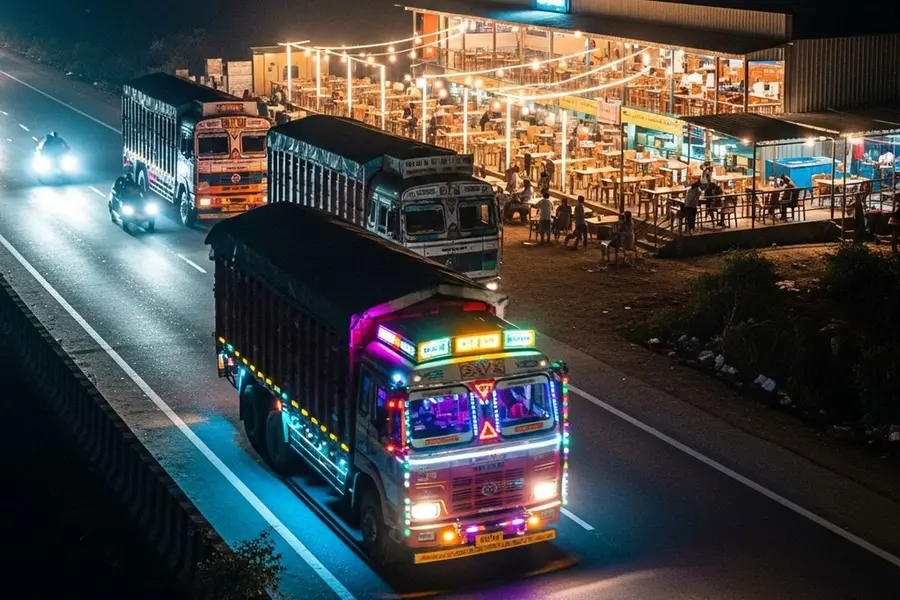
Khambra’s hunting grounds were the dimly lit, diesel-fumed dhabas -- the roadside eateries where exhausted long-haul truck drivers pulled over to grab a hot meal and catch a few winks. Khambra would stroll in, slide onto a bench, and unleash his lethal weapon: a silver tongue.
Khambra treated murder strictly as a profitable business venture. He specifically targeted large, commercial transport trucks containing more than ten wheels, as these vehicles carried the most valuable payloads to rob. Furthermore, his gang showed a stark preference for Tata trucks due to their exceptionally high resale value on the black market. Over more than a decade, Khambra operated on "tours" that kept him away from his home for 20 to 22 days a month, systematically erasing human lives to liquidate stolen cargo through a massive network of black-market intermediaries, buyers, and corrupt traders.
The Highway Trap: "Mind if I charge my phone?"
Khambra formulated an execution strategy that was as simple as it was devastatingly effective, relying heavily on his affable nature and the inherent vulnerabilities of highway transit.
He would frequent roadside eateries (dhabas) along major highways at night, using his gift of the gab to strike up casual conversations with weary truck drivers and cleaners. Once he picked his prey, he’d strike up a casual conversation. His favourite icebreaker was absurdly simple: “Hey brother, mind if I jump in your cab and use your mobile charger?”
Once inside the vehicle and moving along the highway, Khambra would wait for an opportunity to spike the victims' tea, alcohol, or chicken curry with heavy doses of powdered sleeping pills.
As soon as the drugs hit and the victims’ heads rolled back, the trap snapped shut.
Khambra didn't use a gun or a knife. Messy. Loud. Instead, he reached for his gamcha -- a coarse, cotton cloth towel. He’d wrap it around the sleeping man’s throat and pull until the thrashing stopped. The fabric of the towel left absolutely zero fingerprints.
To further stall the police, he completely stripped the victims of their clothing and disfigured their faces before dumping the naked bodies in remote culverts, hilly terrains, or overgrown wastelands where they would rapidly decompose before detection.
However, the most devious aspect of Khambra's modus operandi was how he exploited administrative boundaries. He operated on a strict three-tier jurisdictional division:
1) He would hitch a ride and kill the driver in one specific district or state.
2) He would transport and sell the stolen consignment hundreds of kilometres away in a completely different state.
3) He would abandon the empty truck in a third state.
By splitting a single crime across three distinct police jurisdictions, he ensured that local police departments rarely connected the dots, typically classifying the incidents as independent cases of missing drivers who had simply run away with their employers' cargo.
The arrest and confession
But every streak hits a wall. The beginning of the end for Khambra occurred when his gang deviated from his usual meticulous playbook.
In August, Khambra’s crew got greedy and sloppy. They violently hijacked a truck belonging to the powerful Bansal Group, which was loaded with premium iron bars worth ₹15 lakh. They butchered the 30-year-old driver and dumped him too close to a village near Bhopal. Then the gang quickly drove the truck and sold the iron bars to an iron trader in Old Bhopal for a fraction of their actual value.
This sudden, high-profile murder mobilized a Special Investigation Team (SIT) led by Bhopal South Superintendent of Police Rahul Kumar Lodha and Sub-Inspector Rajni Singh Chauhan.
The Khambra gang didn't realize they had just kicked a hornet's nest. The SIT team and the cops began scrubbing every inch of public and private CCTV footage, tracing the iron back to the fence, who cracked and squealed on Khambra’s henchmen, Jaykaran and Mahesh.
The dominoes fell fast. Jaykaran and Mahesh had just pulled off another heist, hijacking a truck full of sugar. When the contractor who was waiting for the delivery did not receive his goods, he kept calling up Mahesh’s phone only to find it switched off. At one instance, Jaykaran picked up the phone. The contractor demanded to know where was the truck and the goods? Jaykaran foolishly attempted to deflect suspicion by claiming he was not a driver but a humble "dhaba worker". Recognizing the lie, the contractor reported them to the Misrod police.
Sensing the walls closing in while passing through Indore, a sweating Jaykaran dialed his boss, Khambra, and a driver named Tukaram Banjara, begging them to salvage the stolen rig and its sweet cargo. The duo rushed to the scene and took the wheel, completely blind to a tiny, blinking piece of tech: the truck was rigged with a live GPS tracking device. Even worse, as Khambra drove through the highway toll plazas, he paid in cash, but the automated RFID tags on the windshield triggered electronic alerts straight to the owner's phone. The digital noose was tightening.
Jaykaran and Mahesh slipped back into Bhopal -- only to walk right into the waiting handcuffs of the Bilkhiriya police. Faced with hard time for murder, Jaykaran's nerves shattered. He started singing to the cops, spilling every name in the syndicate and pointing his finger straight at the master tailor himself: Aadesh Khambra.
The Misrod police tracked the electronic breadcrumbs straight to the dense, eerie Sultanpur forest near Rae Bareilly. Khambra and his crew were sitting in the woods, waiting to offload the sugar, when heavily armed police units burst through the trees. The highway kingpin was slammed into the dirt and loaded into chains.
Breaking the mastermind
In initial custody, Khambra proved to be an incredibly cold, stubborn, and defiant adversary. Having previously spent intermittent stints in prison for past crimes in Amravati, Guna, Nagpur, and Pune -- all of which he had successfully secured bail for -- he possessed an intimate, sophisticated understanding of police charge sheets, case diaries, and legal loopholes. He openly mocked his interrogators from behind bars, arrogantly taunting them with his favourite phrase: "You’re bound by the same law I break. You won’t kill me."
But the SIT had a psychological ace up their sleeve. They realized brute force wouldn't break a man this cold. They staged a bizarre theatre of deception. High-ranking Inspectors took off their badges and spoke like lowly constables, while junior officers strutted around acting like the bosses. This calculated distortion of authority completely shattered Khambra’s psychological orientation. He lost track of who was who, his arrogance cracked, and the dam broke.
Once broken, the master tailor proudly rattled off a laundry list of slaughter in an unsettling stream of bone-chilling confessions. Cops watched in absolute horror as Khambra described the final moments of his 33 victims with eerie, photographic precision. He remembered what they ate for their last meal, the exact way their bones cracked under his hands, and the precise highway mile-markers where he discarded their naked frames. To him, it wasn’t murder; it was just a smooth day at the office, and no remorse.
During his confession, Khambra explained that he preferred sedating his targets because it ensured a "smooth act" which eliminated any chances of a physical struggle or messy complications.
He also elaborated about why he chose commercial long-haul truckers. He knew that the transport companies would assume the "missing" drivers had simply stolen the cargo and gone into hiding, buying him enough time to dispose of evidence.
Today, Aadesh Khambra sits behind thick iron bars, but the highway still remembers his shadow. Because of his cross-country body-dumping tactics, dozens of his victims remain nameless ghosts, lost to the bureaucratic graveyard of unsolved cases. The master tailor had spent over a decade stitching together the perfect crime machine -- until the digital age finally ripped his narrative apart at the seams.
The author is a bestselling true crime author and Creator-Producer of the hit TV show Savdhaan India, and Producer of Crime Patrol. He is India’s foremost expert in true crime and on Indian serial killers. He is the author of 8 books including The Deadly Dozen: India’s Most Notorious Serial Killers, India’s Money Heist: The Chelembra Bank Robbery and The Hills Are Burning.
Published: 19 Jun 2026, 12:08 pm IST
Related Topics
Disclaimer: Kindly avoid objectionable, derogatory, unlawful and lewd comments, while responding to reports. Such comments are punishable under cyber laws. Please keep away from personal attacks. The opinions expressed here are the personal opinions of readers and not that of Mathrubhumi.
