
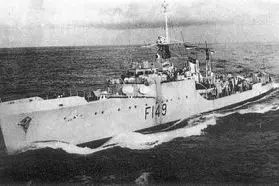
9 December 1971. T.J.Rajasekharan Nair was 19 years old when joining the Indian Navy's INS Khukri. On that wintry night, fifty years ago, Nair was standing on the Khukri's quarterdeck, gazing at the star-lit sky with the serene Arabian sea below. Suddenly, a spate of deafening explosions rocked the ship. Nair was thrown into the dark and chilly sea in a flash. Looking at Khukri from afar, he saw her caught in a massive fire and sinking. The ocean also was ablaze. Nair strained to swim, but he was seriously injured and burnt all over. He saw his many colleagues floating too. Sometime later, Nair managed to get on a life-raft, thrown off the ship in the explosion. There were seven persons on the raft, all exhausted and injured. A few hours later, the condition of John Thomas, a Malayali, worsened. Thomas died on Nair's lap. 'He was wailing throughout and calling out for his little son Roymon. Now, Roy is 52 years old and I called him on the fiftieth anniversary of his father's death. He broke down inconsolably,’ Nair (70) told this writer from his home at Vennikkulam in Pathanamthitta. Nair had retired from the Navy after serving for 16 years more. He is one of the 67 survivors of the Khukri, India's warship sunk in the 1971 war off Gujarat coast in the Arabian Sea by a Pakistani Navy submarine at 8.45 pm on that fateful night.

his wife Vatsala R Nair
The golden jubilee of India's magnificent victory over Pakistan in 1971 and the resultant liberation of Bangladesh is being celebrated now. India hasn't so decisively won a war like this since independence. Yet, the sinking of INS Khukri by PNS Hangor stuck out like a sore thumb among the overall triumph of 1971.
INS Khukri is the only ship India has lost in any war. Nor has any war caused more casualties in a single incident. India lost 194 crew members, including 18 officers in the Khukri disaster. Among them 20 were from Kerala. The highest-ranking officer among the Malayali martyrs was Commander (E) Mukkadavil Oommen Oommen, Khukri's second in command and the head of engineering who belonged to Kuzhikkala, Pathanamthitta.

Sixty seven persons were rescued the following day by Naval ships. Survivors included six Malayalis. Except for one, they are still alive, and coincidentally, all belong to the Pathanamthitta district. They are K Gopalakrishnan Nair (Thelliyur), M K Sukumaran (Niranom), P.K. Gopalakrishnan Nair (Pramadom), T.C. Verghese (Vennikulam), and C.T. John (Mylapra), the senior-most and known in his village as 'Khukri Achayan,' who died at the age of 87 in 2013.
The most dramatic and inspiring incident related to the Khukri disaster was the martyrdom of the Captain M.N. Mulla, 45. The Captain refused to leave the sinking ship until all his colleagues escaped, which was never to be. Finally, he went down with his ship, upholding a brave and hoary naval tradition. He was last seen sitting in the captain's chair on the ship's bridge, a cigarette dangling from his lips as his ship sank into the depths forever.
However, some days later, a chilling fact came to light. The Khukri disaster was avoidable. The tragedy was caused by a series of questionable decisions, technological inferiority, insufficient security, and overall lack of proper planning or prompt remedial action. Even a proper inquiry has not yet been made, and hence those responsible are not held accountable even after half a century. Many survivors and even prominent members of the defense establishment and researchers have pointed out the enormous lapses.
Among the narratives on the disaster is 'The Sinking of INS Khukri' by Major General (Rtd) Ian Cardozo. A Goan, Cardozo is 84 years now and the first war-disabled officer to lead a battalion. During the 1971 war, he had stepped on a landmine, and his leg was critically injured. As gangrene was setting in and there was no medical facility around, Cardozo amputated his leg himself, using a kukri -a Gorkha knife- without anesthesia! Later, a captured Pakistani army prisoner who was a doctor operated on Cardozo. He had a wooden leg afterwards but was yet given command of a battalion and later a brigade.
Based on official documents from India and Pakistan, books by Naval chiefs, accounts by survivors, relatives of victims, Cardozo narrates the heroic story without gloating over the lapses that led to the disaster. They include setbacks like the Indian Navy's general unpreparedness, wrong decisions, instrumental inferiority compared to Pakistani submarines, the failure of Sea King helicopters to provide protection, and the INS Kirpan's haste to save itself rather than rescue victims. Cardozo states: 'The destruction of Khukri need not have happened.'
How many know that the Indian navy did not participate in any of our wars until 1971?. In all of India's three earlier wars, the Navy was absent -against Pakistan in 1947, China in 1962, and Pakistan in 1965. Cardozo, although doesn't refer to the earlier wars, vividly narrates about 1965. Although Pakistan did not succeed in its major offensives, its Navy bombarded Dwaraka town on the Gujarat coast in September 1965. Yet, the Indian navy was not permitted to retaliate.
According to Cardoza, the government did not involve the Navy to prevent the escalation of the war. Defence Minister Y B Chavan had also informed the Indian Navy that its priorities should be to defend Andaman and Nicobar islands against Indonesian advances.
According to Cardozo and other Naval Chiefs like Admirals SN Kohli and SM Nanda, this resulted in the Indian Navy's loss of morale, potency, and technological strength.
In 1971, the Indian Navy was particular not to be excluded and received the go-ahead from Prime Minister Indira Gandhi. The Western Fleet's successful missile assault on Karachi led by a Malayali Rear Admiral Elanjikkal Chandy Kuruvilla proved the Indian Navy's capability at the very beginning of the war. Yet, its technological weakness was revealed barely four days later with the sinking of INS Khukri. All the three Indian anti-submarine frigates -Khukri, Kirpan, and Kuthar- of the Western Fleet's 14th Squadron were purchased from Britain and belonged to the 1950s vintage. India was not happy with its critical equipment like the Sonars (for detecting enemy ship movements) as they were of limited short-range capability. But Britain refused to supply higher sonars saying only NATO members deserved them.
All the three frigates were part of the 13 ship-armada that had moved to Karachi for the assault. But one of them -Kuthar- developed technical failure on the way and the other two escorted it back to Bombay. After reaching Bombay, Khukri and Kirpan were sent off the Diu coast to 'hunt and destroy' the Pakistan submarines detected by the Indian Navy in the region. But Indian Navy was unaware that the Pakistani submarine -belonging to the French Daphne class- was the best of its kind with ten times more sonar capability than the Indian frigates! Hence, even before Indian frigates could detect it, the Pakistani frigate PNS Hangor torpedoed Khukri to rubble. Khukri was also forced to move at a much slower speed -suicidal when enemy submarines were around- because sonar upgrade experiments were allowed to take place on the ship even when it was in the midst of a battle. Khukri was a sitting duck. 'The Indian frigate was like a blindfolded warrior against an opponent who could see perfectly and much longer distance,' according to Commander Anil Kakkar, a survivor.
Another survivor, Commander Manu Sharma, is quoted by Cardozo that the Western Naval Command did not give Khukri any necessary information or intelligence. Instead of coming to the Khukri's rescue, the sister ship Kirpan sailed away from the area. 'Knowing there were no other ships in the vicinity, we realized we had to fend for ourselves.'
Another unanswered question was related to the two Sea King helicopters, which were supposed to carry anti-submarine torpedoes and fly over the Indian frigates to protect them. Yet, the Sea Kings sent for Khukri and Kirpan were unarmed. Moreover, they disappeared from the skies on that fateful day as their reliefs failed to arrive! Another question was raised by Ram Tahiliani, a former Naval Chief of Staff who wondered how Khukri, built for watertight integrity, could sink even if it was torpedoed. 'Even with one hit she should have been able to limp back to port,' said Tahiliani to India Today.
An inquiry into the tragedy made in 1972 by Indian Navy Commander Benoy Bhushan found stunning bunglings that had led to the disaster and their subsequent cover-up. In 2012, Chanchal Singh Gill, a Khukri survivor, filed petitions in the Punjab and Haryana High Court to reveal the bunglings and withdraw the gallantry award given to R.R. Sood, the Commanding Officer of Kirpan, for having turned away instead of rescuing Khukri. Both Bhushan and Sood are not alive today. Gill, now 70, leads a retired life in Chandigarh after many years of working abroad. 'The Navy covered up the entire fiasco to protect the culprits who then headed Indian Navy. I have all the evidence,' Gill told me on the phone.
After many attempts, the Indian Navy's hydrographic survey ship INS Jamuna located Khukri's wreckage in 2004, deeply buried under silt south of Diu. An examination of the debris would have solved all the suspicions and mysteries. Yet, the Navy mysteriously decided 'not to disturb Khukri's grave.' So, along with the Khukri wreckage, all its secrets continue to be buried deep under the Arabian sea.
Published: 01 Jan 2022, 11:23 am IST
Disclaimer: Kindly avoid objectionable, derogatory, unlawful and lewd comments, while responding to reports. Such comments are punishable under cyber laws. Please keep away from personal attacks. The opinions expressed here are the personal opinions of readers and not that of Mathrubhumi.