

Today's “cockroaches” have, to some extent, unified the splintered Opposition, though it remains to be seen whether it can bring about regime change in 2029.
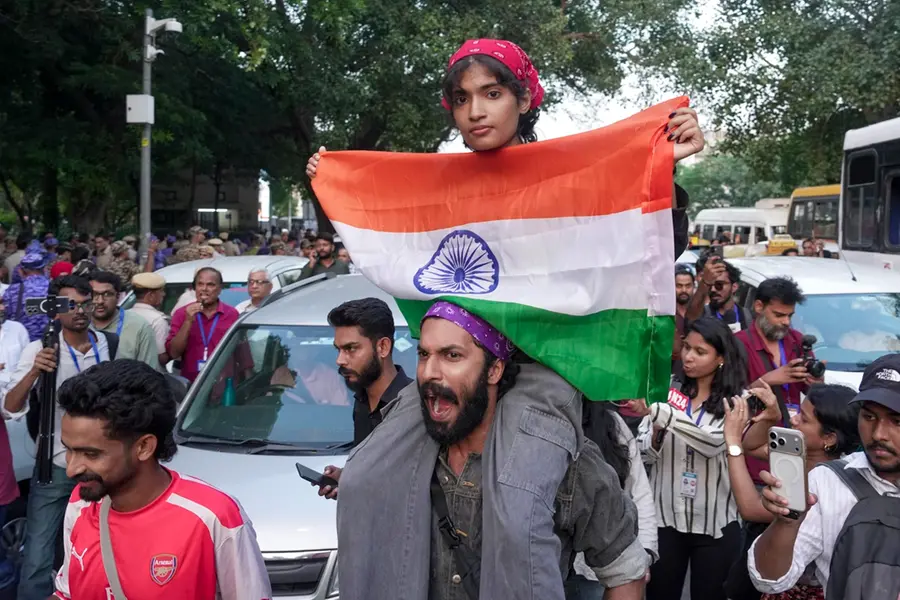
The political tornado unleashed by the Cockroach Janta Party (CJP) and taken up by the Opposition, demanding the resignation of Chief Election Commissioner Gyanesh Kumar, is shaking up India. The moot question is whether it will galvanise a broad opposition movement that could affect the outcome of the crucial 2029 general elections.
Extraordinary as it is, the present storm closely resembles another phase in independent India's history and offers clues to where it could go in the days to come. It was the massive student movement that began in Gujarat in the west in the 1970s and soon spread to Bihar in the east. Like the present agitation, which began over a student-related issue, the NEET question paper leak, the earlier movement too erupted in protest against a hike in hostel fees at an engineering college in Gujarat in late 1973. Both began as non-political, spontaneous protests without conventional organisational structures. Both movements largely comprised students from urban middle-class backgrounds. Economic and social circumstances fuelled both agitations. The 1970s saw stagnant growth, inflation, and high youth unemployment. Despite high economic growth, unemployment and inequality have risen alarmingly in present-day India.
However, the two eras differ starkly on one important point: the roles of the dramatis personae. They have reversed. During the first era, Congress was in power and the target of protests, while the Bharatiya Jana Sangh (BJS) was the key Opposition party. The Congress party split in 1969, and the ruling faction, led by the formidable Prime Minister Indira Gandhi, swept the 1971 polls. Half a century later, the parties have exchanged places: the BJP, the BJS's successor, is in power, and Congress, still led by Indira’s family, leads the Opposition.
Another significant difference between the two eras is the role of the mass media. While the all-pervasive electronic media amplifies and carries every minute detail of the present movement live across the world, newspapers were the only mass medium during the 1970s.
The Gujarat student movement, which began in late 1973, had soon spread across multiple universities and led to violent clashes with the police. The Congress government of Chimanbhai Patel, an Indira loyalist, which enjoyed a huge majority in the Assembly, resorted to brutal repression through police firing, lathicharges and mass arrests. Nearly 100 people died in police firing at several places during the nearly three-month-long agitation. Certainly, it would be worthwhile for Congress, which rightfully laments police action against students today, to remember the far more brutal repression unleashed by the party's government in Gujarat then. The earlier agitation was far more violent, too.
Despite the similarities, the two agitations had fundamental differences as well. While the first was non-ideological until the BJS took over, the second, though non-partisan, openly owes allegiance to “Neel-Lal” politics, a mix of Ambedkarite and Marxist ideologies increasingly popular on current university campuses.
The Gujarat student movement developed a firm political and organisational structure when it was named the Navnirman Andolan, led by the BJS's student wing, the ABVP. In the present case, though Congress leaders maintain a largely ego-driven distance from the CJP, the Congress-led Opposition backs it.
Though led by the BJS, Gujarat’s Navnirman movement could gain civil society support, with all Opposition parties, trade unions, lawyers, and teachers joining it. Soon it turned into a mass agitation against the corrupt and repressive state government. Strikes, bandhs and violent clashes rocked the state. As the movement escalated, even many ruling Congress MLAs resigned in support. In March 1974, veteran Congress (O) leader Morarji Desai began an indefinite fast demanding Chief Minister Patel's resignation. Bowing to popular pressure, Prime Minister Indira Gandhi asked Patel to resign, and the Assembly was dissolved. For the first time in the country, a government resigned under pressure from an extra-parliamentary agitation. (Kerala’s first EMS government did not resign but was dismissed.)
The BJP, which laments the ongoing extra-parliamentary agitation demanding a regime change, should recall its own political history. In his recent book, Indira Gandhi and the Years that Transformed India, Srinath Raghavan recalls how BJS leaders such as Vajpayee and Advani stressed the need for extra-parliamentary agitations to replace corrupt governments during the 1970s. The movement had laid the foundations for transforming Gujarat, once a Congress stronghold, into today's Hindutva citadel. Among the young RSS pracharaks who received their political baptism in that movement was Prime Minister Narendra Modi.
Despite their ideological differences, both the past and present movements share another objective: the agitating youth have invigorated and united an opposition comprising ageing, fractious leaders spanning the ideological spectrum from left to right. In less than a decade, a rainbow coalition of right-wing and left-wing parties ousted Prime Minister Indira Gandhi, who had seemed invincible when the agitation began. Today's “cockroaches” have, to some extent, unified the splintered Opposition, though it remains to be seen whether it can bring about regime change in 2029.
The success in Gujarat inspired students in Bihar to rise against the corrupt Congress government, unemployment and inflation. The eastern state had another advantage. Veteran freedom fighter Jayaprakash Narayan actively supported it, having long struggled in vain to unite the quarrelling Opposition leaders against the increasingly authoritarian Indira Gandhi. Bihar also had a strong Socialist and Communist presence, and its campuses had a tradition of agitations dating back to the freedom struggle.
But the Bihar student movement was politically organised yet divided between groups led by the Communist parties and the more prominent Chhatra Sangharsh Samiti, led by Socialists and, more dominantly, the BJS, under JP's guidance. The agitation spread across the state, followed by brutal repression. While demanding the resignation of the state's Congress ministry led by Abdul Gafoor, JP took the agitation to a higher level, calling for a “Total Revolution” against Indira Gandhi at the Centre. Like Modi in Gujarat, the Bihar student movement produced several leaders who are prominent today, such as Lalu Yadav and Nitish Kumar. Like Patel in Gujarat, Chief Minister Gafoor too resigned before completing his term.
Some of JP's remarks from that period, quoted in Raghavan's book, draw parallels with the present situation. Praising the student agitation, JP said that for the first time since independence, the Indian people were “no longer prepared to remain helpless spectators of wrongs and evils.” He insisted that demanding the resignation of the Bihar ministry and the dissolution of the state legislature was eminently justified: “what are the people to do when constitutional methods and the established democratic institutions fail to respond to their will?” Narayan conceded that such mobilisation “might appear to some, especially those in power, to be unconstitutional and anti-democratic.” Yet he sought to distinguish between the two. “Unconstitutional it certainly is,” he wrote, “but not anti-democratic.”
By then, the phenomenal agitations in Gujarat and Bihar had seriously challenged Indira Gandhi's hegemony. Congress lost power in its one-time citadel of Gujarat, while it scraped through in its strongest fortress, Uttar Pradesh, in the 1975 Assembly elections. Even after such huge setbacks, Indira was willing to talk to JP and other opponents. But then quite unexpectedly, Indira faced a thunderbolt from the judiciary. On 12 June 1975, the very day Congress lost the election in Gujarat, Justice Jagmohanlal Sinha of the Allahabad High Court found Indira guilty of electoral malpractice and set aside her 1971 election to Parliament. He also barred her from holding any elected office for six years. This devastated Indira, as she saw it as part of a grand global conspiracy of the USA and the Indian right-wing to end her political career forever. Thirteen days later, she declared the Emergency and plunged the nation into an unprecedented period of dictatorship. Two years later, Indira paid the price with a historic electoral defeat.
Indira Gandhi's dramatic rise and fall in barely five years show how political fortunes can turn upside down in a short time. Today's apparent strength need not guarantee political survival tomorrow in a democracy.
The question now is how the present political developments will affect Modi's political hegemony. Much will depend on the government's next steps in response to the ongoing agitation demanding the resignation of the Chief Election Commissioner and even a regime change at the Centre. Since a thunderclap like the Allahabad High Court verdict is unlikely to strike Modi, an extreme step such as the Emergency need not be expected. Nor is it likely that more brutal repression of the agitation or a deterioration of the country's economy will necessarily cause the movement to escalate. Yet the government's obstinacy in shielding the tainted CEC despite the highly serious allegations could prove self-destructive. Though the present Supreme Court has been as accommodating towards the central government as it was during the Emergency, it need not always be so in matters concerning the CEC and the SIR. One cannot rule out the politically astute Modi even sacrificing Gyanesh Kumar to prevent the situation from escalating to the point of affecting the outcome of the 2029 elections.
Published: 18 Oct 2026, 12:17 pm IST
ABOUT THE AUTHOR
Related Topics
Disclaimer: Kindly avoid objectionable, derogatory, unlawful and lewd comments, while responding to reports. Such comments are punishable under cyber laws. Please keep away from personal attacks. The opinions expressed here are the personal opinions of readers and not that of Mathrubhumi.