

In his feature debut, Kane Parsons turns ordinary hallways and forgotten spaces into one of the year's most unsettling horror experiences
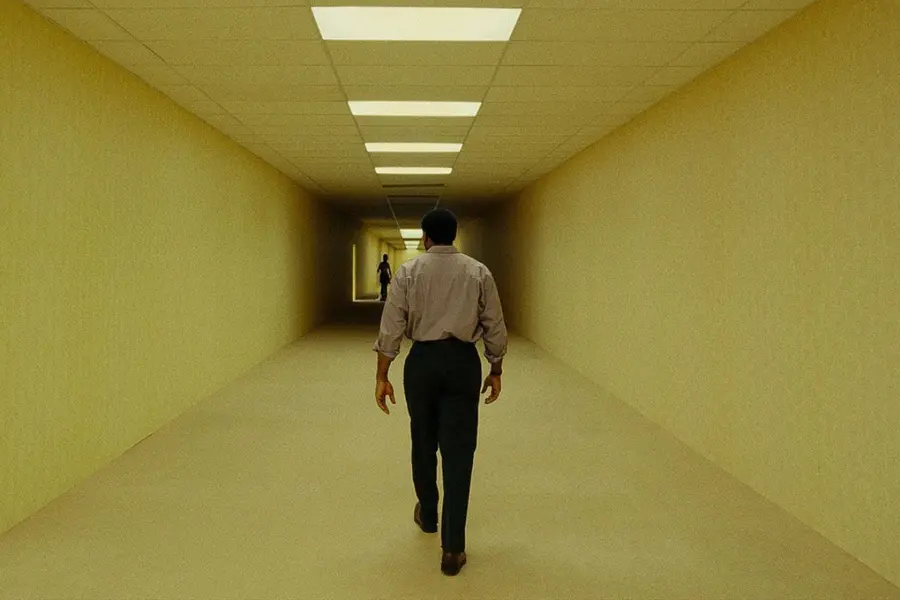
In most horror films, terror arrives wearing a face. Maybe a ghost, a demon, or a masked killer lurking at the end of a corridor.
In ‘Backrooms’, the corridor is the monster.
The surprise box-office phenomenon of 2026, directed by 20-year-old filmmaker Kane Parsons and produced by A24 and Atomic Monster, has become one of those rare films that audiences leave arguing about. Some viewers call it the scariest movie they've seen in years. Others insist that almost nothing happens. Nearly everyone, however, seems to leave with an interpretation.
That may be precisely the point.
Clark, played by Chiwetel Ejiofor, is a failed architect whose life has narrowed into disappointment. Divorced, alcoholic, and managing a struggling furniture store called Cap'n Clark's Ottoman Empire, he spends his days filming embarrassing pirate-themed advertisements and his nights sleeping among showroom beds. His therapist, Mary (Renate Reinsve), carries emotional wounds of her own, haunted by memories of an abusive mother and a childhood shaped by instability.
Then Clark discovers something hidden behind a wall in the basement of his furniture store, a doorway into an infinite labyrinth of rooms. They are not magical or beautiful rooms. Just rooms. Office corridors, storage areas, waiting spaces and forgotten hallways lit by flickering fluorescent lights. The kind of places everyone has seen before but nobody remembers. And they never end.
What keeps the film grounded amid all its conceptual strangeness is Ejiofor's performance. Clark could easily have become a stock horror protagonist wandering from one mystery to the next, but Ejiofor gives him a bruised humanity. Even before he enters the Backrooms, there is a sense that he is already trapped inside a life he no longer recognizes. The labyrinth merely gives physical shape to that feeling.
Halfway through the film, Clark attempts to explain the Backrooms using a deceptively simple analogy. Imagine describing a dog to someone who has never seen one, he says, and then asking them to draw it. The result would contain all the right pieces- four legs, a tail, a snout but something would still feel wrong. Deeply wrong.
That line becomes the key to understanding the film itself.
The Backrooms originated years ago as an internet horror myth, but Parsons understands something many filmmakers overlook. People are not always frightened by what is unfamiliar. Sometimes they are frightened by what is almost familiar. The Backrooms resemble places we've all encountered - a shopping mall after closing, an empty office floor on a Sunday, a furniture showroom after everyone leaves but they feel assembled from fragments of reality remembered imperfectly.
What makes Backrooms particularly fascinating is that Parsons understands this mythology better than anyone. Before Hollywood arrived, he had already spent years building these spaces through a series of increasingly ambitious YouTube shorts. Rather than abandoning the internet origins of the concept, he expands them.
The film belongs to a different tradition of horror, one closer to The Shining, Twin Peaks, or the quiet dread of Severance. The fear comes from the atmosphere, uncertainty and the sensation that reality itself has become unstable. Parsons' visual approach plays a major role in creating that unease. Fluorescent-lit hallways are filmed with remarkable patience, inviting viewers to search every corner of the frame for movement where there may be none with soundscape of distant hums, mechanical echoes and prolonged silence.
The film's greatest achievement is that the Backrooms can sustain multiple interpretations. They can be read as a metaphor for memory, loneliness, addiction, the internet, or simply the fear of becoming trapped inside a life that no longer feels like your own. Parsons never insists on a single answer.
One of the film's most disturbing ideas is that the entities inhabiting the Backrooms may not be monsters at all. They appear instead as imperfect replicas, as though reality itself is trying and failing to remember what human beings look like. The creatures are used sparingly, and wisely so. When they appear, they feel less like conventional horror villains and more like glitches in existence.
That restraint extends to the ending. Modern audiences are conditioned to expect explanations, origins and final revelations that neatly tie everything together. Backrooms offer ambiguity instead. By the conclusion, viewers understand more about the labyrinth than they did at the beginning, but not enough to solve it. The mystery remains intact, which is why conversations continue long after people leave the theatre.
Backrooms will not work for everyone. Audiences expecting clear rules, constant scares and neatly packaged answers may leave frustrated.
Kane Parsons has taken a piece of internet folklore that could easily have remained a niche curiosity and transformed it into unexpectedly cinematic.
Sometimes the scariest place isn't a haunted house. It's a familiar place that no longer makes sense. And once you're inside, finding your way back out becomes impossible.
Published: 17 Jun 2026, 04:21 pm IST
ABOUT THE AUTHOR
Related Topics
Disclaimer: Kindly avoid objectionable, derogatory, unlawful and lewd comments, while responding to reports. Such comments are punishable under cyber laws. Please keep away from personal attacks. The opinions expressed here are the personal opinions of readers and not that of Mathrubhumi.