

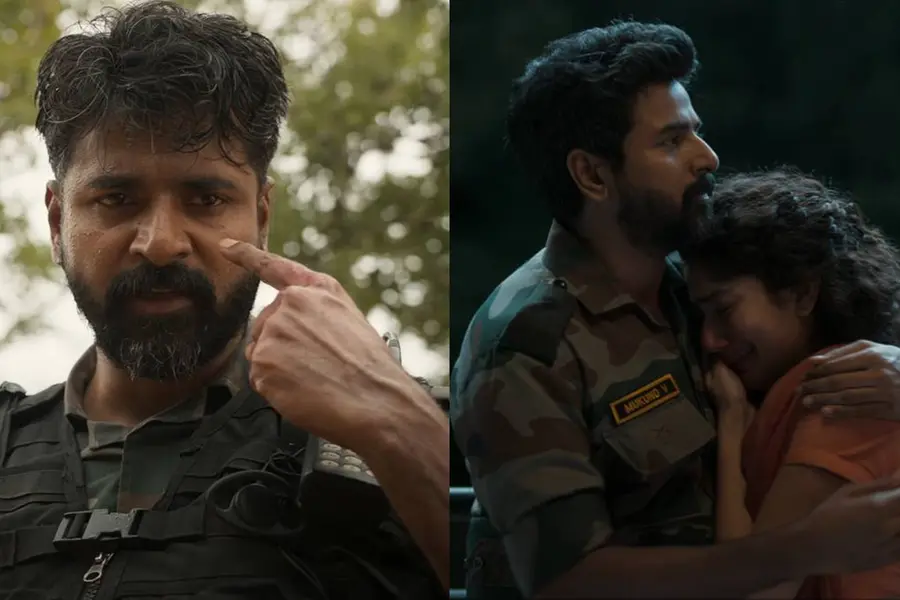
Writing a review for a movie based on a true story can be challenging. If that’s the case for critics, imagine the difficulty filmmakers face in translating real life to the screen. Such is the challenge with the Tamil-language biographical action war film 'Amaran', directed by Rajkumar Periasamy and produced by Raaj Kamal Films International. Starring Sivakarthikeyan and Sai Pallavi in lead roles, the film chronicles the real-life story of the late Major Mukund Varadarajan, a member of the 44th Rashtriya Rifles stationed in Kashmir and a recipient of Ashoka Chakra.
Why it's different?
Like many films that delve into the Indian Army and the insurgent movements in Jammu & Kashmir, 'Amaran' addresses sensitive topics, yet it approaches them in a more neutral manner compared to acclaimed works like 'URI' or the Bollywood classic 'Border'. The film explores how a soldier balances personal life with duty, capturing the complexities of being away from family through the exemplary performances of Sivakarthikeyan and Sai Pallavi. When the narrative veers into political discussions about Kashmir, it seamlessly transitions to the daily struggles of a wife and daughter yearning to connect with a husband far out of reach.
As a biopic, the film covers all aspects of Mukund’s life, extending beyond his military years. It initially unfolds like a typical love story set in a Chennai college, gradually revealing the complexities of a love marriage and Mukund’s determination to join the army. Despite the challenges, Mukund and his wife, Indhu Rebecca Varghese, portrayed by Sai Pallavi, find ways to stay connected. The film adeptly navigates the dynamics between Mukund’s Tamil family and Rebecca’s Christian family in Kerala, delicately addressing societal apprehensions about marrying into an army family. This is further enriched by Mukund's father-in-law recounting his own experiences as an army doctor at the border.
The Emotions
It’s hard to ignore how emotion plays a significant role in the film, and no one does it better than Sai Pallavi. She excels in her role as Indhu, and the little nuances she brings to crucial scenes elevate the overall impact. After exiting the theatre, Pallavi's character lingers in your heart, equally memorable as Mukund, who is the focal point of the story.
As the film progresses, it captures the stress of a long-distance relationship as Mukund moves away for duty. The emotional scenes between the young couple depict their struggles during the challenging early years of their marriage.
In the Kashmir segment, the film effectively sets a tone that highlights the region's turmoil and the complexities of its politics. The action sequences, particularly the encounters with militants, do justice to the narrative, enhancing the film's overall impact. The technical side of the movie, the art direction in particular, did an excellent job.
Summing up
Perhaps the film's greatest strength lies in the director’s ability to know when to draw the line on patriotism. Unlike many recent films that explore similar themes, 'Amaran' maintains a grounded approach, telling the story in a way that honors the sacrifices of Major Mukund and his family. It stands as a heartfelt tribute to those who serve in the Rashtriya Rifles and the Indian Army.
An emotional movie highlighted by Sai Pallavi's stellar performance — ★★★★☆
Published: 01 Nov 2024, 03:13 pm IST
ABOUT THE AUTHOR
Related Topics
Disclaimer: Kindly avoid objectionable, derogatory, unlawful and lewd comments, while responding to reports. Such comments are punishable under cyber laws. Please keep away from personal attacks. The opinions expressed here are the personal opinions of readers and not that of Mathrubhumi.