
Even after 30 years, people still fully enjoy and immerse themselves in the music, as if it were a refreshing rain — without any hesitation or restraint.
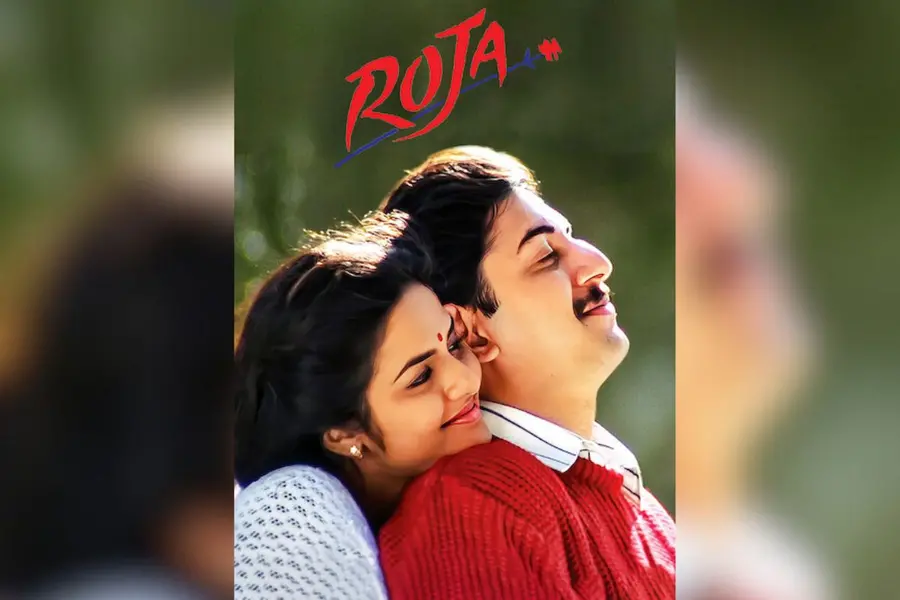
At the heart of Mani Ratnam’s Roja lies a setting in Kashmir — ‘so the song must carry a sense of coolness,’ he insisted. That vision shaped the entire soundscape. A R Rahman, making his debut as a composer, embraced the directive with heart, weaving a melody that exudes the chill of the mountains. The lyricist turned that cold into a drizzle, and the voices of the singers transformed it into a rain of romance. Even after 30 years, people still fully enjoy and immerse themselves in the music, as if it were a refreshing rain — without any hesitation or restraint.
The immortal line, “Puthu vellaiy mazhai ingu pozhikkindrathe, intha kollainailaa udal nanaikindrathe”—penned by Vairamuthu, set to Rahman’s tune, sung by Unni Menon and Sujatha—remains cherished by all generations.
Unni Menon says, “I never envisioned it becoming such a folk sensation or a song people always discuss. Yet, it transcended every hope. Even today, nobody lets me leave a stage without singing Puthu Vellaiymai. From the first breath to the final note, audiences listen with bated breath.”
One late night, Rahman (then credited as Dileep Kumar) called Unni: “I’m a newcomer. Let’s record only if the director likes it. If not, both of us will be ousted. Still interested?” As a displaced singer often overlooked by mainstream cinema, how could Unni refuse?
The following evening, in Rahman’s modest studio, Unni sat to record. Sujatha followed shortly after. There was no grand acoustics—just a small voice room, a mixer and Rahman himself playing chords on a keyboard, guiding every nuance.
Unni Menon had seen that quiet teenager before – the one who used to play the keyboard for music directors like Arjunan Master and Johnson. Soft-spoken and reserved. But they had never really talked. At most, they’d exchange a polite smile.
That shy young man, A R Rahman, didn’t give off any signs of the genius he truly was. Unni didn’t suspect it either — not until he listened to the songs Rahman composed for Roja.
But Sujatha, the veteran playback singer, had seen glimpses of that magic earlier.
‘I want that nasal voice’ – The making of Roja's evergreen songs
“He first called me to sing a jingle for a Nivea talc commercial,” Sujatha recalls.
“I wasn’t keen on it. Singing jingles didn’t feel like my thing. To make it worse, I had a cold at the time. I tried to wiggle out by telling him about it. But Rahman simply said, ‘That’s exactly the sound I want – that blocked nose tone!’”
Sujatha was surprised. Who else would take that kind of creative risk?
Back then, Rahman didn’t have his own studio. She remembers recording that jingle in a modest studio called Amrutanjan.
“Until then, I mostly sang in the middle or upper pitch – that’s where I felt most comfortable. But Rahman made me sing in a lower register. Something I had never tried before. When I heard it back – that deep, bass tone – I was like, ‘Hey, this actually sounds good!’ That was the first time I recognised Rahman’s constant quest for the new, for the different.”
Sujatha went on to sing more jingles for Rahman. And then came the big one: Roja.
“The first thing I recorded was the humming part of ‘Kaadhal Rojave...’. When I finished, Rahman simply raised his hand with a thumbs up. That’s it.”
He had already made it clear that he did not want to follow the beaten path. His music was going to be different — and that made everyone a little anxious.
“Some of Rahman’s ideas may seem strange at first,” Sujatha admits. “But when you hear the final song, you realise how brilliantly it all comes together.”
In the song “Pudhu Vellai Mazhai”, Sujatha accidentally left a slight delay while singing the word “kollai nilaa.” It was a small gap between the words — an unintended slip.
“I apologised and suggested we do another take. But Rahman smiled and said, ‘No problem. It sounds interesting. Let’s keep it like that.’ That was a first for me — someone who saw value even in imperfections. It told me so much about his mind.”
As singers put on their headphones and hear their voices in Rahman’s mixes, they begin to realise the magic.
“There are moments,” Sujatha says, “when even we fall in love with our own voices.”
By the time the final version comes out, the song often transforms beyond even the singer’s expectations.
“Take the part where I sing ‘Nadhiye’ in “Pudhu Vellai Mazhai”. When I heard the double-tracked version, I was stunned. You record with a basic orchestra. But when you hear the fully arranged digital mix — with every layer, every nuance — it’s goosebumps.”
Unni Menon realised that the song he recorded had become a sensation only when his brother-in-law called him from Kerala.
“I had just landed in Thiruvananthapuram from London and was on the way to Kochi in a car. That’s when he popped the Roja cassette into the stereo and called me excitedly after listening.”
“Unni, a musical bomb has dropped!”
It was a time when media was not so widespread, and Unni did not even know the cassette had been released. His brother-in-law raved about the freshness of the music, the orchestration, the sound — and even Unni’s voice had a unique edge.
“I went straight to a music store in T Nagar, bought the cassette, and as soon as I listened to it — I understood. This wasn’t just an album. This was a musical revolution.”
He watched the film on release day at Udayam Theatre in K K Nagar.
“Sitting in the dark theater, watching the song sequence on screen… it was surreal. Hearing my own voice like that. It felt like someone else. That’s Rahman’s magic.”
Though the story of Roja was set in Kashmir, the song sequences were shot in the icy beauty of Kullu Manali. Choreographer Kala Master recalls, “We started shooting at 3 am and wrapped only by noon. Arvind Swamy and Madhoo performed while freezing. It was tough. That’s why it felt special when this song won me the Pepsi Award for Best Song Picturisation that year.”
Interestingly, the original lyrics Vairamuthu wrote for the film’s iconic opening weren’t the ones we now know. His first draft was: “Idhu Kashmiramaa, Ink Kaarkaalamaa, En Kovilpuraa, Indha Kulir Thaangumaa…”
But Mani Ratnam wanted it changed to evoke a specific emotion — that subtle coolness, that gentle chill. So Vairamuthu rewrote the now-iconic lines.
Roja earned Vairamuthu the National Award for Best Lyricist (for Chinna Chinna Aasai) and many other honours.
And for Rahman — it was his first National Award for Best Music Direction, the Tamil Nadu State Award and the Filmfare Award. Roja changed everything.
The pursuit of perfection
After Roja, Unni Menon sang around 26 songs for Rahman in various languages.
“But I doubt we’ve spoken even 26 sentences to each other in all this time,” he laughs.
That’s just Rahman’s style. Once the recording is done, he rarely discusses it. Not a word. By then, he’s already moved on in his mind to the next project.
Sujatha says, “He has this quiet brilliance in drawing exactly what he wants from his singers. And he’ll wait — patiently — for as long as it takes. He doesn’t demand only the technically perfect voices. For Rahman, uniqueness matters more than polished perfection.”
When Sujatha went to record for Roja, the first thing Rahman did was play her a song he’d recorded the day before – “Chinna Chinna Aasai”, sung by Minmini.
“As it played, I got goosebumps. When Rahman asked what I thought, I said, ‘I can’t even imagine a better tune for this song.’ Minmini’s innocent, untouched freshness — that’s what made the song so magical.”
Sujatha’s voice also features in the background score of Roja, as humming.
“It was just 3–4 days before the film’s release. I was busy with a concert in Dubai, flew back to Chennai, and went straight from the airport to the studio. That final humming you hear when Arvind Swamy and Madhoo meet — we recorded that in a rush.”
But when she finally watched the film, she was stunned by how beautifully those delicate notes had been used in the background.
“The way Rahman used it… pure magic.”
Even after three decades, that sense of wonder still remains. Generations have passed. Tastes have changed. But that feeling — that Rahmaniya — still stands, irreplaceable.
Published: 08 Aug 2025, 08:11 pm IST
Related Topics
Disclaimer: Kindly avoid objectionable, derogatory, unlawful and lewd comments, while responding to reports. Such comments are punishable under cyber laws. Please keep away from personal attacks. The opinions expressed here are the personal opinions of readers and not that of Mathrubhumi.
