
Celebrating the acting legend Mammootty’s latest State Award win, this evocative piece by Thaha Madayi delves into the enduring charisma, versatility and emotional depth of one of Malayalam cinema’s most beloved stars.
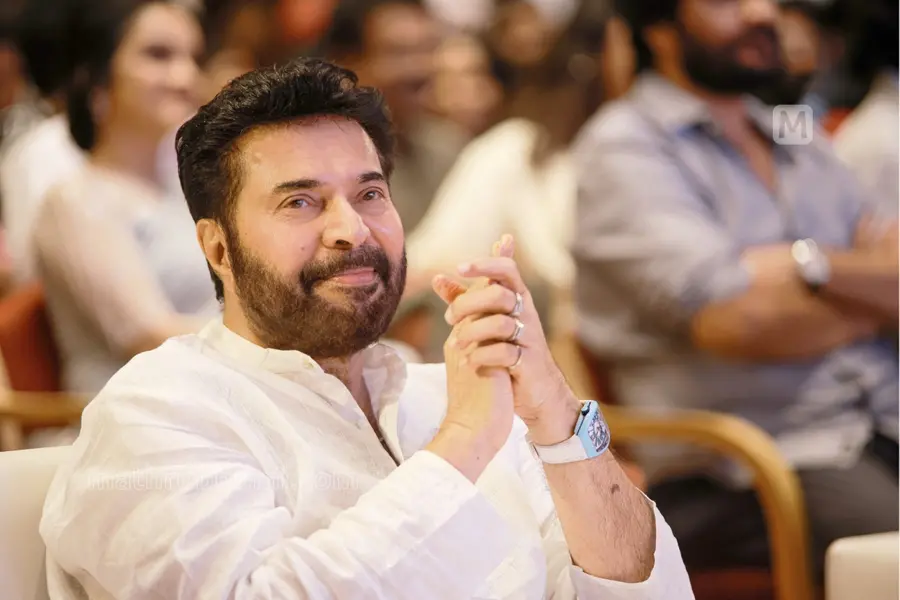
മമ്മൂട്ടി | Mbi Library
When you meet someone you love deeply after a long interval, one question inevitably rises within you, “How long has it been since I last saw you? Where have you been all this time?”
Sight and time merge in that question — yet there are some people to whom we have never asked it. Mammootty is one among them. Since the 1970s, Malayalis have never had to ask one another, “How long has it been since we saw Mammootty? Where has Mammootty been all this while?”
From the seventies to this very day, every passing age of the Malayali has also been the age of Mammootty. Standing between modernity and postmodernity, he remains a barometer of constant renewal. If one era could be called the age of the “modern Mammootty”, the subsequent one — through postmodern and even post-truth times — has continued to see him clearly in the light.
In my village, sometime in the early eighties, Mammootty had come to inaugurate a hotel. The whole village poured out to see him. As Mammootty walked through the crowd, my neighbour and friend Reena reached out and touched him. For the rest of that day, Reena looked at her own fingers as though they were someone else’s.
“Not your fingers, but my fingers,” she said, adding “these fingers touched Mammootty.”
In another sense, Mammootty is the man whom Malayalis “touch” every day through their memories. With all 10 fingers, they have longed to reach out and touch him.
Once, in a friendly conversation, a friend asked, “How many lovers live inside Mammootty?”
“Think about it,” she said,
“Isn’t ‘My chosen Mammootty lovers’ quite a delightful theme?”
That single thought sent us journeying through the bus that still carries the lovers of ‘Yathra’ — the film by Balu Mahendra — along with the songs of that trip, the priest with chocolate-toned garment, the crowd of fellow travellers and the mysterious stranger who joined them from somewhere unknown.
The lover in Yathra reminds us that love is a lifelong wound — that love is at once waiting, imprisonment and liberation. We have never quite alighted from that bus in which Mammootty tells his story. Even today, Yathra can be watched as though it were a newly released film. Its famous tagline still feels timeless: “If you haven’t seen this film, you haven’t seen the best of Malayalam cinema.”
Whom Reena touched that day was the lover from Yathra. Though the film is often discussed as a commentary on the human rights violations of the seventies, it is, above all, a tender record of love’s sorrow, endurance and the undying beauty of its fulfilment. Yathra makes us feel that love is sorrow — and sorrow itself can be transformed into beauty. The lovers in that film stand before us like a mirage, shimmering yet real.
With Mammootty come the faces of Seema, Shobana and Suhasini. The heroines may change, but the lover remains either Mammootty or Mohanlal. In the constellation of Malayalam cinema’s romantic heroes after the seventies, there have been only two names — Mammootty and Mohanlal.
There are “Mammootty men” who stand before us as silent victims of fate — in ‘Nirakkoottu’, ‘Thaniyavarthanam’ and ‘Bhoothakkannadi’. These are the films that place before us the weeping man.
In front of women, in front of love and affection, Mammootty stands melting within. There were women who, after watching him cry in a film, shut themselves away at home for days — lost in a desert of grief. No other man had wept before them with such surrender.
Mammootty becomes a true man only when he cries.
He could never charm audiences merely through laughter or witty words. His masculinity found its truest expression in tears — a weeping virility. After watching ‘Nirakkoottu’ and ‘Yathra’, many women would wistfully sigh, “If only we too had lovers who could cry like that.”
Mammootty-The weeping man
The man who reveals this weeping man most profoundly is Chandu from ‘Oru Vadakkan Veeragatha’. In that film, Mammootty removes the crown of deceit history had placed upon “Chathiyan Chandu” (cheat). We see not a deceiver, but a betrayed man — a weeping Chandu, whose trembling memories of his beloved end upon the sharp edge of fate.
That man, who turned the saga of masculinity into a story of sacrifice that burned through women’s hearts — we have seen him in film after film.
Beyond the trembling virility of ‘Athirathram’ and others, Mammootty’s masculine depth shone best through characters in ‘Amaram’, ‘Vidheyan’, ‘Ponthan Mada’ and ‘Bhramayugam’. Who else could have embodied the man in ‘Ponthan Mada’ with such gravity? In truth, that role was an artistic rebellion against the very establishment called “Mammootty”.
In 1999, I wrote an article criticising Mammootty in the Mathrubhumi Weekly (July 11 issue). Later, when Mammootty completed 50 years in cinema, I revisited that piece, rereading him in the light of a new age and its emotional awakenings.
Today, Kerala is home to a generation that reached middle age watching Mammootty. To reread him is to understand this: 50 years of Mammootty have mirrored the desires, anxieties, melancholies, madnesses and ecstasies of Malayali life. The actor’s body is bound by the expectations of society and the diversity of social life itself. Each of his characters reflects the moods, fashions and moral dilemmas of its time. In that sense, Mammootty is a textbook of vision. Through countless roles, he became woven into the daily lives of Malayalis — a man they carried within themselves. Through gesture, expression and voice, Mammootty offered his audience an electric presence.
That 1999 article bore the title “Azharum Mammootiyum” — Azhar and Mammootty. It was written during a time when cricketer Mohammad Azharuddin’s poor form had led even his fans to demand his retirement. Writers like Gavaskar, Vengsarkar and Malayalam’s own sports commentator Vincy echoed that sentiment. The article questioned why, when a singer with a failing voice could retire gracefully, film stars should not. It was a period when Mammootty’s films were suffering repeated failures — when he seemed to compromise with every story and role. The piece arose from the disappointment of a Mammootty fan.
A few lines from that article read: “It was Mammootty’s physical grace that first attracted Malayalis. When they realised he possessed the virtue of acting, they began to love and adore him. Spontaneity in acting is alien to him — perhaps because acting should never be effortless. Mammootty always acts with an inner awareness — I am acting. That consciousness is what makes him a great actor. Whenever he loses that awareness, audiences reject him. Recall his fatherly roles with Shalini.”
The article, as expected, drew heavy criticism. The following week, Mathrubhumi Weekly published selected letters from readers under the note: “Here are a few responses.” It was the issue that received the most letters in the magazine’s history. Yet even in disagreement, the language of those letters was courteous and democratic — not the aggressive trolling of today’s social media fans.
It didn’t end there. Days later, while sitting with my friend Damodaran at Madayippara, a motorbike circled us. A young man pointed at me and asked, “Are you the one who wrote about Mammootty in Mathrubhumi?”
Every narrow path down Madayippara flashed before my eyes like a scene from a film — but they did not harm me. They simply glared, then rode away.
A week later came one of the most beautiful silent letters of my life. Beginning poetically with “Dear **”, it mentioned places I used to visit — Valapattanam Sagar, Chirakkal Vanaja and Chovva Krishna. (It was at Chovva Krishna that I had watched K G George’s classic Swapnadanam — the very film produced by Bappu K, whose biography Mathrubhumi later published.) The letter, filled with spelling mistakes, accused: “Someone who watches blue films has no right to criticise Mammootty.”
That strange, wordless letter inspired me to write the novelette “Shareeram, Chila Pularkala Swapnangal” (The body and dome dawn dreams).
What will that question be — the one I would ask?
Years later, I saw my beloved actor Mammootty on a stage again — at the DC Books International Book Fair, Ernakulam. He was launching K G George’s book. On the same stage, Gemini Shankaran’s autobiography “Malakkam Mariyunnu Jeevitham” (A life that turns somersaults) was also being released. As the author of that book, I too had a seat beside Mammootty, Sathyan Anthikkad, K G George and Shankaran.
I looked with reverence at the great actor who had inspired my vision for decades. Yet I did not introduce myself or take a photo. With the quiet self-regard of a viewer, I simply stood there — full of wonder.
Perhaps someday, as a biographer or interviewer, I may get the chance to sit before Mammootty. When that moment comes, I will begin with just one beautiful question.
What will that question be?
Published: 04 Nov 2025, 09:08 am IST
Related Topics
Disclaimer: Kindly avoid objectionable, derogatory, unlawful and lewd comments, while responding to reports. Such comments are punishable under cyber laws. Please keep away from personal attacks. The opinions expressed here are the personal opinions of readers and not that of Mathrubhumi.
