
Despite being one of the best cinematographers in Indian cinema, his trust in a woman for the cinematography of such an important film was a remarkable act of sincerity.
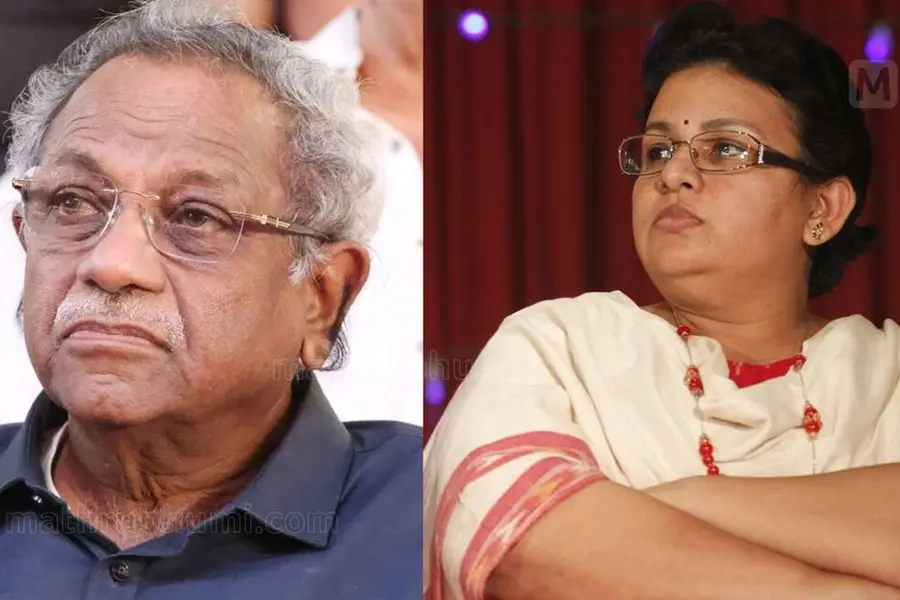
Paying tribute to late director Shaji N Karun, noted screen writer Deedi Damodaran speaks: It was after completing my sixth round of chemotherapy that Shaji N Karun approached me for a documentary titled 'Waiting’. The documentary was about those who are waiting for death. The focus of the documentary was to capture how the wait for death is different for each individual. When I speak of the sixth chemotherapy session, the situation is quite clear. The personal bond that began in such a state was preserved until the very end, sincerely. He looked at me as someone who was facing death face to face. That care and concern was given to me by him until the very end.
Shaji N Karun worked with my father (T Damodaran). They shared a very close relationship. When my father knew Shaji was coming, the first thing he said was about Shaji's punctuality. He said Shaji would arrive at exactly 3.30 pm. I had gone out at that time. When I returned, my father said, ‘Because it is Shaji, you should never arrive later than 3.30’. My father greatly respected Shaji's punctuality.
Shaji N Karun was a director who placed Malayalam cinema on the national and international map. He was someone who carved a distinct path in cinema. In Kuttisranku, he brought a female cinematographer into the spotlight, who went on to win a national award. The announcement of the award was interesting; it said, "Best cameraman Anjali Shukla”. The term "Cinemawoman" or "Cinemaperson" was not used then. The field of cinematography was typically associated with the term ‘cinematographer’. I consider Shaji’s contribution in Kuttisranku as a relevant gift to the film industry. Despite being one of the best cinematographers in Indian cinema, his trust in a woman for the cinematography of such an important film was a remarkable act of sincerity.
He was always present at every film festival. For a long period, Shaji N Karun's films were showcased as the signature films at the IFFK (International Film Festival of Kerala). What surprised me was that many people had differing opinions about him. He was someone who loved to engage in discussions about films and listened to opinions and criticisms with an open mind. When there were complaints from female directors regarding the KSFDC's film project, I requested him to engage in a conversation about it. He agreed. "We can arrange a time for that," he said. Our decision was to listen to both sides—female directors and Shaji N Karun, or those responsible for KSFDC. But we couldn’t meet, and I regret that.
I maintained a very close personal bond with him. Even though his films did not resonate with me personally, when he explained the layers of themes in his films, I understood them better. I realised in a discussion with him that the term 'Swam' in his film cannot stand alone. The reason the film was called Swam was because the woman in it was portrayed as isolated. The term 'Swam' is one that naturally connects with other words. Presenting it solely through a female character was his intellectual skill.
I saw Shaji N Karun’s cinematographer as someone who was a notch above in terms of his filmmaking ability. Vanaprastham and Kuttisranku were distinct experiments. This was the first film in which Mammootty’s body was subjected to a "female gaze”, which was captured by Anjali Shukla’s camera. Shaji N Karun was a director who didn’t attract the usual box-office attention. He created serious films using commercial artists.
As chairman of the Kerala State Film Development Corporation (KSFDC), he had dealt directly with every organisation in the film industry. When we were called as part of the WCC (Women in Cinema Collective), we prepared well. However, we received a set of questions in return, and I found myself disagreeing with one: "To preserve heritage”. I disagreed because 'heritage' is completely a paternalistic term, and the responsibility to preserve it does not lie with us, representing the WCC. Usually, such disagreements do not go down well, and they lead to conflict. But Shaji listened to all of it with tolerance. We discussed the use of the term 'heritage’. He had the ability to handle opposition with patience.
His loss is deeply painful for me on a personal level.
Published: 28 Apr 2025, 09:49 pm IST
Related Topics
Disclaimer: Kindly avoid objectionable, derogatory, unlawful and lewd comments, while responding to reports. Such comments are punishable under cyber laws. Please keep away from personal attacks. The opinions expressed here are the personal opinions of readers and not that of Mathrubhumi.
