
A bizarre new social media trend has left teenagers in the UK and Ireland alarmed, prompting police forces to step in and address growing concerns online.
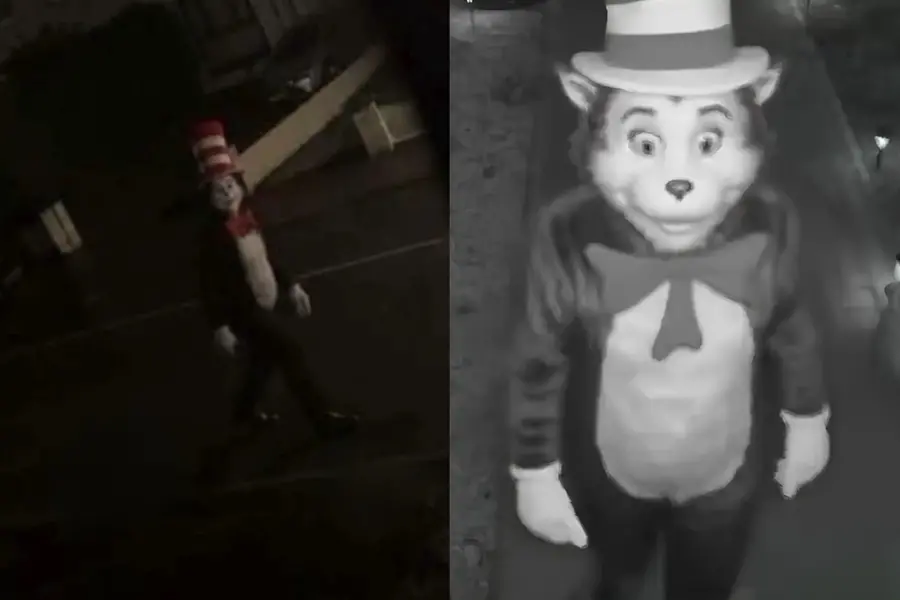
A character created for children has become the unlikely face of a viral horror trend, with AI-generated images of the ‘Cat in the Hat’ appearing across social media and sparking genuine concern among teenagers in the UK and Ireland.
Posts showing a towering, sinister-looking version of Dr Seuss' famous character apparently lurking in streets, driveways and outside homes have circulated widely on TikTok, Instagram, Facebook and other platforms. The images and videos are fake, however, and police forces in both countries have had to reassure the public that there is no real-life ‘Cat in the Hat’ stalking residential areas.
The trend has transformed the 2003 live-action film starring Mike Myers into an unlikely source of internet horror, blending dark humour, AI-generated imagery and found-footage-style videos.
How did the ‘Cat in the Hat’ trend begin?
The trend can be traced to June 30, 2026, when TikTok user Daletok uploaded a clip featuring Mike Myers as the ‘Cat in the Hat’ dancing in the 2003 film. The footage was paired with the ominous Guts' Theme from the 1997 anime ‘Berserk’ and carried the caption: "How mfs be dancing at prom just to overdose 2 weeks later."
The post reportedly attracted more than 4.4 million views within a week. Other users soon began creating their own versions, taking scenes from the film and adding unsettling captions and music.
What started as an internet joke gradually developed into a horror aesthetic. The Cat's exaggerated grin, unusual movements and distinctive striped hat made clips from the otherwise comedic film particularly easy to reinterpret as disturbing footage.
AI turned a meme into a fake threat
The trend took a more serious turn when creators began using artificial intelligence to place a realistic, life-sized version of the ‘Cat in the Hat’ into familiar locations.
AI-generated pictures and videos showed the character appearing on dark streets, standing in driveways, looking through windows and, in some cases, apparently chasing people. The deliberately grainy, shaky presentation made some of the footage resemble security-camera or found-footage recordings.
Images and alleged sightings began circulating from places in Ireland including Limerick, Wexford, Cork, Tipperary and Dublin. Similar claims emerged in several parts of England and Wales, including Sheffield, Manchester, Merseyside, Newcastle, Essex, Leeds, York, Cardiff and Blackpool.
Some posts even encouraged people to lock their doors or claimed that a "killer ‘Cat in the Hat’" was roaming a particular town.
The claims were false.
Police in UK and Ireland debunk fake sightings
The growing number of posts prompted police forces to address the trend directly.
Wexford Gardaí explained that the images were created by using AI to insert the fictional character into photographs and videos of real locations.
“In an unusual turn of events, we are hearing a lot about an elusive Dr Seuss character doing the rounds online, apparently causing havoc in neighbourhoods and towns across the country.
“Fortunately, we can rule out the issue, which is essentially an AI prompt that places the character into images/videos of familiar places. To be clear, the ‘Cat in the Hat’ was not in your driveway while you were out and he is not currently hiding out in Curracloe.”
South Yorkshire Police also had to respond after a fabricated social media post was circulated as though it were an official police warning about a ‘Cat in the Hat’ sighting near Meadowhall.
“To confirm, we have not had any reports of a cat in a hat in Meadowhall, or anywhere else in South Yorkshire for that matter.
“We can also confirm no recent sightings of his associates Thing One and Thing Two. On a serious note, if you do see posts online providing policing updates and advice, please check that they are from an official policing account.
“The cat is not out of the hat on this one... we don't have a new account or a new logo. Please don't believe everything you read on social media.”
Police have repeatedly urged social media users to check whether supposed warnings come from verified official accounts before sharing them.
Why were teenagers genuinely scared?
While many posts are clearly intended as jokes, the trend has caused real anxiety among some young people.
The BBC spoke to teenagers who said the videos had made them afraid to go outside at night. Sixteen-year-old Skye described watching ‘Cat in the Hat’ videos during a sleepover at about 3am. When she later walked down her friend's driveway, she became convinced that the character could appear and called her mother to pick her up.
“I was having a sleepover but everyone started watching ‘Cat in the Hat’ videos. It was 3am. I wanted to go home. When I started walking down my friends' driveway, I got totally freaked out that the ‘Cat in the Hat’ was going to jump out. I had to call my mum to pick me up."
Another teenager, 14-year-old Lily, reportedly said she wanted to meet the character after hearing claims about a particular location. Her mother responded: "You are not going to meet anyone in the woods in the middle of the night."
The reaction demonstrates how quickly fictional internet content can feel real when it is repeatedly presented as supposed eyewitness footage.
The Mike Myers costume added to the fascination
The horror trend received another boost when Propstore announced that the original ‘Cat in the Hat’ costume worn by Mike Myers in the 2003 movie would be auctioned.
The costume was estimated to be worth up to $24,000. Its unusual appearance quickly became part of the online conversation, with users sharing images of the prop and using it to fuel increasingly elaborate theories about the character.
Some social media users even joked or speculated that Mike Myers was somehow trapped inside the costume.
A post featuring the original costume and the caption "Help, what do I do?" reportedly received 14.6 million views over three weeks.
Is this another killer clown-style panic?
The ‘Cat in the Hat’ phenomenon has similarities to earlier internet-fuelled scares, particularly the so-called killer clown craze of 2016.
During that period, people dressed as frightening clowns and filmed encounters with members of the public, while rumours of clown sightings spread across the UK and elsewhere. Police forces were called to investigate several incidents, and at least one school was temporarily closed amid concerns.
The difference this time is that AI can create convincing images of a fictional figure without anyone having to put on a costume and appear in public.
The trend also fits into the broader tradition of online horror storytelling, often described as creepypasta, where fictional characters and frightening stories are repeatedly shared until they acquire the appearance of an urban legend.
AI has made that process more difficult to distinguish from reality by allowing fictional scenes to be placed convincingly in recognisable locations.
Why is the trend spreading panic?
The ‘Cat in the Hat’ trend combines several elements that can make misinformation particularly convincing: a familiar character, recognisable locations, realistic-looking AI imagery and social media posts framed as eyewitness accounts or police warnings.
Repeated exposure can also make fabricated claims appear more credible. When users see multiple videos supposedly showing the same character in different places, they may interpret the volume of content as evidence that the sightings are genuine.
The ‘Cat in the Hat’ may have become an unlikely horror icon online, but there is no evidence that the fictional character is actually appearing on streets across the UK or Ireland.
Published: 25 Aug 2026, 04:00 pm IST
ABOUT THE AUTHOR

Related Topics
Disclaimer: Kindly avoid objectionable, derogatory, unlawful and lewd comments, while responding to reports. Such comments are punishable under cyber laws. Please keep away from personal attacks. The opinions expressed here are the personal opinions of readers and not that of Mathrubhumi.