
In the midst of his hectic schedule—balancing cinema, writing and his role as chairman of the Kerala State Cultural Welfare Fund—Madhupal takes time to be, simply, a father and husband.
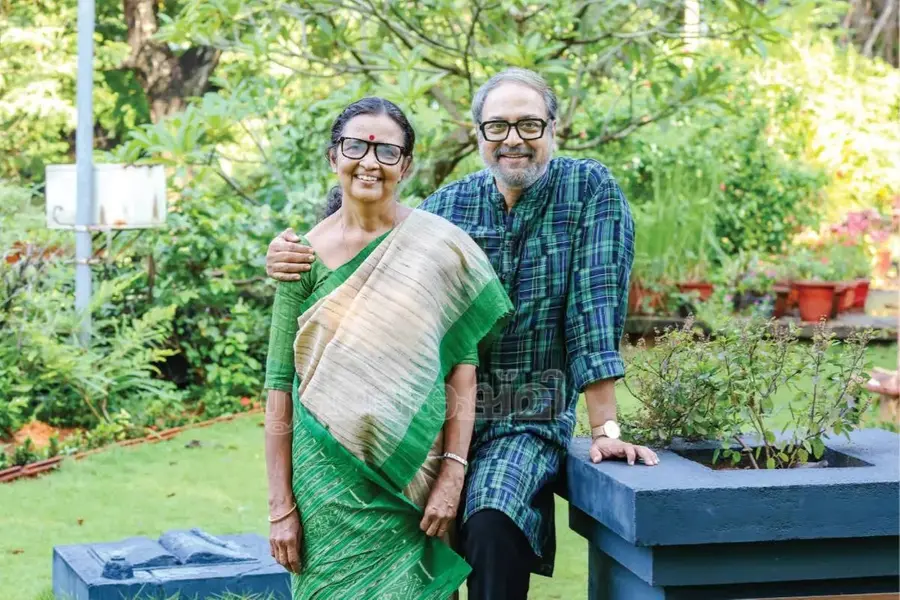
At filmmaker, writer and actor Madhupal’s home at Kanjiramppara in Thiruvananthapuram, stories drift down like they are from the book shelves of his sitting room. Tales from a life well lived, shared with his wife Rekha Vasumathi, daughters Madhavi and Meenakshi, and his mother Rugmini. In the midst of his hectic schedule—balancing cinema, writing and his role as chairman of the Kerala State Cultural Welfare Fund—Madhupal takes time to be, simply, a father and husband.
He never intended to become an actor, he says with a quiet laugh. That part of his life, like much else, happened without warning.
The journey begins
Madhupal’s journey began, quite unceremoniously, on a bus from Kochi to Palakkad in 1985. It was there that he met Rekha, a student at the Panangad Fisheries College. A conversation led to an exchange of addresses, and soon, a friendship blossomed through letters. When they married in 1989, Madhupal was still a young man with dreams of cinema. His father Chenkalath Madhavan Menon, who ran cinema theatres in Palakkad, had passed on a deep love for film. His mother Kannambath Rugmini, a kind-hearted woman with a love for books and cinema, gently guided her son into the worlds of writing and storytelling.
After dabbling in a few telefilms as an assistant director, Madhupal decided to pursue cinema seriously. Rekha, already working in a government job, was his greatest strength. “I have a job,” she told him then. “That’s enough. You chase your dreams.” Madhupal credits her unwavering support for everything that followed.
In 1990, the couple moved to Thiruvananthapuram. That same year, their first daughter, Madhavi (affectionately called Ammu), was born—on the very day Madhupal began working on his first film as an assistant director, Yamanam, directed by Bharath Gopy. “I went straight from the hospital to the film set,” he recalls. “Even when they were discharged, I wasn’t there to take them home. That’s how late I arrived in the world of cinema—into the quiet world of art films, not the glitter of mainstream cinema.”
The absent father
The stories sparked memories for his daughters, who had their own bone to pick. “He never came to a single PTA meeting,” said Meenakshi, the younger one, half-laughing, half-serious. “True,” added Madhavi. “But he did visit my school once—as a guest!” That, too, was during a period when Madhupal was in constant demand as an actor—racing from set to set, playing leads and villains alike. “He didn’t even know which class we were in!” they tease, but they understand. “We grew up watching him run from film to film.”
Eventually, when he took a step back from acting and embraced direction, life at home slowed down, and the girls got more of their father.
Madhavi, now a journalist and writer for online platforms, holds degrees in journalism and demography. She is married to Aravind, a merchant navy engineer, and their daughter Janaki is the family’s newest joy. Meenakshi, the younger daughter, works as a software engineer in Technopark. Both sisters agree on their favourite film by their father—Ozhimuri. Of his performances, Madhavi loves Guru, while Meenakshi favours the villain in Kashmeeram.
Gopy’s five thousand
Working with Bharath Gopy on Yamanam was like attending a film school, says Madhupal. “I was with the film for three months, observing every little detail. When it was done, Gopyettan handed me a bundle of notes. I opened it—five thousand rupees. A fortune back then.”
That film also introduced him to art director Rajeev Anchal, who became a dear friend and mentor. Madhupal’s next role—as assistant director—came in Rajeev’s film Butterflies, initially titled Australia.
The accidental actor
He never dreamt of becoming an actor, yet fate had other plans. During a shoot in Delhi for Kashmeeram, a key actor dropped out at the last moment. Rajeev Anchal turned to Madhupal: “Can you do the role?” And just like that, he became the villain in a film that audiences still remember.
What followed was a flood of roles, too many to count. “It was the time my children missed me most,” he says. “That absence—running between sets—meant I wasn’t around much.” Directing films brought back the balance.
In 2008, Thalappavu, his directorial debut based on the life of a Naxalite and the policeman who executed him, marked his emergence as a powerful voice in Malayalam cinema. The film won state awards for Best Debut Director and Best Actor (Lal), and went on to international acclaim.
His 2012 film Ozhimuri, scripted by Jeyamohan, won 15 awards including recognition at the Indonesia Film Festival. His third directorial, Oru Kuprasidha Payyan, was released in 2018.
Each film navigated history, politics and beauty with equal care. He is now preparing for his next.
The culture of creativity
It was at Kalapeedam, an art space at Karikkamuri in Ernakulam, run by Kaladharan, that Madhupal found his artistic bearings. “It was a place where painting, music, cinema and conversations all came together.” He would interview visitors there and write for Mathrubhumi Weekly. That was also when his short stories started appearing in leading magazines.
Writers like P F Mathews (Mathachan), Thomas Joseph and George Joseph were key influences.
“Whatever you write should live beyond the page,” Mathews once told him—a piece of advice he follows to this day. Many of his earlier short stories were never compiled into anthologies, simply because he didn’t feel they stood the test of time.
The man who loves to travel
“Travel frees a person, dissolves ego, purifies the self,” says Madhupal, who finds deep joy in exploration. “Even the same place can offer different experiences depending on who you're with, when you go or what you’re seeking.” A visit to Sri Lanka left such an impression on him that he returned soon after—with his whole family.
“I’ve travelled all over Kerala,” he says, “and nowhere else have I felt such a strong connection to the land. No place embraces nature the way Kerala does.”
Fifteen rented homes later
In 1990, Madhupal moved with his family to Thiruvananthapuram. Since then, they’ve lived in 15 different rented houses—from Kavadiyar to Vazhuthacaud to Kanjiramppara. “Owning a house just kept getting postponed for various reasons,” he says with a shrug.
Perhaps that nomadic rhythm is what helped him make Ozhimuri—a film that delved deep into the matrilineal Nair households of southern Kerala, despite being a Malabar native himself. The answers to that question, it seems, lie not in geography—but in a life shaped by stories, curiosity and empathy.
Published: 25 Jun 2025, 09:50 pm IST
Disclaimer: Kindly avoid objectionable, derogatory, unlawful and lewd comments, while responding to reports. Such comments are punishable under cyber laws. Please keep away from personal attacks. The opinions expressed here are the personal opinions of readers and not that of Mathrubhumi.
