
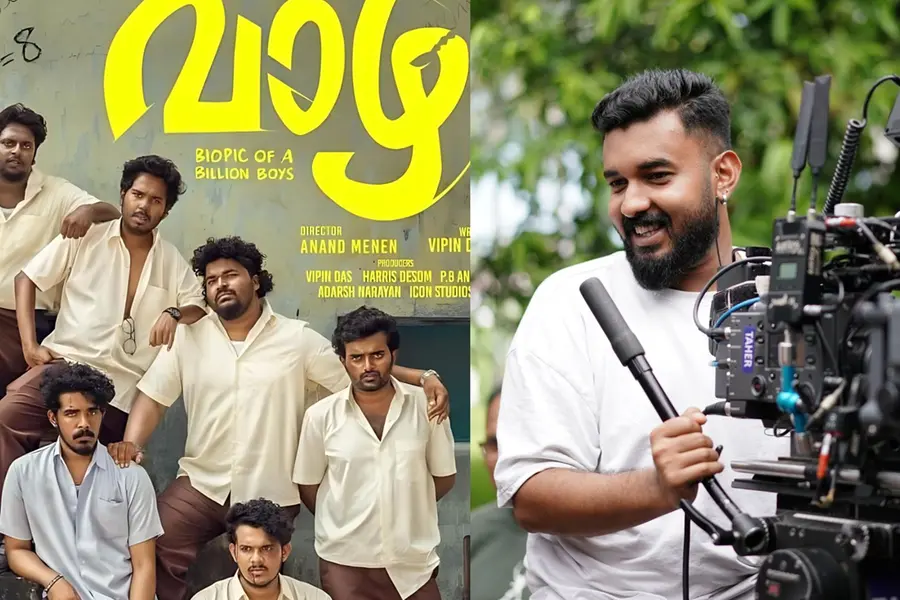
Young cinematographer Aravind Puthussery brings a fresh and dynamic vision to the Malayalam film industry as the cinematographer of Vaazha: Biopic of a Billion Boys. Since embarking on his career in 2015, this Thiruvananthapuram native has carved out a distinguished path for himself.
Having assisted acclaimed Cinematographer MJ Radhakrishnan on six films and Rajeev Ravi on the critically-lauded Virus, Aravind has built a solid foundation in the field. He has worked with Dr Biju on three movies, and has worked as Chief Associate Cinematographer on Naradhan and Second Unit Cinematographer on Guruvayoor Ambalanadayil.
With his latest project, Vaazha, marking his 18th film, Aravind's career is a testament to his artistic vision. In an interview with Mathrubhumi English, he delves into his journey -- specifically in Vaazha -- the challenges he faced, and the creative processes behind his work.
What was your experience working as the cinematographer on your first independent film?
The project came about quite unexpectedly. There was a four-month break during the shooting of Guruvayoor Ambalanadayil because actor Prithviraj had an accident on another set. This gap created an opportunity to plan this project. Although they had initially started shooting with another cinematographer, things didn’t work out, which is when I was brought in. They had originally contacted me earlier, but I felt I wasn’t ready for independent work at that time. Eventually, I decided to take on the role.
The lack of preparation time made the project challenging, but I enjoy challenges. I went with the flow. I had the chance to work with MJ Radhakrishnan, one of my biggest influences. He’s known for his on-the-spot approach rather than extensive pre-work, which proved very beneficial for me. Sometimes, unplanned elements lead to the most special outcomes.
Did you anticipate the movie becoming a success?
Initially, no. However, as we progressed through the work and reached the post-production stage, we began to sense that it might become a hit. The final preview gave us the impression that it would work well with the audience.
The bicycle racing scene at the beginning of the movie effectively established the strength of the cinematography. Was this a deliberate choice for a first-time independent cinematographer, or did it happen by chance?
The sequence was included in the script and its execution was discussed among myself, the editor, and the director. It was actually filmed during the second schedule. We planned for it to be dynamic, incorporating zooms, crashes, gimbals, drones, and running shots within the cycling scenes. The initial shot received positive feedback from everyone. We’re pleased that we were able to achieve the desired effect with the setup we had.
The writer of the movie, Vipin Das, is well-known for his directorial work on 'Guruvayoor Ambalanadayil' and 'Jaya Jaya Jaya Jaya Hey'. How was it working with him?
Since I had previously worked with him on Guruvayoor Ambalanadayil, I was already familiar with his style. He excels at improvising key scenes, which made working with him both challenging and rewarding. His experience and guidance were invaluable.
The script is a major strength of the film. While reading it on our own might not fully capture the intended mood, his narration during script reading sessions reveals the film's mood and pace more effectively. This makes the script come alive and helps everyone understand the vision more clearly.

The first half of the movie was mostly comedic whereas the second half has more of a sentimental undertone. What were the major differences in handling each of these emotions?
Basically, I was instructed that this film should have a very grounded, candid feel. As a result, we used a handheld, fluid approach throughout the movie. The lighting was also kept natural and grounded rather than cinematic. We prioritised capturing emotions over simply making the visuals beautiful. Lensing and framing were primarily focused on the emotional aspects of each scene, using very natural light.
This approach was consistent throughout the film. Even the comedy scenes were shot with a breathy feel, as if observing the events from among the actors. The style shifts towards the end when the drama intensifies, introducing more static shots and track movements. Track movements and other techniques were kept to a minimum, with the basic idea being to use minimal techniques overall.
The college fight scene was shot with a stunt master at Irinjalakuda Christ School, which served as the college location in the movie. We only had permission to shoot on Sundays. It was definitely a challenge. This was my first time shooting a fight scene, despite having worked on over 16 movies. I hadn't encountered such intense fight scenes before, so it was very interesting and a great learning experience.
There were some challenges due to the overtime work, but that’s part of the process in a small-budget film. We also faced time constraints, but everything was executed smoothly.
What was the major challenge of managing the movie’s cinematography single-handedly, and how did you make the judgement calls?
Although there was a basic overall plan, there was no detailed pre-planning, so much of the work was done on the spot. We often had to adapt and divide scenes based on the actors' performances. Actors would rehearse their parts, sometimes adding their own inputs, which meant adjustments to the plan. Proper shot division would only be established once we had a sense of the actors' performances and the scene's dynamics.
As we addressed lighting and other technical aspects, we would discuss and refine the plan with the director, writer, and other team members. During these discussions, we would evaluate which shots would be most effective. Despite this, we largely adhered to the basic plan, making adjustments as needed based on real-time feedback and observations.
What did you find the most challenging part to shoot in the movie?
The most challenging parts to shoot were the fight scenes and the cycle chase scene, as they required a significant amount of physical effort. The cycle chase scene, filmed in April, took place entirely outdoors under the scorching sun and heat. Everyone was exhausted from the heat -- actors had to ride bicycles back and forth, while technicians and gimbal operators had to run around with heavy equipment. Despite the physical strain, the immense mental satisfaction after completing a well-executed sequence made it worthwhile.
The first schedule of the movie was particularly tight. We had numerous late-night shoots, with the college phase -- making up a major part of the film -- primarily shot during this period. Most of the work was done at night. Rain also posed a significant issue during this schedule. A lengthy scene in front of the general hospital took several days to complete due to repeated postponements caused by rain. The first schedule was thus physically and logistically demanding.
The second schedule, which took place in March-April, also involved massive heat but didn’t disrupt shooting. It was hectic but manageable. Although the fight scenes were physically challenging, working on something I enjoy was ultimately satisfying. The experience of pushing through the work brought a sense of exhilaration, with no significant mental stress.
Which part of the movie did you find most enjoyable to shoot?
The entire film was a pleasure to work on, but if I had to highlight one part, it would be the climax. The emotional drama in those final scenes was shot using a distinctive approach. It was exciting. The shift in tone during this segment was especially engaging, and it was thrilling to see how it all came together.
Since the authoritative style of directors is less prominent now compared to earlier times -- such as John Abraham’s declaration of being “the Hitler of my cinema" -- how would you describe Anand’s involvement in the film as a director?
The actors, the director, and I were all from the same age group and had similar experiences. There were no veterans among us, and a hierarchical mentality was absent. Anand (the director) made the final decisions, and we sought his input for the final word. However, he did not use an authoritative approach. Anand’s team and my team exchanged feedback throughout the process.
We also benefited greatly from the guidance of Vipin, who is more experienced and whom we all admire. His input was invaluable. Overall, the production was a collaborative effort, which contributed to the movie's success as well. It was a true testament of give-and-take and teamwork.
How did the initial vision of the movie’s cinematography turn out when completed? Did it work out as planned?
Naturally, having previously worked with MJ Radhakrishnan and Rajeev Ravi, I have been greatly influenced by their work and training. However, as I mentioned, I joined the project at the last minute, so I didn’t have a pre-planned vision. My ideas were developed as I progressed through the film. The basic concept was provided by Anand and Vipin. Based on their input, my work was done in a 'build as we go' approach. Normally, pre-production and references are essential parts of the preparation process, but since this was a last-minute project, that didn’t happen. Despite this, the outcome aligned with my initial vision and worked out as I had hoped.
Considering the entire film, do you think any particular part was considerably enhanced by the cinematography?
Not just cinematography, but every element contributed to the film’s success. I believe that cinematography should seamlessly blend into the movie rather than stand out. I hope we achieved that. However, if I had to highlight specific moments, it would be the fight sequence and the bicycle racing scene at the beginning. To enhance their dynamics, which required the most attention, techniques were explored. Other scenes were filmed in a more straightforward, grounded manner.
Were you inspired by any cinematographers or their styles while making this movie?
Since I joined the project at the last minute, there was no time or opportunity for references. Typically, when working on films, various cinematographic techniques and colour palettes are used as references. However, given the time constraints and circumstances, I had to rely on my instincts and work with what came to mind in the moment.
After the movie's release, do you think anything could have been done differently, such as changing any scenes?
Personally, I never achieve 100 percent satisfaction with any project I work on. It’s not in my nature to feel completely content. I always believe that there’s room for improvement in every scene. There are various constraints, such as joining the project at the last minute, time limitations, and availability issues. I often think each scene could have been executed better. I scrutinise my work closely and am rarely fully satisfied. I am content with the overall film, but I believe my work could have been improved even further.
What about future projects?
Future projects are currently in discussion, but nothing has been confirmed yet. Will have updates soon.
Do you have any plans to venture into directing?
Not at the moment. Right now, I am focusing on cinematography.
Published: 01 Sept 2024, 02:52 pm IST
ABOUT THE AUTHOR
Related Topics
Disclaimer: Kindly avoid objectionable, derogatory, unlawful and lewd comments, while responding to reports. Such comments are punishable under cyber laws. Please keep away from personal attacks. The opinions expressed here are the personal opinions of readers and not that of Mathrubhumi.