
The film explores themes of identity, silence, and human complexity against the backdrop of political unrest.
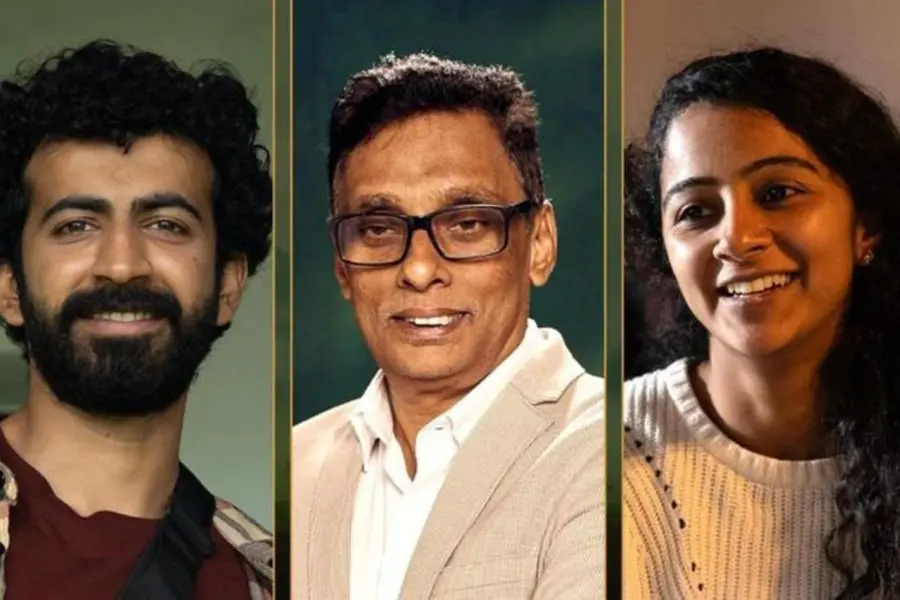
‘Paradise’, the critically acclaimed film featuring Roshan Mathew and Darshana Rajendran in the lead roles, recently dropped on the OTT platform MUBI. Directed by celebrated Sri Lankan filmmaker Prasanna Vithanage, the film explores themes of identity, silence, and human complexity against the backdrop of political unrest. In this exclusive conversation with Mathrubhumi English, Vithanage speaks candidly about the deeply personal nature of Paradise, his enduring creative partnership with Indian cinema, and why silence, more than dialogue, often holds the emotional truth in his storytelling.
Q. 'Paradise' was initially released in 2023 and has now arrived on MUBI. The film has received immense love. Looking back at the reception, how do you feel?
Prasanna: Elated! I’m genuinely happy. For a filmmaker, more than awards or accolades, what truly matters is when the audience, critics, and journalists pick up on the subtle, hidden layers of a film — the things that aren’t immediately obvious.
When 'Paradise' released in India, it gave me immense joy. I grew up watching Indian cinema — not just films, but also engaging with Indian literature, politics, and culture. So to see my film being released in Kerala, in Tamil Nadu — places I’ve frequently visited — and to feel like I was part of India’s film culture, that was the most rewarding aspect of the 'Paradise' journey.
Q. You, Roshan Mathew, and Darshana Rajendran all come from a theatre background. How does that experience influence your approach to filmmaking?
Prasanna: Every theatre actor and director knows how challenging acting is. It’s no easy task to truly step into someone else’s shoes and live as that character.
As a theatre director transitioning to film, I still deeply respect actors — even though cinema is typically considered a director’s medium. I believe one of the most important things a director can do is create an atmosphere where actors can deliver their most honest and uninhibited performances. That sensitivity definitely comes from my theatre background.
Roshan and Darshana still actively do theatre while working in cinema, and I admire that. It created a strong, positive energy among the three of us. We didn’t have to constantly talk about how much we respect actors — it was evident in how we worked together.
Roshan, being a star, could have chosen the safer route. But he wasn't afraid to expose the fragile layers of male masculinity. It’s easy to portray toxic masculinity in a villainous light, but in reality, even the best of men carry traces of it. It’s hidden and sometimes erupts unexpectedly. I’m grateful to Roshan for embracing that complexity so fearlessly on screen.
As for Darshana, she portrayed her character with such precision. Women often suppress their emotions, especially within the framework of marriage. That suppression might not be voiced, but it shows — in silence, in a look. Darshana mastered the timing of those silences and expressions. Her performance was brilliant.
Q. The silence in 'Paradise' speaks volumes. How did you conceptualize this?
Prasanna: Silence can be as powerful as music. In real life, we don’t speak constantly. Silence occupies more space than dialogue. But in films, characters are often treated as talking heads — always expressive, always verbal. That’s not reality. Most people hide their emotions beneath silence.
In my films, I try to capture that truth. Silence is part of that. Sometimes, silence can even be a weapon — especially in relationships. A man doesn’t have to shout or use abusive words; his silence alone can be oppressive.
In 'Paradise', silence is not just a stylistic choice — it’s deeply embedded in the characters, especially in Keshav’s. It reflects the way I see life and how I try to portray it in cinema.
Q. You've said 'Paradise' is one of your most personal films. During the writing or directing process, was there a moment that felt creatively or emotionally liberating?
Prasanna: Every time I make a film, I believe it should feel personal. Otherwise, I’m just repeating myself.
A story doesn’t have to be based on your own experiences, but it should become personal in the way you tell it. That’s what I believe. You have to enter the heart of every character, feel their pulse, live their truth. I always ask myself — am I truly going deep, or am I just skimming the surface? If I’m being honest, filmmaking is often cathartic. It gives you a sense of emotional release — a kind of healing.
Q. Your films often engage with Sri Lanka’s socio-political realities. But in 'Paradise', you chose to tell the story through the lens of an Indian couple. Was that a conscious decision to bring in an outsider’s perspective?
Prasanna: Let me tell you a little about myself. I’ve been coming to India since 1993, and I’ve spent almost half my life here. I feel that the destiny of India is in some ways intertwined with mine. I have friends here. I understand their aspirations.
The themes in 'Paradise' — middle-class indifference, the pursuit of upward mobility — are not unique to India. They exist in Sri Lanka too. But yes, I do see it in cities like Mumbai, Kochi, Trivandrum, or even Chennai, where I’ve spent time. What I depicted in 'Paradise' is based on lived experiences, observations, and stories shared by friends and loved ones here.
I never tried to intellectualize the story. I approached it with empathy. Every character has their reasons, their truths.
Q. Do you feel there’s a difference between Indian and Sri Lankan cinema, or is it mainly a difference in language?
Prasanna: I first watched Pather Panchali when I was in Grade 8, and it had a profound impact on me. The poetry, the dignity, the life in that film — it changed everything. After that, I watched everything I could by Satyajit Ray, Adoor Gopalakrishnan, Ritwik Ghatak, Bimal Roy, and Guru Dutt.
These filmmakers awakened certain truths within me — truths I didn’t know how to articulate until I saw them on screen. Like in ‘Aparajito’, the relationship between a mother and son — that’s universal. It could be in India or Sri Lanka.
What I realized is that some filmmakers, regardless of where they’re from — Kerala, Assam, Mumbai, Europe, the U.S., Africa, the Middle East — are seeking truth through their art. That’s the club I want to belong to. Not every filmmaker does. Some aim to offer escapism, to make the audience forget their reality for two or three hours. I don’t judge that — but that’s not me. I want to show the reality.
Q. You’ve spoken about the impact filmmakers like Satyajit Ray and Guru Dutt had on you. Are there any recent Indian films or filmmakers who’ve left a lasting impression?
Prasanna: Yes, absolutely. Chaitanya Tamhane’s ‘Court’ (2015) is one such film — deeply impactful. I also loved ‘Udaan’ and Anurag Kashyap’s ‘Black Friday’. And although it’s not recent, Adoor’s ‘Elippathayam’ is unforgettable.
There are others too. For instance, PS Vinothraj's ‘Pebbles’. It's a Tamil film and incredibly original, cinematically speaking.
When I visit Kochi, young filmmakers often meet me to share their short films or independent features. Many of these may never reach theatres, but the potential I see in them is immense.
And how can I not mention ‘All We Imagine As Light’? It’s a brilliant film — a beautiful, deeply human piece of cinema.
Q. What’s the next ‘personal’ project you’re working on? And like ‘Paradise’, are there more Indian collaborations in the pipeline?
Prasanna: Every film I make is deeply personal. Even the one I did with a historical backdrop became a personal exploration — because it dealt with identity. In Sri Lanka, many people, especially ethnic minorities and those from marginalized communities, have suffered due to the ethnic conflict. When identity becomes the reason for division and violence, it’s no longer just a political issue — it becomes a deeply personal one.
As for Indian collaborations — ever since 2008, every film of mine has been in partnership with India. I’ve survived as a filmmaker because of that support. Indian collaborators have helped me tell my stories, and I truly hope that continues in the future.
In fact, I’m currently in talks for a hybrid project — a feature-length documentary — which also involves Indian characters. So yes, that collaboration continues, and for good reason. I feel India is a part of me — emotionally, culturally, and creatively. I’ve been shaped by its rich traditions in philosophy, literature, theatre, and art. And most of all, by its people.
Published: 19 Jul 2025, 08:26 pm IST
Disclaimer: Kindly avoid objectionable, derogatory, unlawful and lewd comments, while responding to reports. Such comments are punishable under cyber laws. Please keep away from personal attacks. The opinions expressed here are the personal opinions of readers and not that of Mathrubhumi.
