
National Award-winning director Nagesh Kukunoor discusses his new web series, `The Hunt,` exploring the Rajiv Gandhi assassination. An exclusive interview.
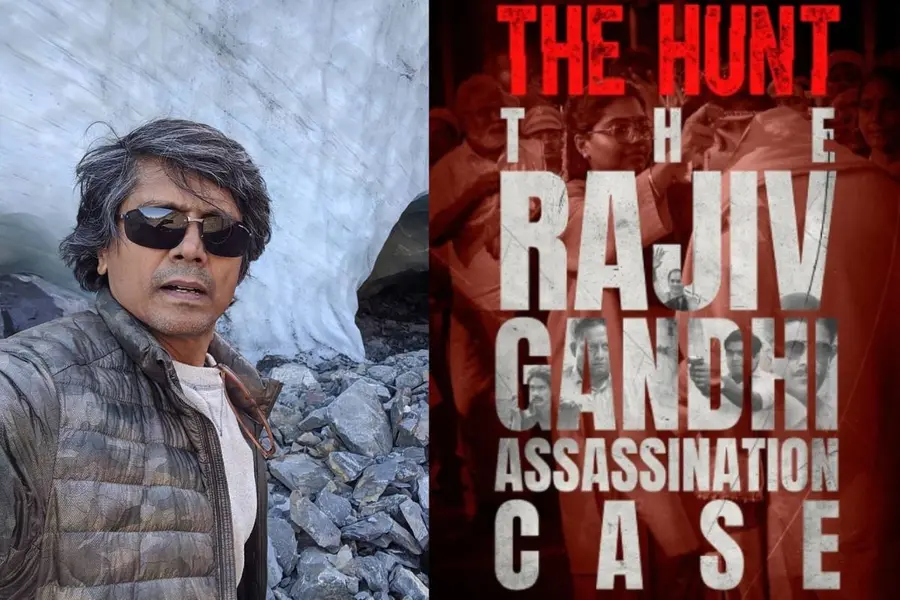
With a filmography that has consistently challenged the mainstream, National Award-winning filmmaker Nagesh Kukunoor has carved a distinct space for himself in Indian cinema. Best known for his pathbreaking works like ‘Hyderabad Blues’, ‘3 Deewarein’, ‘Iqbal’, and ‘Dor’, Nagesh is a storyteller who thrives on bringing realism in his stories. In this exclusive interview with Mathrubhumi English, the director opens up about his much-anticipated web series, ‘The Hunt: The Rajiv Gandhi Assassination Case’, which begins streaming this Friday on Sony LIV.
Starring the formidable Amit Sial in the lead, ‘The Hunt’ revisits one of the most shocking chapters in India’s political history — the 1991 assassination of former Prime Minister Rajiv Gandhi — through the lens of a gripping investigative thriller.
Speaking candidly, Nagesh takes us behind the scenes of the series: from the extensive research that went into the project, to the tightrope walk of adapting real-life events without sensationalism, and the importance of staying true to facts. True to his philosophy, he also shares why his work has never been star-driven — and why performance, not popularity, remains the cornerstone of his casting choices. Read excerpts from the interview:
Q. This is the first time that you’re tackling a real-life political assassination that shook the entire nation. What drew you to ‘The Hunt’, and what are the things that the show explores that may not have been showcased in past works that are made on the case?
Nagesh: I’ve been with 'City of Dreams' for three whole seasons. I have been doing a lot of political shows, but the beauty of 'City of Dreams' is that I can cook up whatever I want with my fellow writer, because it’s pure fiction. The difference with this is that the incident actually took place, and what followed since the assassination also took place. One has to be very careful with the veracity of our accounts and the manner in which we are presenting the material.
What drew me to this, and why it is unique from everything that was done previously, is very simple — Anirudhya Mitra’s book ‘90 Days – The True Story of the Hunt for Rajiv Gandhi’s Assassins’ deals with what happened after the assassination. When you talk about a lot of stuff that was made on the Rajiv Gandhi assassination, you are primarily talking about the events before, the stuff that led up to it, what happened, and yes, there is a fair amount of reporting that was done after. This — the web series — is based on the book, plays out purely as a thriller, and plays out as a crime police procedural, and that is what attracted me to it.
Even though I have been doing a political show for the last five to six years, I made sure I steer clear of anything that has to do with present-day politics. What we write is purely fictional. In the same way, while writing this show, I had to be very careful that I would not weigh in on any politics; I stuck purely to the thrilling part of the police investigation. And that is how I said yes to the show when it was offered to me. A lot of the stuff that happens in the book is jaw-dropping. Like I said, it’s a thriller, and while you’re watching, you’re like, ‘Oh my god! Did that really happen?’ All of us were around at that time when the actual assassination happened. You follow the events as and how it was reported in the days after, and eventually, when it led to its conclusion, but the nuts and bolts of how it played out — when you actually get into the making of the web series — it is like, ‘Oh my god!’ And that’s why I did it.
Q. You’ve always had a deep respect for realism in your storytelling, which is also evident with ‘The Hunt’. When adapting a real-life investigation, especially one as sensitive as this, how did you strike a balance between keeping it close to the facts and less of dramatization?
Nagesh: Two things had to obviously play out… One is, how do you make it appealing to the audience? If you just present it purely as a documentary, then you have people going, ‘That’s good,’ but you know, they will just switch it off. On the other hand, if you just sensationalize it and misrepresent the facts, that is not the kind of filmmaker that I am; that is something that would never happen. I would pay very close attention to it.
The third most important thing is the sensitivity (of the subject), because there are a lot of people who are involved, who are still alive. I wanted to make sure that everything that happened—and I guarantee that we are not going to land 100% perfect of exactly the way everything unfolded, every meeting or the dialogue spoken by the character—that is the stretch. There is no way a lot of this stuff we would ever have had access to, and as a matter of fact, there is a lot of stuff that is reported, that there is an outcome of an event, but the exact details were never mentioned.
It was a real tightrope walk. But the most important thing is, in my worldview, presenting it with a very healthy dose of reality, the way I see the world, so I don’t ever want to stray from it. I use drones for minimal effect, but all of a sudden, I’m not going in and around people’s legs, and the camera is coming out elsewhere. Here (in the series), the camera is minimally invasive, just presenting as it is. Please remember that the most important thing is that the actual facts are so dramatic and shocking that just putting a camera and letting people talk is enough. When you see the show, you will realize that.
Q. What kind of research process did you and your team undergo for ‘The Hunt’? Were there any moments that made you completely rethink how you’d approach the series?
Nagesh: We placed a bulk of our faith and research into Anirudhya’s book. It’s very simple, because you also want to keep all the legality and the paperwork intact. You can’t just randomly keep pulling up stuff saying, ‘I read this here, I read this there.’ However, we did do all our research by reading articles and stuff like that, just to make sure that there was some degree of accuracy to back it up. So, blindly just taking an event and writing whatever you want — we did not do that.
The problem is that the amount of information that is out there is limited, in the sense that it’s all reported by the journalists of that time. Anirudhya himself, being a journalist — his account — he had access to a lot of people up top, arguably one of the closest that you can get to the most dramatic events that got played out. The source material that we had (his book) was probably the best thing moving forward. Therefore, the decision was made to keep the book as the primary source and run with it. We did the other research to supplement it whenever we were getting into the specific scenes.
Now, this happens on any web series or film you’re working on. When you’re filming, there is a continuous question — when you write words on paper, when you write dialogues, it comes in a certain way. So, to answer your question, there was tailoring that was done on set, because at no point did I want to offend the people who are already out there, living, and have been a huge part of this process. I wanted to present them as accurately as possible, and as humanely as possible. And this goes out to both sides — the SIT as well as all the LTTE members who are out there — because presenting them as human beings being driven by their own set of circumstances is far more important to me than pointing fingers.
Q. You’ve assembled a cast of top-notch actors. In an age of star-driven content, what goes into your casting decisions?
Nagesh: One thing I am always proud of is my casting, because I have never been star-driven or hero-driven; names don’t matter to me. But if I get them and I get a larger budget, then it’s a bonus, but the person has to fit the role.
In ‘The Hunt’, we had something else to go by or on. We had to try and see if the actors we cast were visually close to the characters they were playing; we were bound by that. The biggest, most amazing turn of fortune in this entire show was Sahil Vaid. The reason is simple — he was one character we had to hand our hat to who could speak Hindi and Tamil with ease. Both languages with ease.
Now, I could have cast a character who spoke good Hindi, and then he invests the next six to eight months to pick up the Tamil dialect well. The Tamil dialect is so freaking difficult that people, when they attempt it, the actual people who speak Tamil can sense it from a mile away that it’s b**shit.
I spent a good chunk of time in Tamil Nadu; as a matter of fact, I went to boarding school in Tamil Nadu. At one time, I used to speak Tamil relatively well, not like Sahil. That boarding school was located in Yercaud, and the next big town located close to Yercaud is Salem. And guess where Sahil grew up? Salem!
You’re talking about where all the conspiracy things come into play, and you’re drawing all the strings… I get an actor who is not only good, whose Hindi is, of course, one needn’t bring into question, and he starts speaking in Tamil, and I go, ‘How did this even happen?’
And once I have an actor of a certain standing, I’m not concerned about what work they have done in the past. I like completely casting against the type, and that was it! We had SP Amit Verma — the hothead chap!
Q. The series maintains a gripping pace without faltering or dragging the scenes. How involved were you in the edit room, and what were the key decisions you made to keep it taut?
Nagesh: I have a great editor, Farooq Hundekar, who cut the show and has been cutting my other shows as well. I totally trust Farooq!
How much does a director get involved in the editing? 100% or maybe like a 1000%! It is because the editor — he or she — builds everything. Finally, I have to say yes. The moment I say yes, the ownership is mine; you cannot blame the editor anymore. That is where the trust factor comes in. We’re thinking along the same lines… I am someone who hires professionals, completely trusting them, but the final say will always be mine. It is because I will take the responsibility, good or bad.
With ‘The Hunt’, I did something which is not different from the process that I follow with every single thing, going all the way back up to ‘Hyderabad Blues’. ‘Hyderabad Blues’ was 82 minutes. People said, “Make it 100, and if not 100, then keep it at 90,” which is a standard magical number. I didn’t want to pad it up with eight b**shit minutes. It landed at 82, and I left it at 82.
I have done this all my life, and I’m brutal with it. I’ll give a random example: in 'City of Dreams', there is one sequel that was shot on the last day, and arguably the most expensive sequence that I have ever done in a show. Two days later, when I was editing it, I said, “This doesn’t fit in the show,” and I cut it. It was a big sequence with Atul Kulkarni and Uday Tikekar.
I am very brutal with my stuff, so I have no issues letting it go. My idea is to give the audience less — that is okay. Just don’t give them too much. Don’t fall in love with your material.
Published: 02 Jul 2025, 03:54 pm IST
Disclaimer: Kindly avoid objectionable, derogatory, unlawful and lewd comments, while responding to reports. Such comments are punishable under cyber laws. Please keep away from personal attacks. The opinions expressed here are the personal opinions of readers and not that of Mathrubhumi.
