
How does travel writing fare a time of the virtual wanderings on the internet? Are the travel writers facing any challenges typical of the changing times?
But the who and who of the travel writing denies it outrightly, and emphasise that till the date human life goes on with its known traits, its essential diversities and varieties, travelling and the writings on it will continue.
The venue was the Mathrubhoomi International Festival of Letters at Kanakakkunnu Palace in Thiruvananthapuram, and the discussion unequivocally emphasised that the days of travel writings are very bright through experiences and thoughts.
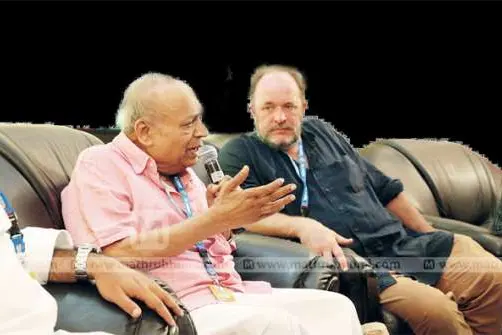
The discussion led by Shireen Quadri had proven talents from the field including William Dalrymple, M P Veerendra Kumar and Santhosh George Kulangara as panellists.
The travels begin from The Mahabharata and The Old Testament.
William Dalrymple, while giving away his introductory speech, remembered the human journey and the various routes it had taken over the times. The journeys started right from The Gilgamesh, The Mahabharata and The Old Testament. Later Xuanzang, Ibn Battuta and Marco Polo followed. And further, later Pico Iyer and Vikram Seth came. All of them ventured into their journey, different lands and wrote brilliantly about it. Today, when virtual journeys have become the correctitude, still there are places to go and there is a space to write about it.
Those are cloistered realms and places difficult for human beings to set foot.Be it the mountain ranges of Afghanistan or the largely prohibited areas of Iran and Syria, only a travelogue writer can do justice to such places. The writings on the well-known places, its details in minutia are also possible.
However poised and advanced the cyberworld will become, who will pass to us the smell of each land passed behind? Any writing, which cannot capture the smell, tastes and winds of each land, is destined to be lifeless.
What you talk to the man of the land forms the major part of any trip.
Veerendrakumar joined the discussion by sharing his experiences during his journeys. "When I went to Vienna, incidentally I asked a person there whether it was not the land of Hitler. But he retorted that he would prefer the place to be known as the land of Ludwig Wittgenstein, the noted philosopher.
When I was in Haridwar, a tea shop owner told me that it was 'Devabhoomi' the land of god, and on the banks of Bharathappuzha, a person described the land as 'Vedabhoomi' the land of Veda. In the Himalaya, a man showed me the place where Karna of the Mahabharata was cremated."
"Like this, what all you expire with the people of each land defines the nature of a journey to a considerable extent. A traveller should first set aside the thought that he was the one who knew so many things before he sets out for any trip. Every human being has a story to tell. We only have to give our ears. We can go ahead with a mind-boggling speed, but we have to come back, at least in the mind" Veerendrakumar said.
Until the magic of writing retains its spell, travel writing will continue to charm us all.
Renowned globetrotter Santhosh George Kulangara, who rose to fame with ‘Sancharam,’ a series of video travelogue programme, started with an experience he encountered during one of his trips to Cambodia.
“I started seeing the world through one eye while keeping the other glued to the viewfinder of my camera,” Kulangara said. “In Cambodia, I got a young man as my guide. He took me through the murderous lanes of Pol Pot.
“When I was taking a walk around the infamous concentration camps of Pol Pot, my guide was standing still, keenly looking at the photographs of people who were brutally killed by the mindless regime.
“Once we came out of the memorial, I asked him, ‘What were you searching for in those photographs?’ ‘My father,’ he said. ‘His picture was not there in that room. I’ll check other rooms when I come here next,’
“I could not capture this moving experience in my camera. I wrote it down later,” Kulangara said, elaborating on the compelling power of letters.
“Many have visited Mittayitheruve in Kozhikode across ages. But, S. K. Pottekkatt saw what no CCTV camera could ever see. And that gifted us the immortal work – Oru Theruvinte Kadha,” Kulangara said.
“Travel writing will remain strong till the magic of writing is not lost,” the travel enthusiast concluded.
Published: 03 Feb 2018, 11:23 am IST
Disclaimer: Kindly avoid objectionable, derogatory, unlawful and lewd comments, while responding to reports. Such comments are punishable under cyber laws. Please keep away from personal attacks. The opinions expressed here are the personal opinions of readers and not that of Mathrubhumi.
