
Know the significance of Margazhi Masam, its dates, religious observances, and its role in Tamil music and dance traditions across the world.
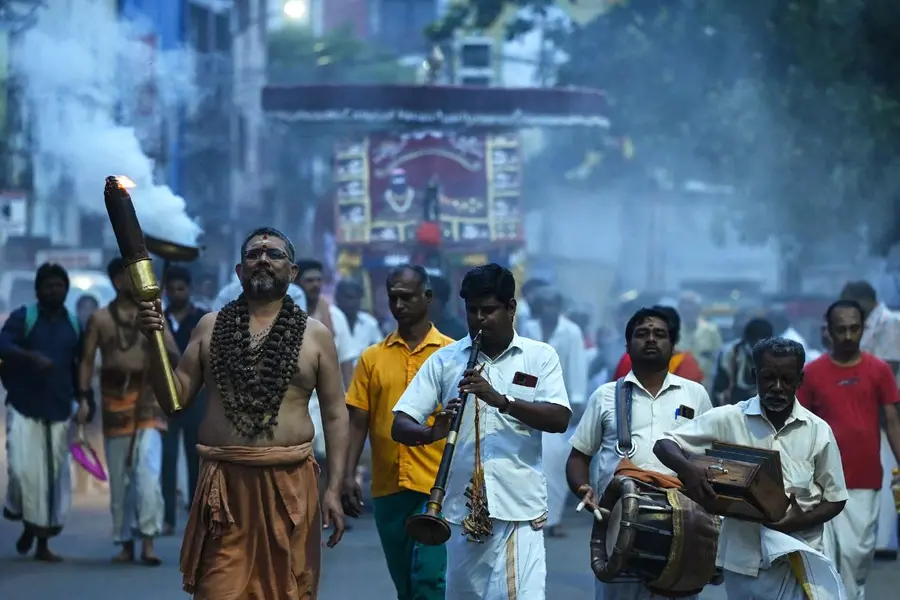
Margazhi Masam, the ninth month of the traditional Tamil calendar, is widely regarded as an auspicious period for devotees of both Shiva and Vishnu.
According to the Tamil calendar, Margazhi runs from December 16, 2025, to January 14, 2026. Also known as Margali Masam, it corresponds to Margashira Masam and the Poush month in other Hindu calendars. The period aligns with the Bengali months of Agrahayan and Poush, and with Dhanur Masam in the Malayalam calendar.
The month carries deep religious significance for Vaishnavites and Saivites alike. In Vaishnavite temples, Andal’s 'Thiruppavai' is recited daily, while Saivites chant 'Tiruvempavai' and 'Thirupalliezhuchi'. The 'Tiruvempavai' was composed by Manickavachagar at Thiruvannamalai.
Margazhi is closely linked to the Arudra star, when Lord Nataraja is believed to have revealed his cosmic dance to sages Vyagrapada and Patanjali. Of the five sacred temples representing the classical elements, Thiruvannamalai symbolises fire.
Known in Sanskrit as Margasheersha, the month is considered especially favourable for spiritual disciplines such as sadhana, vrata, bhajan and pooja among followers of Shiva, Shakti and Vishnu.
Religious observances intensify during this period, with households performing early-morning pujas. Kolams, intricate geometric designs formed with lines, curves and loops around a grid of dots, are drawn at entrances to welcome Lakshmi, the goddess of prosperity, and to ward off negative influences. While kolam drawing is a daily practice in Tamil Nadu and Sri Lanka, more elaborate and symbolic designs mark the Margazhi season.
Beyond its spiritual dimension, Margazhi is also a vibrant season for the arts, particularly music and dance. Artists and practitioners with Tamil roots across the world use this period to perform and present the disciplines they have trained in or continue to practise. In Chennai, various sabhas (Music and dance communities) and venues host an array of concerts and performances, a tradition mirrored in other parts of Tamil Nadu and in global centres where Tamil communities are present.
The Hindu calendar differs structurally from the Gregorian system. While the Gregorian calendar adjusts for the lunar–solar mismatch by adding days, the Hindu calendar preserves the lunar cycle and periodically inserts an additional month, roughly every 32 to 33 months, to ensure festivals and agricultural observances remain aligned with the seasons.
Published: 16 Dec 2025, 02:36 pm IST
Related Topics
Disclaimer: Kindly avoid objectionable, derogatory, unlawful and lewd comments, while responding to reports. Such comments are punishable under cyber laws. Please keep away from personal attacks. The opinions expressed here are the personal opinions of readers and not that of Mathrubhumi.
