
If your best ideas seem to arrive after dark, your daily routine may not be the only factor. Your body’s internal clock could play a role.
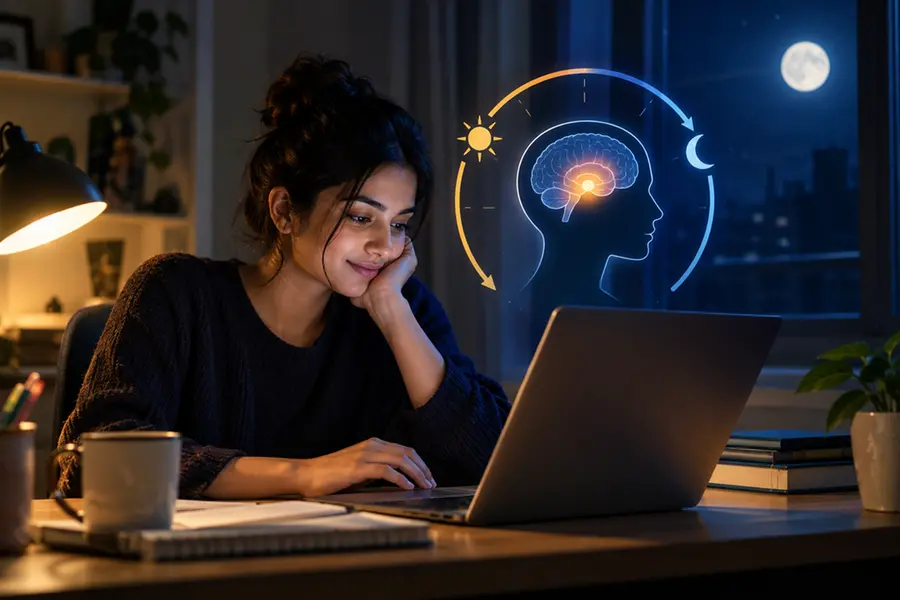
For some people, the day seems to begin only after sunset. While mornings may bring sluggishness and endless cups of coffee, concentration can suddenly sharpen at night. Emails feel easier to tackle, ideas flow more freely and unfinished work that seemed impossible in the afternoon suddenly feels manageable.
It is tempting to dismiss this as simply being a “night owl”. But when you feel most alert is partly shaped by your body’s internal timing system. Known as the circadian rhythm, this roughly 24-hour cycle influences sleep, alertness, hormones, body temperature and several other functions.
That means your late-night productivity may not be entirely about discipline, motivation or having fewer distractions. For some people, their biological clock naturally places their peak alertness later in the day.
Your body has its own timetable
The National Institutes of Health (NIH) explains that the body uses an internal clock to regulate when we feel awake and when we become ready for sleep. This clock works alongside another system: sleep pressure, which builds the longer we remain awake.
The master clock is located in a region of the brain called the suprachiasmatic nucleus, or SCN. It responds to signals from light reaching the eyes and helps coordinate biological rhythms throughout the body. According to the National Institute of General Medical Sciences (NIGMS), the system also influences processes including hormone release and body temperature.
So your energy levels are not expected to remain constant from morning to midnight. Alertness naturally rises and falls across the day as the circadian system and sleep pressure interact.
You may simply be an evening chronotype
People differ in when they naturally prefer to sleep, wake and be active. This tendency is known as chronotype. The US National Library of Medicine's Medical Subject Headings database defines chronotype as a person's natural preference for the time of day when they are most active, particularly in relation to their sleep-wake pattern.
Broadly, people can lean towards morningness or eveningness, although many fall somewhere between the two.
For someone with an evening chronotype, the biological timing of alertness may be shifted later. Research has found that cognitive performance can be better when a person's task schedule matches their preferred biological timing.
A study published in Sleep Medicine in 2022 examined chronotype and work productivity. Researchers found that earlier sleep was linked with better productivity among people with a morning preference, while later wake-up times were associated with better productivity among those with an evening preference. The researchers also highlighted the role of sleep disturbance in the relationship between chronotype and productivity.
Why night-time can feel like your peak
Your circadian rhythm does not simply switch from “awake” to “asleep” at sunset. Instead, it changes the body's level of alertness over the course of the day.
The Sleep Foundation explains that the circadian system and sleep pressure work together to determine how awake or sleepy you feel. This helps explain why alertness can rise again after an afternoon dip rather than steadily declining throughout the day.
For people whose internal timing runs later, that period of stronger alertness can occur later in the evening. Research published in PubMed has also found differences between morning and evening chronotypes in how alertness changes across the day. One study found that evening-type participants maintained their best alertness later into the night, while morning types showed a different pattern.
Another study involving 80 participants found that evening chronotypes showed enhanced performance later in the day, while morning chronotypes tended to perform better earlier.
This does not mean every night owl will automatically be more productive at night. Rather, the findings suggest that performance can depend partly on whether the timing of a task matches an individual's biological preference.
Light plays a major role
One of the strongest signals controlling the body clock is light.
According to NIGMS, the brain's master clock receives information about light through the eyes and uses it to regulate circadian rhythms. As daylight fades, the system increases signals involved in melatonin production, helping prepare the body for sleep.
The Sleep Foundation notes that melatonin generally rises in the evening as darkness sets in, while morning light suppresses its production and supports wakefulness.
This is also why modern evening habits can complicate the body's natural timetable. Bright artificial light and electronic screens can provide signals that resemble daytime exposure, potentially delaying sleep-related processes.
For a natural night owl, this can create an interesting contradiction: they may feel mentally switched on late at night, but staying awake for hours under artificial light can push their sleep schedule even later.
The problem with fighting your natural timing
Feeling productive at night is not necessarily a problem. The bigger issue can arise when your preferred schedule clashes with your responsibilities.
A person whose body naturally favours later sleep may still have to wake early for work, college or other commitments. Research on sleep timing and chronotype describes this mismatch between biological time and social schedules as “social jetlag”. Late chronotypes can accumulate sleep debt when they go to bed late but still have to wake early.
That can turn a productive evening into a cycle of insufficient sleep and difficult mornings.
The NIGMS also warns that disruptions to circadian rhythms, such as those caused by shift work or crossing time zones, can contribute to drowsiness, poor coordination and difficulty maintaining focus.
Should you force yourself to become a morning person?
Not necessarily. The goal is less about becoming a morning person and more about understanding when you naturally function best while protecting your sleep.
A 2025 systematic review of research into chronotype and cognitive performance found evidence of a “synchrony effect” in a substantial portion of studies, meaning some people performed better when cognitive tasks were carried out at their optimal time of day. However, the review also found that most studies did not show a simple overall effect of chronotype on cognitive function.
In other words, being an evening person does not automatically make you more productive, just as being an early riser does not guarantee better performance.
Instead, your most effective working hours may depend on the interaction between your chronotype, sleep quality and the time at which you are expected to perform.
Making your body clock work for you
If your concentration naturally peaks in the evening, that period can be useful for demanding tasks, provided it does not regularly cut into the amount of sleep you need.
Keeping sleep and wake times relatively consistent, getting natural light earlier in the day and reducing bright artificial light at night can help keep the circadian system aligned. The Sleep Foundation recommends gradual adjustments rather than abruptly changing your sleep schedule.
The important distinction is between being productive late because that is when your body naturally performs well and staying awake late because artificial light, screens or an irregular routine have pushed your sleep schedule back.
Your body clock may explain why midnight sometimes feels like your most productive hour. But productivity is only one part of the equation. The real goal is to find a schedule that works with your natural rhythm without sacrificing the sleep your brain and body need.
Published: 15 Sept 2026, 11:06 am IST
ABOUT THE AUTHOR

Related Topics
Disclaimer: Kindly avoid objectionable, derogatory, unlawful and lewd comments, while responding to reports. Such comments are punishable under cyber laws. Please keep away from personal attacks. The opinions expressed here are the personal opinions of readers and not that of Mathrubhumi.