
Egg freezing can preserve reproductive options, but age, egg quality, fertilisation, embryo development and implantation still shape the chances of having a baby.
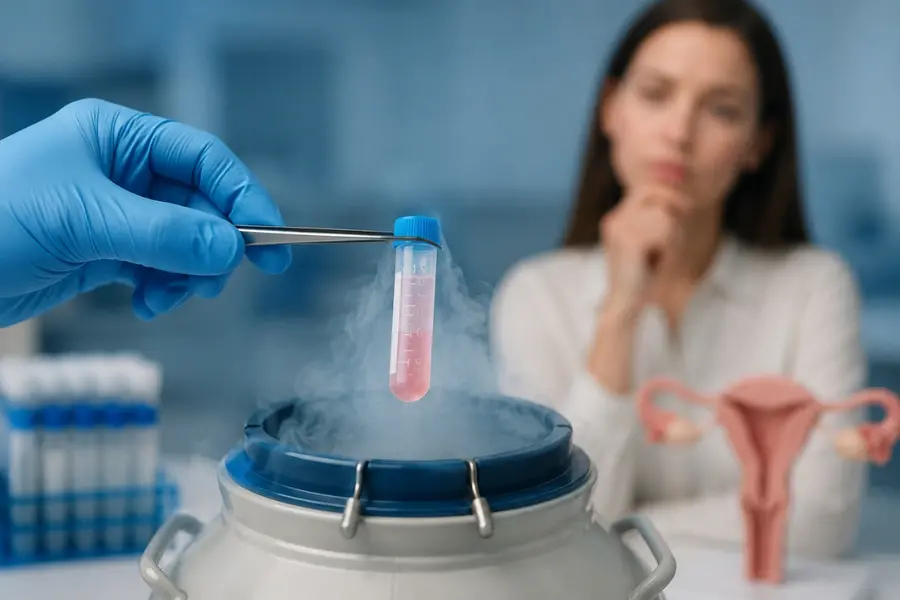
Egg freezing is no longer a procedure discussed only in specialist fertility clinics. As more women consider postponing motherhood for personal, professional or medical reasons, fertility preservation has become part of a wider conversation around reproductive choices.
But while freezing eggs can preserve an important reproductive option, it cannot guarantee a pregnancy or a baby in the future.
'The main myth would likely be the word 'guarantee'.
According to Dr. Deepthi Surendran, Fertility Specialist, Nova IVF Fertility, Palakkad, Kerala, egg freezing preserves eggs available at a particular point in a woman's reproductive life.
It does not freeze a future pregnancy or eliminate the biological factors that can influence whether those eggs eventually result in a successful birth.
What happens when eggs are frozen?
Egg freezing, medically known as oocyte cryopreservation, involves hormonal medication that stimulates the ovaries to develop multiple follicles during a menstrual cycle.
The eggs are subsequently collected through a procedure, and mature eggs are rapidly frozen using vitrification.
When a woman is ready to use them, the eggs are thawed and generally fertilised using intracytoplasmic sperm injection, or ICSI. The resulting embryos are then cultured in a laboratory before a suitable embryo is transferred into the uterus.
In other words, there are several stages between freezing an egg and having a baby.
An egg has to survive the thawing process, be successfully fertilised, develop into a viable embryo and then implant in the uterus to establish a pregnancy. Each stage can influence the eventual outcome.
Why does age matter when freezing eggs?
One of the most important factors in egg freezing is the woman's age at the time the eggs are retrieved.
Egg quantity and quality generally decline with age, while the likelihood of chromosomal abnormalities in eggs increases. Freezing eggs earlier can therefore preserve eggs before some of these age-related changes occur.
However, there is no universal 'perfect' age for every woman to freeze her eggs.
The decision depends on factors such as a woman's reproductive plans, ovarian reserve, overall health and how long she expects to postpone pregnancy.
Egg freezing can preserve the biological age of the eggs, but it does not stop reproductive ageing itself.
More eggs do not automatically mean a baby
Another misconception is that freezing a particular number of eggs guarantees a future pregnancy.
Not every egg retrieved during a cycle will be mature enough to freeze. Not every frozen egg will survive the thawing process, and not every surviving egg will fertilise successfully.
Even after fertilisation, some embryos may not develop sufficiently to be transferred. The number of eggs needed can also differ from woman to woman.
Age at the time of freezing, egg maturity, laboratory conditions and individual reproductive factors can all influence the chances of success.
This is why fertility specialists generally discuss probabilities and cumulative chances rather than promise a specific outcome.
Having a larger number of mature eggs preserved may improve the chances of eventually achieving a pregnancy, but it cannot guarantee one.
Egg freezing cannot address every fertility factor
Freezing eggs preserves the eggs, but pregnancy depends on several other factors too.
The health of the uterus can influence implantation and pregnancy. Sperm quality can affect fertilisation and embryo development. Other medical and reproductive factors may also influence the chances of a successful pregnancy.
The age at which the frozen eggs are eventually used can also be relevant to pregnancy-related risks, even though the genetic age of the frozen eggs remains the age at which they were retrieved.
Dr. Surendran therefore stresses that fertility preservation should be understood as a way of creating an additional reproductive option, rather than a guarantee against future infertility.
What does ovarian reserve testing tell you?
Women considering egg freezing may undergo tests such as anti-Müllerian hormone (AMH) testing and antral follicle count to assess ovarian reserve.
These tests can help fertility specialists estimate how the ovaries might respond to stimulation and provide an indication of the potential number of eggs that could be retrieved.
But ovarian reserve testing cannot tell a woman exactly how many eggs she needs to have a baby.
Egg quantity and egg quality are also not the same thing. A woman can have a relatively high ovarian reserve while experiencing age-related changes in egg quality. Similarly, a woman with a lower egg count may still have eggs capable of resulting in a pregnancy.
For this reason, ovarian reserve results need to be considered alongside age, reproductive history and individual fertility goals.
When should women consider egg freezing?
There is no single recommendation that applies to every woman. However, for women who are considering delaying pregnancy, fertility specialists often consider the late 20s to early 30s a favourable period to discuss egg freezing, when egg quality and quantity are generally more favourable.
As reproductive age advances, the number and quality of eggs may decline.
By the late 30s, this can mean fewer eggs being retrieved and a potentially greater chance that more than one egg-freezing cycle may be required.
That does not mean women in their late 30s cannot benefit from egg freezing. Instead, the potential benefits and limitations should be assessed on an individual basis.
Egg freezing can also be particularly relevant before treatments such as chemotherapy, which can affect ovarian function.
In such circumstances, discussing fertility preservation before treatment begins may be important.
What should women ask before freezing their eggs?
A consultation with a fertility specialist can help women understand what egg freezing may realistically offer them.
Important considerations include their age, ovarian reserve, expected egg yield, the number of mature eggs that may be retrieved, the possibility of needing more than one cycle and the potential process of using the eggs in the future.
It is equally important to understand that no test or treatment can provide a guarantee of future motherhood.
As Dr. Deepthi Surendran explains, egg freezing may be valuable because it preserves possibilities, not because it promises a particular outcome.
The bottom line
Egg freezing can give women an additional option if they want to postpone pregnancy, and freezing eggs at a younger age may preserve eggs before some age-related decline occurs.
But the journey from a frozen egg to a baby involves several biological stages: from thawing and fertilisation to embryo development, implantation and pregnancy.
'Therefore, for women considering postponing pregnancy, egg freezing may be valuable mostly in terms of possibilities rather than guarantees.'
The decision is ultimately a personal one and should be based on an informed discussion about age, reproductive goals, ovarian reserve, medical history and realistic expectations.
Egg freezing can preserve an opportunity for the future. It cannot promise the outcome.
Published: 27 Aug 2026, 01:20 pm IST
ABOUT THE AUTHOR

Related Topics
Disclaimer: Kindly avoid objectionable, derogatory, unlawful and lewd comments, while responding to reports. Such comments are punishable under cyber laws. Please keep away from personal attacks. The opinions expressed here are the personal opinions of readers and not that of Mathrubhumi.